







Question: Question 2, Concept Question 2.4 N HW Score: 53.64%, 5.9 of 11 points Part 2 of 2 Points: 0.5 of 1 Consider the following competitive
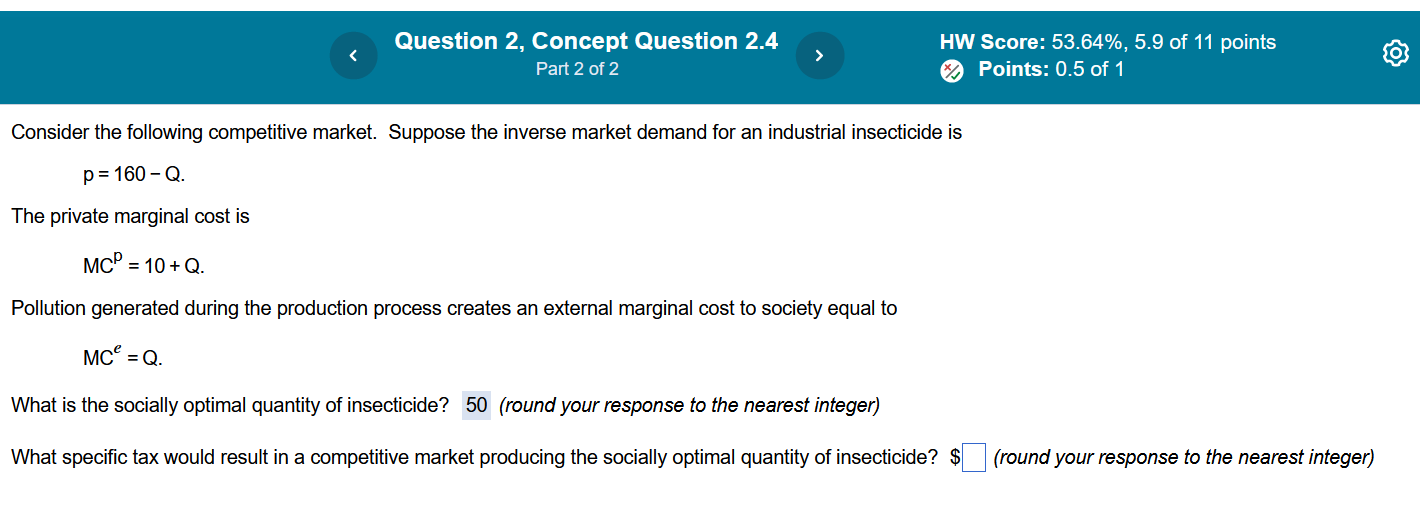
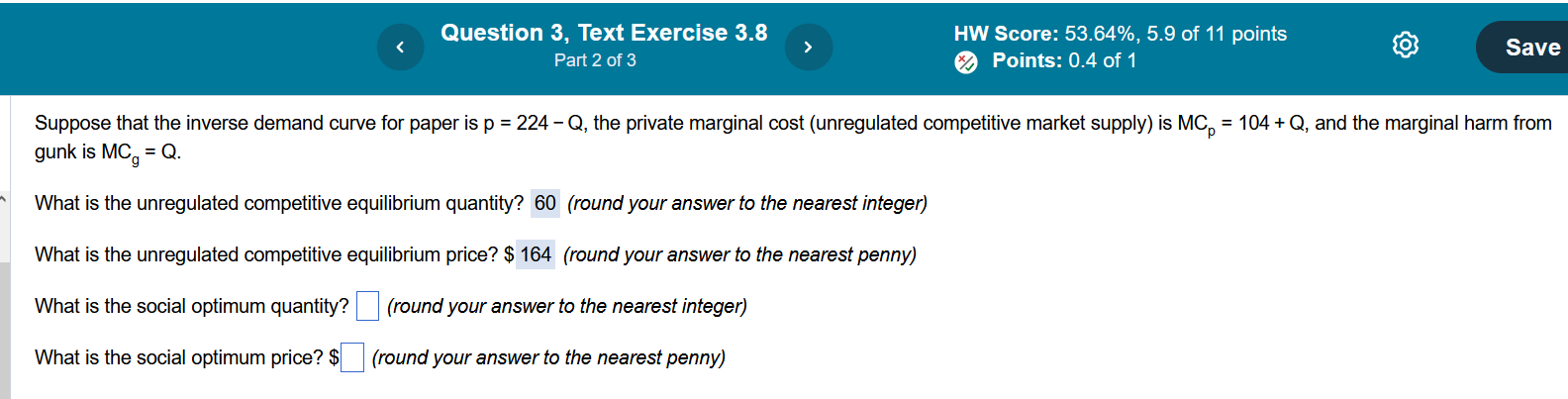
Question 2, Concept Question 2.4 N HW Score: 53.64%, 5.9 of 11 points Part 2 of 2 Points: 0.5 of 1 Consider the following competitive market. Suppose the inverse market demand for an industrial insecticide is p=160-Q. The private marginal cost is mcP=10+Q. Pollution generated during the production process creates an external marginal cost to society equal to MC* =Q. What is the socially optimal quantity of insecticide? 50 (round your response to the nearest integer) What specific tax would result in a competitive market producing the socially optimal quantity of insecticide? $ | (round your response to the nearest integer) Question 3, Text Exercise 3.8 N HW Score: 53.64%, 5.9 of 11 points Rl R & Points: 0.4 of 1 Suppose that the inverse demand curve for paper is p = 224 - Q, the private marginal cost (unregulated competitive market supply) is MC,, = 104 + Q, and the marginal harm from gunk is MC = Q. * What is the unregulated competitive equilibrium quantity? 60 (round your answer to the nearest integer) What is the unregulated competitive equilibrium price? $ 164 (round your answer to the nearest penny) What is the social optimum quantity? (round your answer to the nearest integer) What is the social optimum price? $ | (round your answer to the nearest penny)
Step by Step Solution
There are 3 Steps involved in it

Get step-by-step solutions from verified subject matter experts
 Study Help