







Question: Question 2 Consider the decision tree shown in the diagram below. The counts shown in the leaf nodes correspond to the number of training records
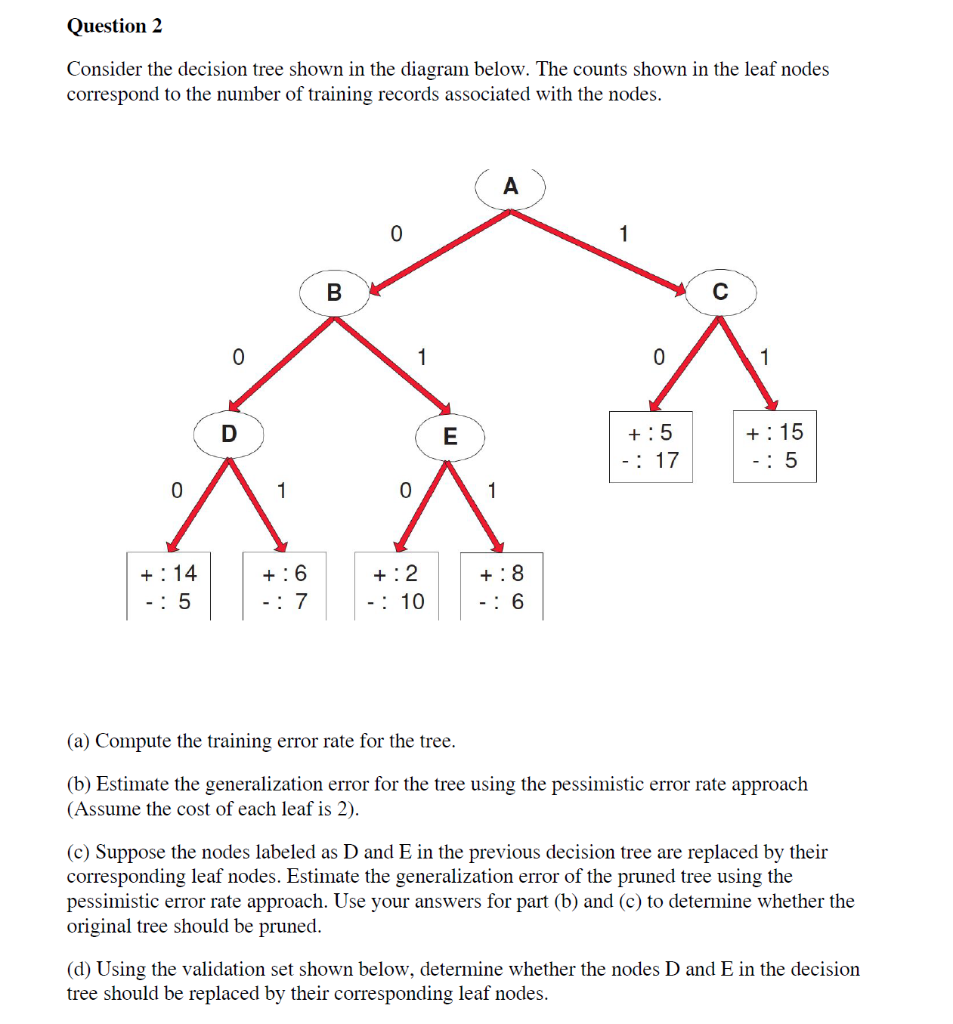
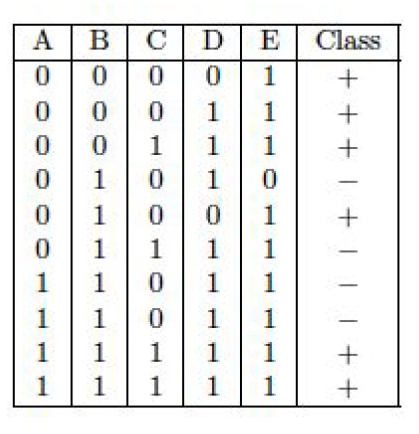
Question 2 Consider the decision tree shown in the diagram below. The counts shown in the leaf nodes correspond to the number of training records associated with the nodes 0 0 5 0 (a) Compute the training error rate for the tree (b) Estimate the generalization error for the tree using the pessimistic error rate approach (Assume the cost of each leaf is 2) (c) Suppose the nodes labeled as D and E in the previous decision tree are replaced by their corresponding leaf nodes. Estimate the generalization error of the pruned tree using the pessimistic error rate approach. Use your answers for part (b) and (c) to determine whether the original tree should be pruned (d) Using the validation set shown below, determine whether the nodes D and E in the decision tree should be replaced by their corresponding leaf nodes A BCD E Class 0 10 1 0- 0 10 0 0 11 1 1 11 011 Question 2 Consider the decision tree shown in the diagram below. The counts shown in the leaf nodes correspond to the number of training records associated with the nodes 0 0 5 0 (a) Compute the training error rate for the tree (b) Estimate the generalization error for the tree using the pessimistic error rate approach (Assume the cost of each leaf is 2) (c) Suppose the nodes labeled as D and E in the previous decision tree are replaced by their corresponding leaf nodes. Estimate the generalization error of the pruned tree using the pessimistic error rate approach. Use your answers for part (b) and (c) to determine whether the original tree should be pruned (d) Using the validation set shown below, determine whether the nodes D and E in the decision tree should be replaced by their corresponding leaf nodes A BCD E Class 0 10 1 0- 0 10 0 0 11 1 1 11 011
Step by Step Solution
There are 3 Steps involved in it

Get step-by-step solutions from verified subject matter experts
 Study Help