



Question: Question 2 ) Consider the following network of five hosts ( h 1 to h 5 ) , five Openflow switches ( s 1 to
Question
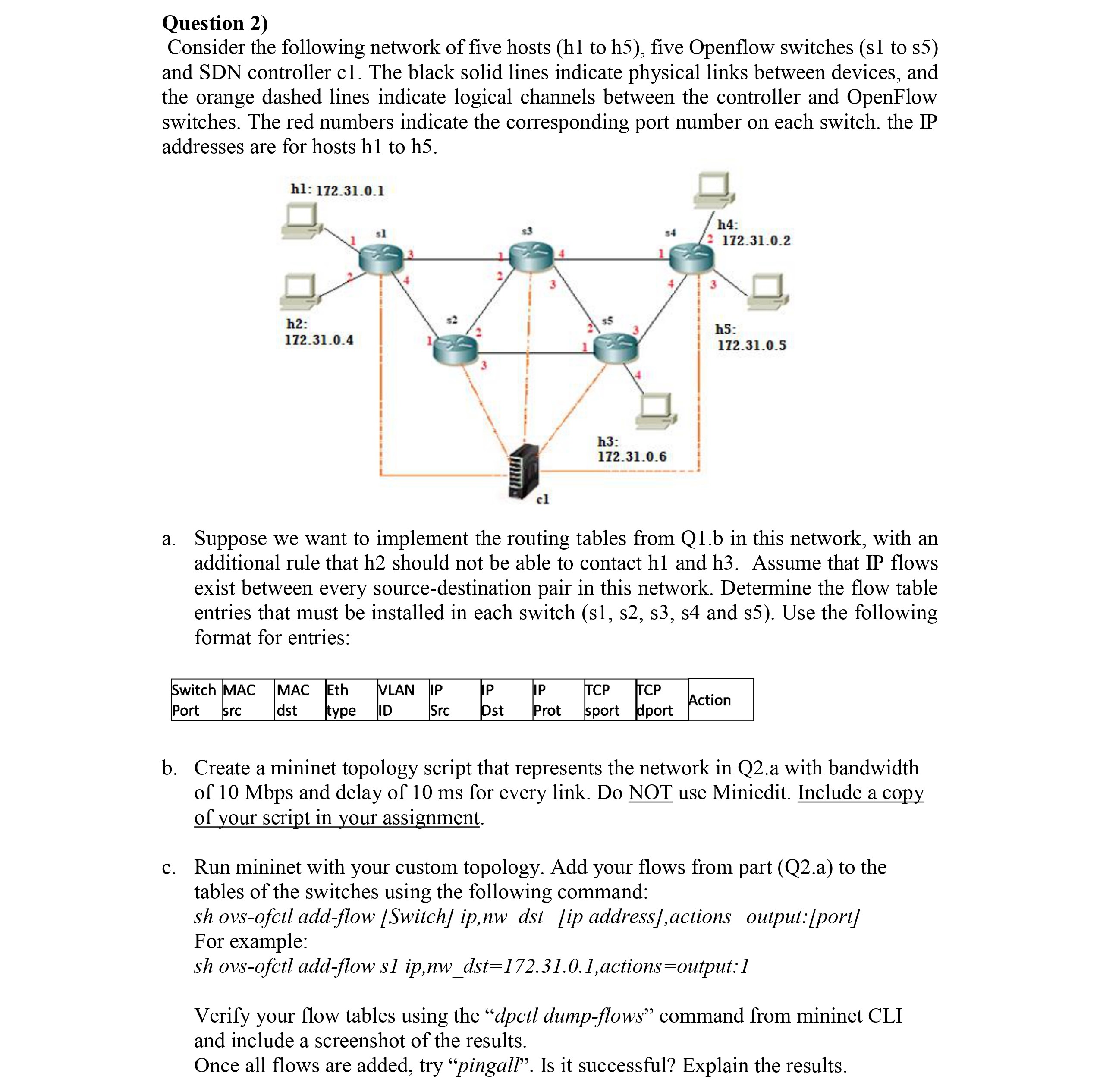
Consider the following network of five hosts h to h five Openflow switches s to s and SDN controller cl The black solid lines indicate physical links between devices, and the orange dashed lines indicate logical channels between the controller and OpenFlow switches. The red numbers indicate the corresponding port number on each switch. the IP addresses are for hosts h to h
a Suppose we want to implement the routing tables from Qb in this network, with an additional rule that h should not be able to contact h and h Assume that IP flows exist between every sourcedestination pair in this network. Determine the flow table entries that must be installed in each switch mathrmsmathrm~smathrm~smathrm~s and s Use the following format for entries:
b Create a mininet topology script that represents the network in Qa with bandwidth of Mbps and delay of ms for every link. Do NOT use Miniedit. Include a copy of your script in your assignment.
c Run mininet with your custom topology. Add your flows from part Qa to the tables of the switches using the following command:
sh ovsofctl addflow Switch ipnwdstip addressactionsoutput:port
For example:
sh ovsofctl addflow sl ipnwdstactionsoutput:
Verify your flow tables using the dpctl dumpflows" command from mininet CLI and include a screenshot of the results.
Once all flows are added, try "pingall". Is it successful? Explain the results.
Step by Step Solution
There are 3 Steps involved in it
1 Expert Approved Answer
Step: 1 Unlock

Question Has Been Solved by an Expert!
Get step-by-step solutions from verified subject matter experts
Step: 2 Unlock
Step: 3 Unlock