Question: Question 2 Please Montego Bay Case Study (Daft, 2008) was feeling devalued and the friendly work environment was shattered. Despite these disadvantages, however, sales were
 Question 2 Please
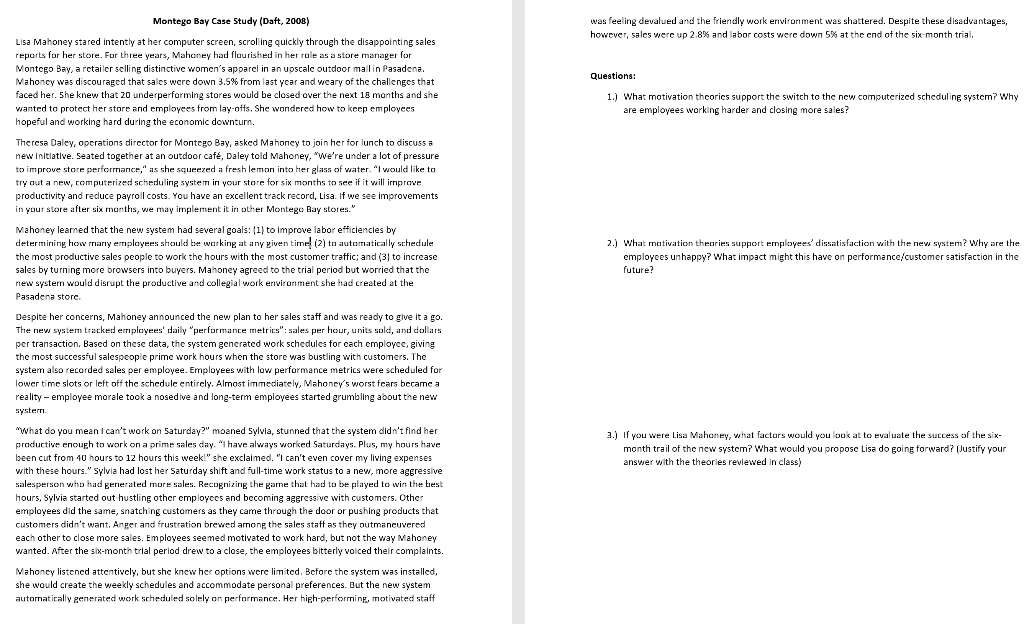
Montego Bay Case Study (Daft, 2008) was feeling devalued and the friendly work environment was shattered. Despite these disadvantages, however, sales were up 2.8% and labor costs were down 5% at the end of the six-month trial. Questions 1.) What motivation theories support the switch to the new computerized scheduling system? Why are employees working harder and closing more sales? Lisa Mahoney stared intently at her computer screen, scrolling quickly through the disappointing sales reports for her store. For three years, Mahoney had flourished in her role as a store manager for Montego Bay, arctailer selling distinctive women's apparel in an upscale outdoor mallin Pasadena. Mahoney was discouraged that sales were down 3.5% from last year and weary of the challenges that faced her. She knew that 20 underperforming stores would be closed over the next 18 months and she wanted to protect her store and employees from lay-oits. She wondered how to keep employees hopeful and working hard during the economic downturn. Theresa Daley, opcrations director for Montego Bay, asked Mahoney to join her for lunch to discuss a new initiative. Seated together at an outdoor caf, Daley told Mahoney, 'We're under a lot of pressure to improve store performance," as she squeezed a fresh lemon into her glass of water. "I would like to try out a new, computerized scheduling system in your store for six months to see if it will improve productivity and reduce payroll costs. You have an excellent track record, Lisa. If we see improvements in your store after six months, we may implement it in other Montego Bay stores." Mahoney learned that the new system had several goals: (1) to improve labor efficiencies by determining how many employees should be working at any given time (2) to automatically schedule the most productive sales people to work the hours with the most customer traffic; and (3) to increase sales by turning more browsers into buyers. Mahoney agreed to the trial period but worried that the new system would disrupt the productive and collegial work environment she had created at the Pasadena store Despite her concerns, Mahoney announced the new plan to her sales staff and was ready to give it a go. The new system tracked employees' daily "performance metrics": sales per hour, units sold, and dollars per transaction. Based on these data, the system generated work schedules for each employee, giving the most successful salespeople prime work hours when the store was bustling with customers. The system also recorded sales per employee. Employees with low performance metrics were scheduled for lower time slots or left off the schedule entirely. Almost immediately, Mahoney's worst fears became a reality - employee morale took a nosedive and long-term employees started grumbling about the new system 2.) What motivation theories support employees' dissatisfaction with the new system? Why are the employees unhappy? What impact might this have on performance/customer satisfaction in the future? 2.) If you were Lisa Mahoney, what factors would you look at to evaluate the success of the six- month trail of the new system? What would you propose Lisa do going forward? (Justify your answer with the theories reviewed in cla "What do you mean I can't work on Saturday?" moaned Sylvia, stunned that the system didn't find her productive enough to work on a prime sales day. "I have always worked Saturdays. Plus, my hours have been cut from 40 hours to 12 hours this week!" she exclaimed. "I can't even cover my living expenses with these hours." Sylvia had lost her Saturday shift and full-time work status to a new, more aggressive salesperson who had generated more sales. Recognizing the game that had to be played to win the best hours, Sylvia started out hustling other employees and becoming aggressive with customers. Other employees did the same, snatching customers as they came through the door or pushing products that customers didn't want. Anger and frustration brewed among the sales staff as they outmaneuvered each other to close more sales. Employees seemed motivated to work hard, but not the way Mahoney wanted. After the six-month trial period drew to a close, the employees bitterly voiced their complaints. Mahoney listened attentively, but she knew her options were limited. Before the system was installed, she would create the weekly schedules and accommodate personal preferences. But the new system automatically generated work scheduled solely on performance. Her high-performing motivated staff









 Study Help