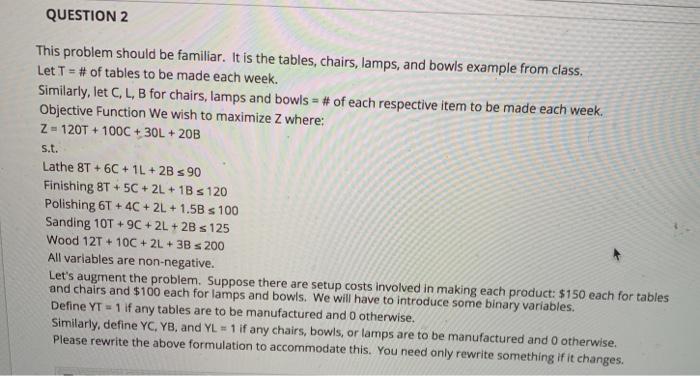
Question: QUESTION 2 This problem should be familiar. It is the tables, chairs, lamps, and bowls example from class. Let T = # of tables to
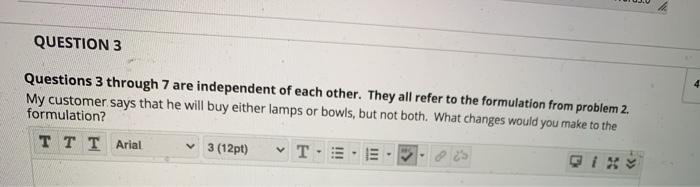
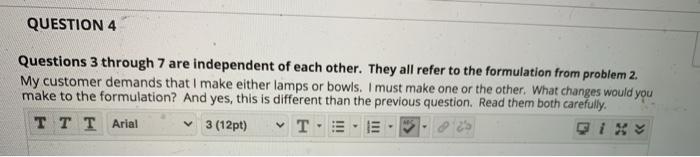
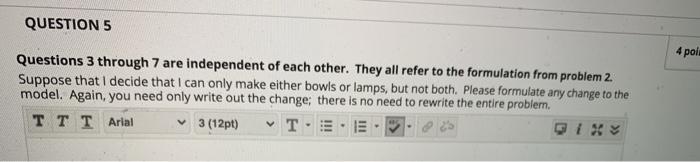
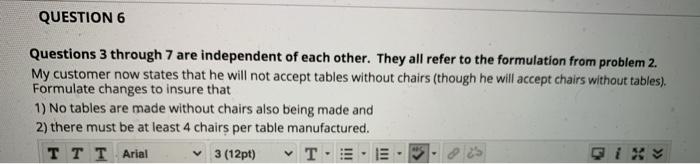
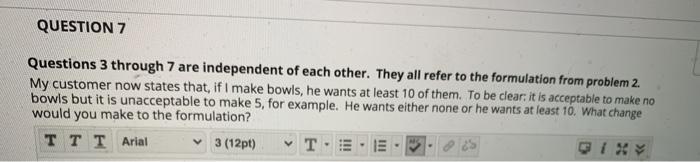
QUESTION 2 This problem should be familiar. It is the tables, chairs, lamps, and bowls example from class. Let T = # of tables to be made each week. Similarly, let C. L, B for chairs, lamps and bowls = # of each respective item to be made each week. Objective Function We wish to maximize Z where: Z-120T + 100C + 30L + 20B s.t. Lathe 8T +6C + 1L + 2B s 90 Finishing 8T + 5C + 2L +18 s 120 Polishing 6T + 4C + 2L+1.5B s 100 Sanding 10T +90 + 2L + 2B s 125 Wood 12T +10C + 2L + 3B s 200 All variables are non-negative. Let's augment the problem. Suppose there are setup costs involved in making each product: $150 each for tables and chairs and $100 each for lamps and bowls. We will have to introduce some binary variables. Define YT = 1 if any tables are to be manufactured and otherwise. Similarly, define YC, YB, and YL = 1 if any chairs, bowls, or lamps are to be manufactured and otherwise, Please rewrite the above formulation to accommodate this. You need only rewrite something if it changes. QUESTION 3 4 Questions 3 through 7 are independent of each other. They all refer to the formulation from problem 2. My customer says that he will buy either lamps or bowls, but not both. What changes would you make to the formulation? T T T Arial 3 (12pt) T QUESTION 4 Questions 3 through 7 are independent of each other. They all refer to the formulation from problem 2. My customer demands that I make either lamps or bowls. I must make one or the other. What changes would you make to the formulation? And yes, this is different than the previous question. Read them both carefully. TT T Arial 3 (12pt) T-E- E- QUESTION 5 4 poid Questions 3 through 7 are independent of each other. They all refer to the formulation from problem 2. Suppose that I decide that I can only make either bowls or lamps, but not both. Please formulate any change to the model. Again, you need only write out the change; there is no need to rewrite the entire problem. TT T Arial 3 (12pt) T.S.E QUESTION 6 Questions 3 through 7 are independent of each other. They all refer to the formulation from problem 2. My customer now states that he will not accept tables without chairs (though he will accept chairs without tables). Formulate changes to insure that 1) No tables are made without chairs also being made and 2) there must be at least 4 chairs per table manufactured. TT T Arial 3 (12pt) T. QUESTION 7 Questions 3 through 7 are independent of each other. They all refer to the formulation from problem 2. My customer now states that, if I make bowls, he wants at least 10 of them. To be clear: it is acceptable to make no bowls but it is unacceptable to make 5, for example. He wants either none or he wants at least 10. What change would you make to the formulation? T T T Arial 3 (12pt) IX QUESTION 2 This problem should be familiar. It is the tables, chairs, lamps, and bowls example from class. Let T = # of tables to be made each week. Similarly, let C. L, B for chairs, lamps and bowls = # of each respective item to be made each week. Objective Function We wish to maximize Z where: Z-120T + 100C + 30L + 20B s.t. Lathe 8T +6C + 1L + 2B s 90 Finishing 8T + 5C + 2L +18 s 120 Polishing 6T + 4C + 2L+1.5B s 100 Sanding 10T +90 + 2L + 2B s 125 Wood 12T +10C + 2L + 3B s 200 All variables are non-negative. Let's augment the problem. Suppose there are setup costs involved in making each product: $150 each for tables and chairs and $100 each for lamps and bowls. We will have to introduce some binary variables. Define YT = 1 if any tables are to be manufactured and otherwise. Similarly, define YC, YB, and YL = 1 if any chairs, bowls, or lamps are to be manufactured and otherwise, Please rewrite the above formulation to accommodate this. You need only rewrite something if it changes. QUESTION 3 4 Questions 3 through 7 are independent of each other. They all refer to the formulation from problem 2. My customer says that he will buy either lamps or bowls, but not both. What changes would you make to the formulation? T T T Arial 3 (12pt) T QUESTION 4 Questions 3 through 7 are independent of each other. They all refer to the formulation from problem 2. My customer demands that I make either lamps or bowls. I must make one or the other. What changes would you make to the formulation? And yes, this is different than the previous question. Read them both carefully. TT T Arial 3 (12pt) T-E- E- QUESTION 5 4 poid Questions 3 through 7 are independent of each other. They all refer to the formulation from problem 2. Suppose that I decide that I can only make either bowls or lamps, but not both. Please formulate any change to the model. Again, you need only write out the change; there is no need to rewrite the entire problem. TT T Arial 3 (12pt) T.S.E QUESTION 6 Questions 3 through 7 are independent of each other. They all refer to the formulation from problem 2. My customer now states that he will not accept tables without chairs (though he will accept chairs without tables). Formulate changes to insure that 1) No tables are made without chairs also being made and 2) there must be at least 4 chairs per table manufactured. TT T Arial 3 (12pt) T. QUESTION 7 Questions 3 through 7 are independent of each other. They all refer to the formulation from problem 2. My customer now states that, if I make bowls, he wants at least 10 of them. To be clear: it is acceptable to make no bowls but it is unacceptable to make 5, for example. He wants either none or he wants at least 10. What change would you make to the formulation? T T T Arial 3 (12pt) IX









 Study Help