







Question: QUESTION 25 (10 points) - Critical Path Method (CPM) with Crashing The film The Lord of the Rings: The Return of the King, the last
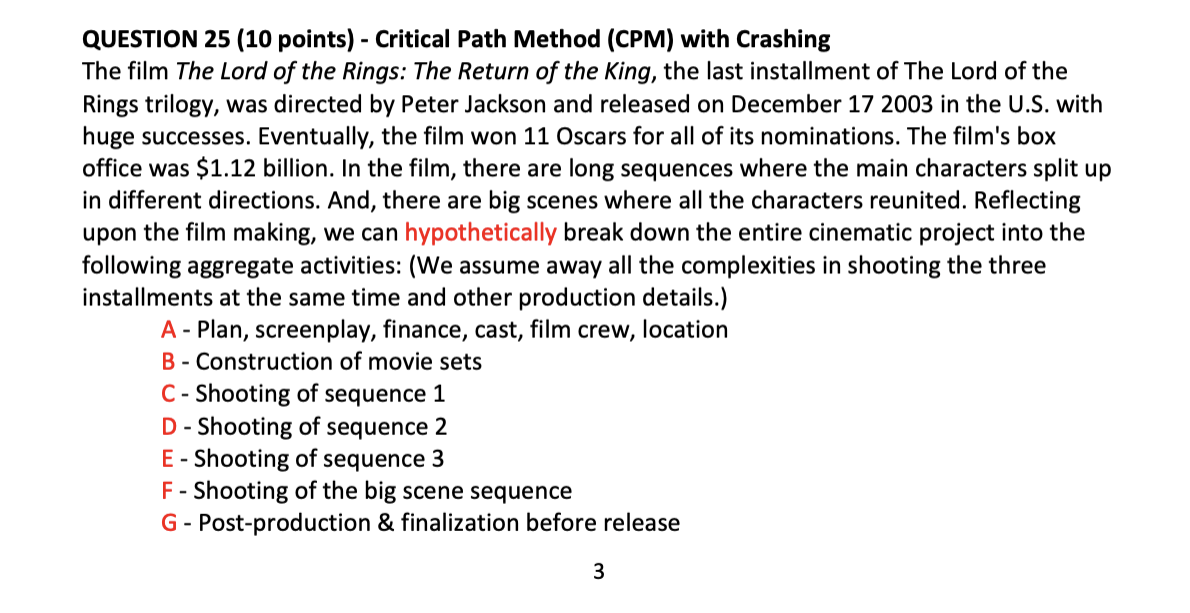
QUESTION 25 (10 points) - Critical Path Method (CPM) with Crashing The film The Lord of the Rings: The Return of the King, the last installment of The Lord of the Rings trilogy, was directed by Peter Jackson and released on December 17 2003 in the U.S. with huge successes. Eventually, the film won 11 Oscars for all of its nominations. The film's box office was $1.12 billion. In the film, there are long sequences where the main characters split up in different directions. And, there are big scenes where all the characters reunited. Reflecting upon the film making, we can hypothetically break down the entire cinematic project into the following aggregate activities: (We assume away all the complexities in shooting the three installments at the same time and other production details.) A - Plan, screenplay, finance, cast, film crew, location B - Construction of movie sets C - Shooting of sequence 1 D - Shooting of sequence 2 E - Shooting of sequence 3 F - Shooting of the big scene sequence G - Post-production & finalization before release
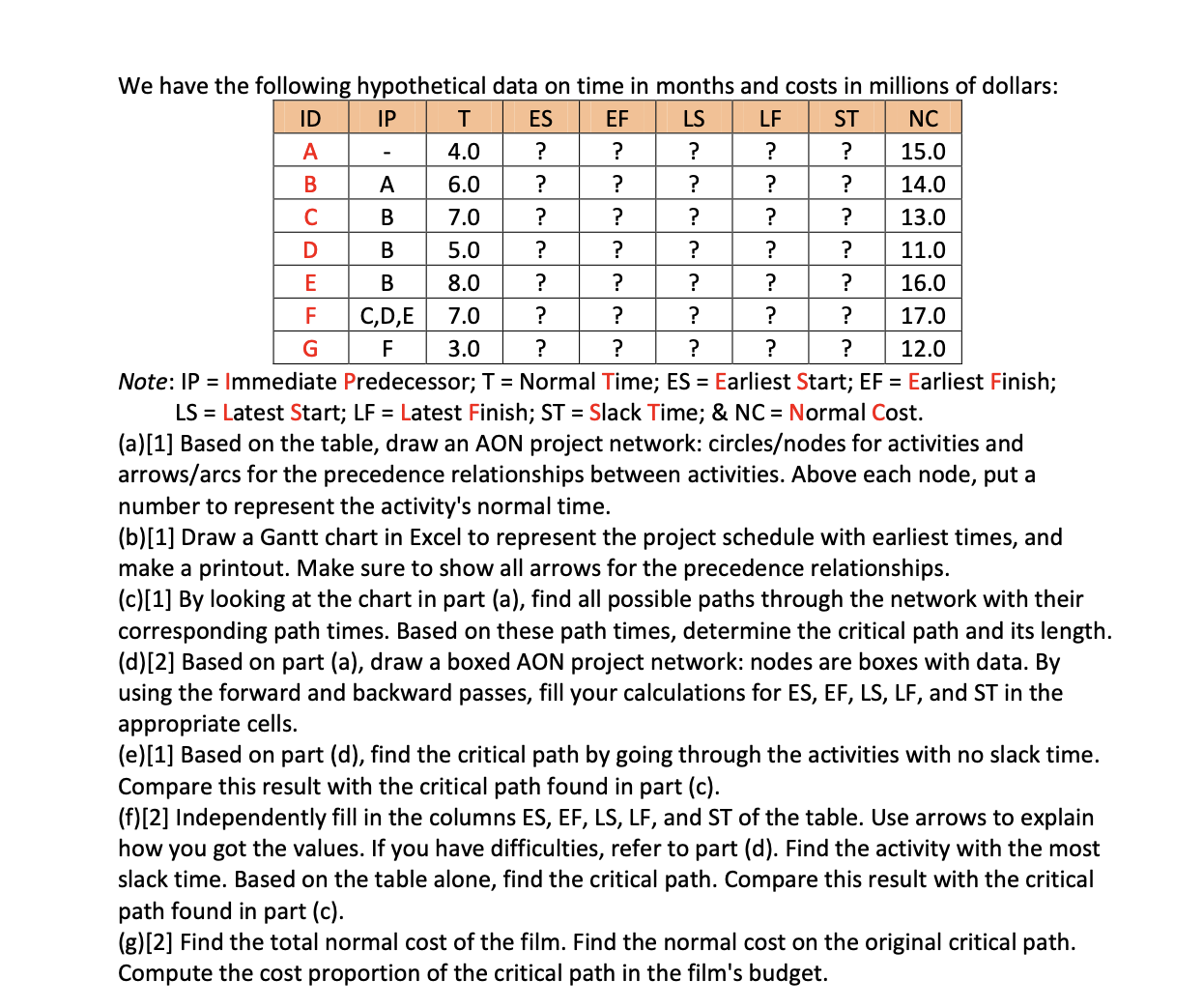
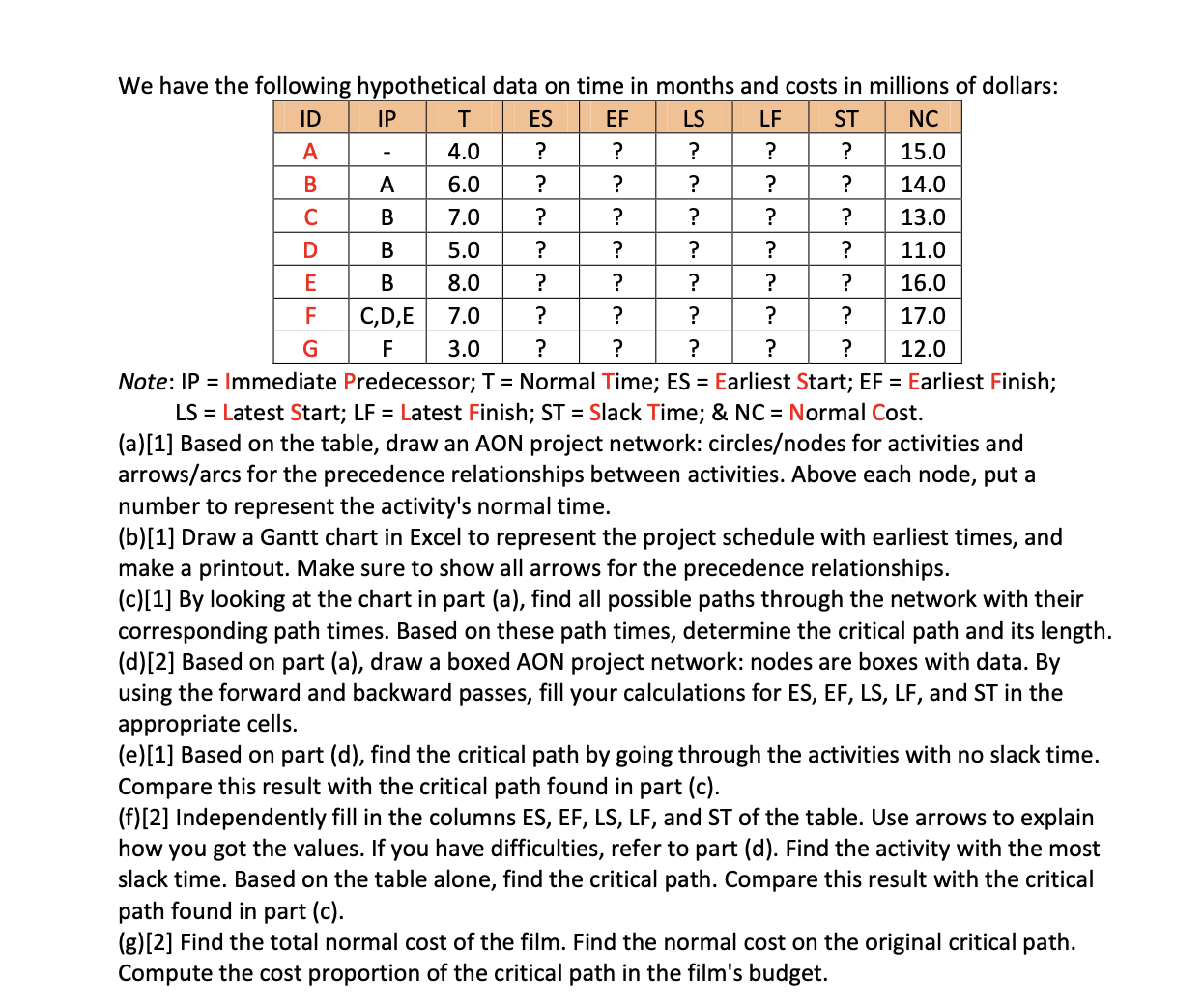
We have the following hypothetical data on time in months and costs in millions of dollars: ID IP T ES EF LS LF ST NC A - 4.0 ? ? ? ? ? 15.0 B A 6.0 ? ? ? ? ? 14.0 C B 7.0 ? ? ? ? ? 13.0 D B 5.0 ? ? ? ? ? 11.0 E B 8.0 ? ? ? ? ? 16.0 F C,D,E 7.0 ? ? ? ? ? 17.0 G F 3.0 ? ? ? ? ? 12.0 Note: IP = Immediate Predecessor; T = Normal Time; ES = Earliest Start; EF = Earliest Finish; LS = Latest Start; LF = Latest Finish; ST = Slack Time; & NC = Normal Cost. (a)[1] Based on the table, draw an AON project network: circlesodes for activities and arrows/arcs for the precedence relationships between activities. Above each node, put a number to represent the activity's normal time. (b)[1] Draw a Gantt chart in Excel to represent the project schedule with earliest times, and make a printout. Make sure to show all arrows for the precedence relationships. (c)[1] By looking at the chart in part (a), find all possible paths through the network with their corresponding path times. Based on these path times, determine the critical path and its length. (d)[2] Based on part (a), draw a boxed AON project network: nodes are boxes with data. By using the forward and backward passes, fill your calculations for ES, EF, LS, LF, and ST in the appropriate cells. (e)[1] Based on part (d), find the critical path by going through the activities with no slack time. Compare this result with the critical path found in part (c). (f)[2] Independently fill in the columns ES, EF, LS, LF, and ST of the table. Use arrows to explain how you got the values. If you have difficulties, refer to part (d). Find the activity with the most slack time. Based on the table alone, find the critical path. Compare this result with the critical path found in part (c). (g)[2] Find the total normal cost of the film. Find the normal cost on the original critical path. Compute the cost proportion of the critical path in the film's budget.
QUESTION 25 (10 points) - Critical Path Method (CPM) with Crashing The film The Lord of the Rings: The Return of the King, the last installment of The Lord of the Rings trilogy, was directed by Peter Jackson and released on December 17 2003 in the U.S. with huge successes. Eventually, the film won 11 Oscars for all of its nominations. The film's box office was $1.12 billion. In the film, there are long sequences where the main characters split up in different directions. And, there are big scenes where all the characters reunited. Reflecting upon the film making, we can hypothetically break down the entire cinematic project into the following aggregate activities: (We assume away all the complexities in shooting the three installments at the same time and other production details.) A - Plan, screenplay, finance, cast, film crew, location B - Construction of movie sets C - Shooting of sequence 1 D - Shooting of sequence 2 E - Shooting of sequence 3 F - Shooting of the big scene sequence G - Post-production & finalization before release 3 We have the following hypothetical data on time in months and costs in millions of dollars: Note: IP = Immediate Predecessor; T = Normal Time; ES = Earliest Start; EF = Earliest Finish; LS = Latest Start; LF = Latest Finish; ST = Slack Time; & NC = Normal Cost. (a)[1] Based on the table, draw an AON project network: circlesodes for activities and arrows/arcs for the precedence relationships between activities. Above each node, put a nhumber to represent the activity's normal time. (b)[1] Draw a Gantt chart in Excel to represent the project schedule with earliest times, and make a printout. Make sure to show all arrows for the precedence relationships. (c)[1] By looking at the chart in part (a), find all possible paths through the network with their corresponding path times. Based on these path times, determine the critical path and its length. (d)[2] Based on part (a), draw a boxed AON project network: nodes are boxes with data. By using the forward and backward passes, fill your calculations for ES, EF, LS, LF, and ST in the appropriate cells. (e)[1] Based on part (d), find the critical path by going through the activities with no slack time. Compare this result with the critical path found in part (c). (f)[2] Independently fill in the columns ES, EF, LS, LF, and ST of the table. Use arrows to explain how you got the values. If you have difficulties, refer to part (d). Find the activity with the most slack time. Based on the table alone, find the critical path. Compare this result with the critical path found in part (c). (g)[2] Find the total normal cost of the film. Find the normal cost on the original critical path. Compute the cost proportion of the critical path in the film's budget
Step by Step Solution
There are 3 Steps involved in it

Get step-by-step solutions from verified subject matter experts
 Study Help