







Question: = Question 3. (10 marks) We are given a directed graph G (V, E) and two distinguished nodes st EV. A set of s-to-t paths
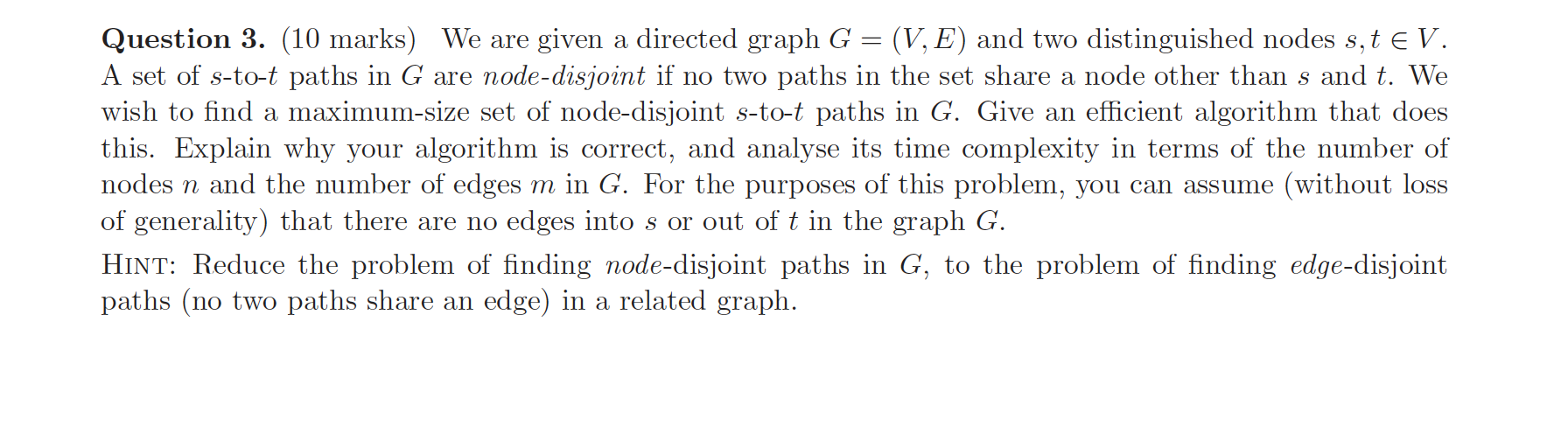
= Question 3. (10 marks) We are given a directed graph G (V, E) and two distinguished nodes st EV. A set of s-to-t paths in G are node-disjoint if no two paths in the set share a node other than s and t. We wish to find a maximum-size set of node-disjoint s-to-t paths in G. Give an efficient algorithm that does this. Explain why your algorithm is correct, and analyse its time complexity in terms of the number of nodes n and the number of edges m in G. For the purposes of this problem, you can assume (without loss of generality) that there are no edges into s or out of t in the graph G. HINT: Reduce the problem of finding node-disjoint paths in G, to the problem of finding edge-disjoint paths (no two paths share an edge) in a related graph. = Question 3. (10 marks) We are given a directed graph G (V, E) and two distinguished nodes st EV. A set of s-to-t paths in G are node-disjoint if no two paths in the set share a node other than s and t. We wish to find a maximum-size set of node-disjoint s-to-t paths in G. Give an efficient algorithm that does this. Explain why your algorithm is correct, and analyse its time complexity in terms of the number of nodes n and the number of edges m in G. For the purposes of this problem, you can assume (without loss of generality) that there are no edges into s or out of t in the graph G. HINT: Reduce the problem of finding node-disjoint paths in G, to the problem of finding edge-disjoint paths (no two paths share an edge) in a related graph
Step by Step Solution
There are 3 Steps involved in it

Get step-by-step solutions from verified subject matter experts
 Study Help