



Question: Question 3 (a) a (1) A call option on the stock of Bovisand has an exercise price of $56 and time to maturity of one
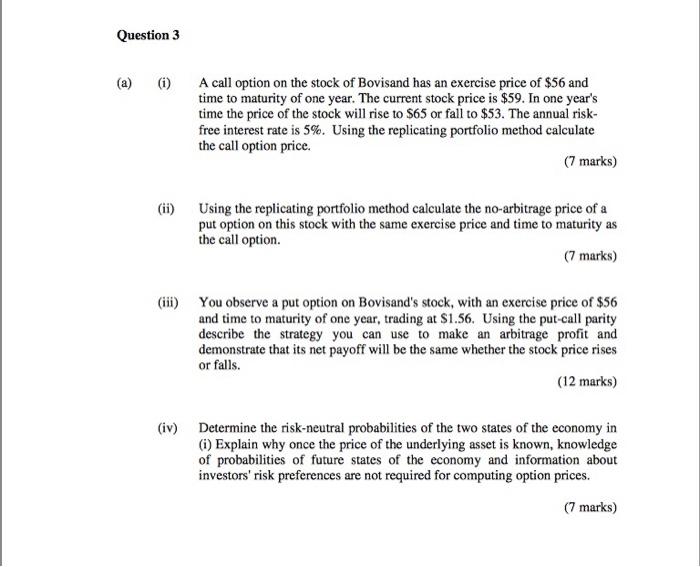
Question 3 (a) a (1) A call option on the stock of Bovisand has an exercise price of $56 and time to maturity of one year. The current stock price is $59. In one year's time the price of the stock will rise to $65 or fall to $53. The annual risk- free interest rate is 5%. Using the replicating portfolio method calculate the call option price. (7 marks) (ii) Using the replicating portfolio method calculate the no-arbitrage price of a put option on this stock with the same exercise price and time to maturity as the call option. (7 marks) (iii) You observe a put option on Bovisand's stock, with an exercise price of $56 and time to maturity of one year, trading at $1.56. Using the put-call parity describe the strategy you can use to make an arbitrage profit and demonstrate that its net payoff will be the same whether the stock price rises or falls. (12 marks) (iv) Determine the risk-neutral probabilities of the two states of the economy in (1) Explain why once the price of the underlying asset is known, knowledge of probabilities of future states of the economy and information about investors' risk preferences are not required for computing option prices. (7 marks) Question 3 (a) a (1) A call option on the stock of Bovisand has an exercise price of $56 and time to maturity of one year. The current stock price is $59. In one year's time the price of the stock will rise to $65 or fall to $53. The annual risk- free interest rate is 5%. Using the replicating portfolio method calculate the call option price. (7 marks) (ii) Using the replicating portfolio method calculate the no-arbitrage price of a put option on this stock with the same exercise price and time to maturity as the call option. (7 marks) (iii) You observe a put option on Bovisand's stock, with an exercise price of $56 and time to maturity of one year, trading at $1.56. Using the put-call parity describe the strategy you can use to make an arbitrage profit and demonstrate that its net payoff will be the same whether the stock price rises or falls. (12 marks) (iv) Determine the risk-neutral probabilities of the two states of the economy in (1) Explain why once the price of the underlying asset is known, knowledge of probabilities of future states of the economy and information about investors' risk preferences are not required for computing option prices. (7 marks)
Step by Step Solution
There are 3 Steps involved in it

Get step-by-step solutions from verified subject matter experts