







Question: Question 3 - Process Scheduling (45 points) (This question is related to ILO 2a - discuss the mechanisms and policies in efficiently sharing of
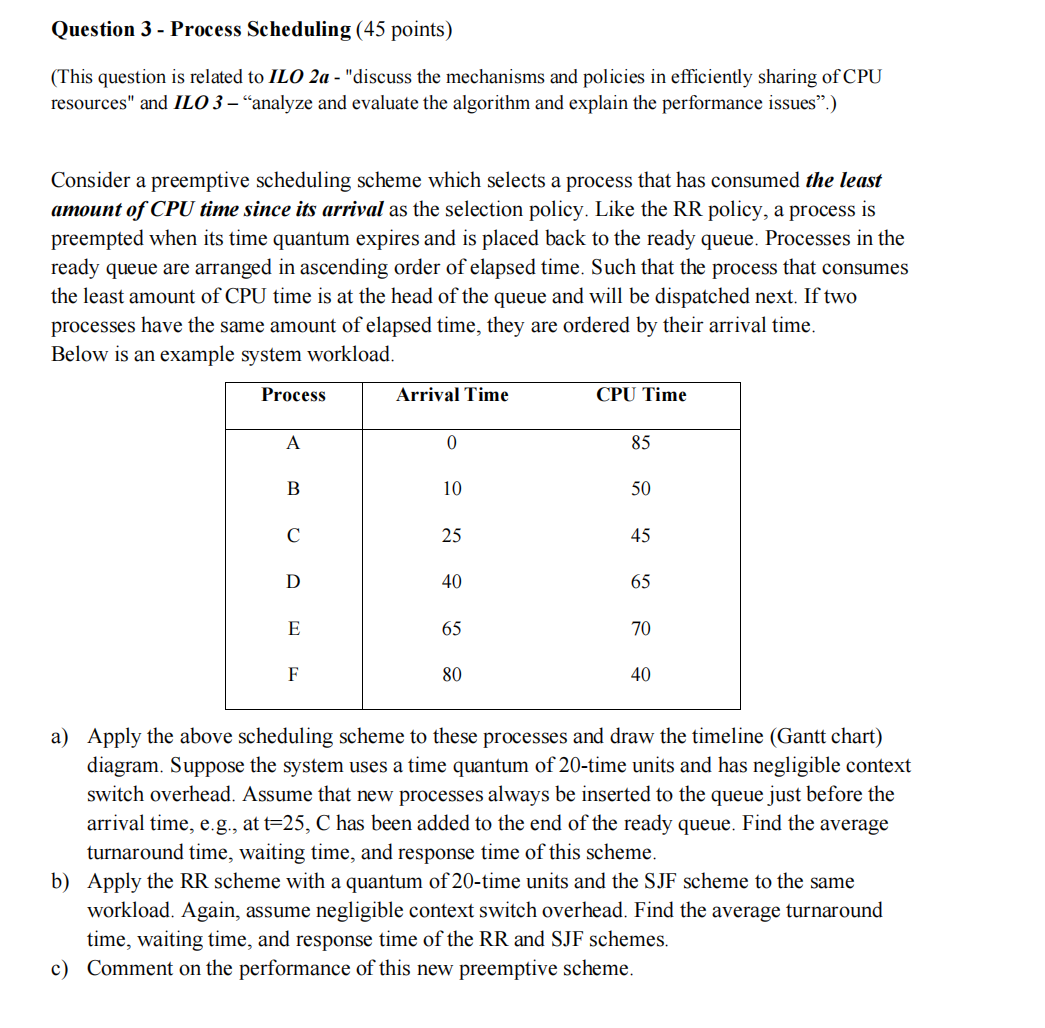
Question 3 - Process Scheduling (45 points) (This question is related to ILO 2a - "discuss the mechanisms and policies in efficiently sharing of CPU resources" and ILO 3 "analyze and evaluate the algorithm and explain the performance issues".) Consider a preemptive scheduling scheme which selects a process that has consumed the least amount of CPU time since its arrival as the selection policy. Like the RR policy, a process is preempted when its time quantum expires and is placed back to the ready queue. Processes in the ready queue are arranged in ascending order of elapsed time. Such that the process that consumes the least amount of CPU time is at the head of the queue and will be dispatched next. If two processes have the same amount of elapsed time, they are ordered by their arrival time. Below is an example system workload. Process A B D E F Arrival Time 0 10 25 40 65 80 CPU Time 85 50 45 65 70 40 a) Apply the above scheduling scheme to these processes and draw the timeline (Gantt chart) diagram. Suppose the system uses a time quantum of 20-time units and has negligible context switch overhead. Assume that new processes always be inserted to the queue just before the arrival time, e.g., at t=25, C has been added to the end of the ready queue. Find the average turnaround time, waiting time, and response time of this scheme. b) Apply the RR scheme with a quantum of 20-time units and the SJF scheme to the same workload. Again, assume negligible context switch overhead. Find the average turnaround time, waiting time, and response time of the RR and SJF schemes. c) Comment on the performance of this new preemptive scheme.
Step by Step Solution
3.46 Rating (159 Votes )
There are 3 Steps involved in it

Get step-by-step solutions from verified subject matter experts
 Study Help