







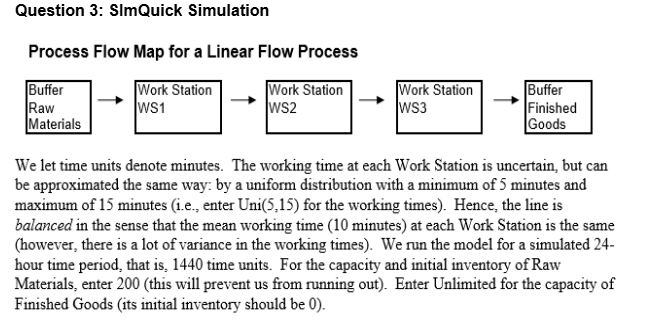
Question: Question 3 : SImQuick Simulation Process Flow Map for a Linear Flow Process We let time units denote minutes. The working time at each Work
Question : SImQuick Simulation
Process Flow Map for a Linear Flow Process
We let time units denote minutes. The working time at each Work Station is uncertain, but can
be approximated the same way: by a uniform distribution with a minimum of minutes and
maximum of minutes ie enter Uni for the working times Hence, the line is
balanced in the sense that the mean working time minutes at each Work Station is the same
however there is a lot of variance in the working times We run the model for a simulated
hour time period, that is time units. For the capacity and initial inventory of Raw
Materials, enter this will prevent us from running out Enter Unlimited for the capacity of
Finished Goods its initial inventory should be
SimQuick Exercise : For each of the situations a through e below, perform simulations and report the identified metrics in the table below. Note: overall mean cycle time through the process from the time it enters WS to the time it leaves WS This is computed by adding the overall mean cycle times through the internal buffers, the Buffers added between Work Stations if any and the mean working times at the Work Stations.
a Consider the SimQuick model base case as shown above. Note that the Working time for each Work Station is Uni
b Consider the original model, and change the working time at each Work Station to
Uni Note that the new working times have the same mean but a smaller variance.
c Consider the original model, using the reduced variance distribution from part b on WS
only.
d For the original model, add a Buffer between WS and WS and another Buffer between
WS and WSwith no initial inventory Set the capacity of both Buffers
e For the original model, add a Buffer between WS and WS and another Buffer between
WS and WSwith no initial inventory Set the capacity of both Buffers
begintabularllllll
hline Resultsscenarios & begintabularc
part a
base case
Uni
endtabular & begintabularc
Part b
Uni
endtabular & begintabularc
Part c
WS only
at
endtabular & begintabularl
Part d
WIP Buf
Cap
endtabular & begintabularl
Part d WIP
Buf Cap
endtabular
hline begintabularl
Throughput
Final Inventory of
FG
endtabular & & & & &
hline begintabularl
Overall mean cycle
time of system
WS through WS
endtabular & & & & &
hline begintabularl
WIP buff#
units
endtabular & & & & &
hline Time in Buff & & & & &
hline begintabularl
WIP buff
#units
endtabular & & & & &
hline Time in Buff & & & & &
hline Util WS & & & & &
hline Block WS & & & & &
hline Util WS & & & & &
hline Block WS & & & & &
hline Util WS & & & & &
hline Block WS & & & & &
hline
endtabular
Step by Step Solution
There are 3 Steps involved in it
1 Expert Approved Answer
Step: 1 Unlock

Question Has Been Solved by an Expert!
Get step-by-step solutions from verified subject matter experts
Step: 2 Unlock
Step: 3 Unlock
 Study Help