Question: QUESTION 33 20 points Save Answer For reasons I am unable to discern, Blackboard requires me to input something here. I guess I would remind
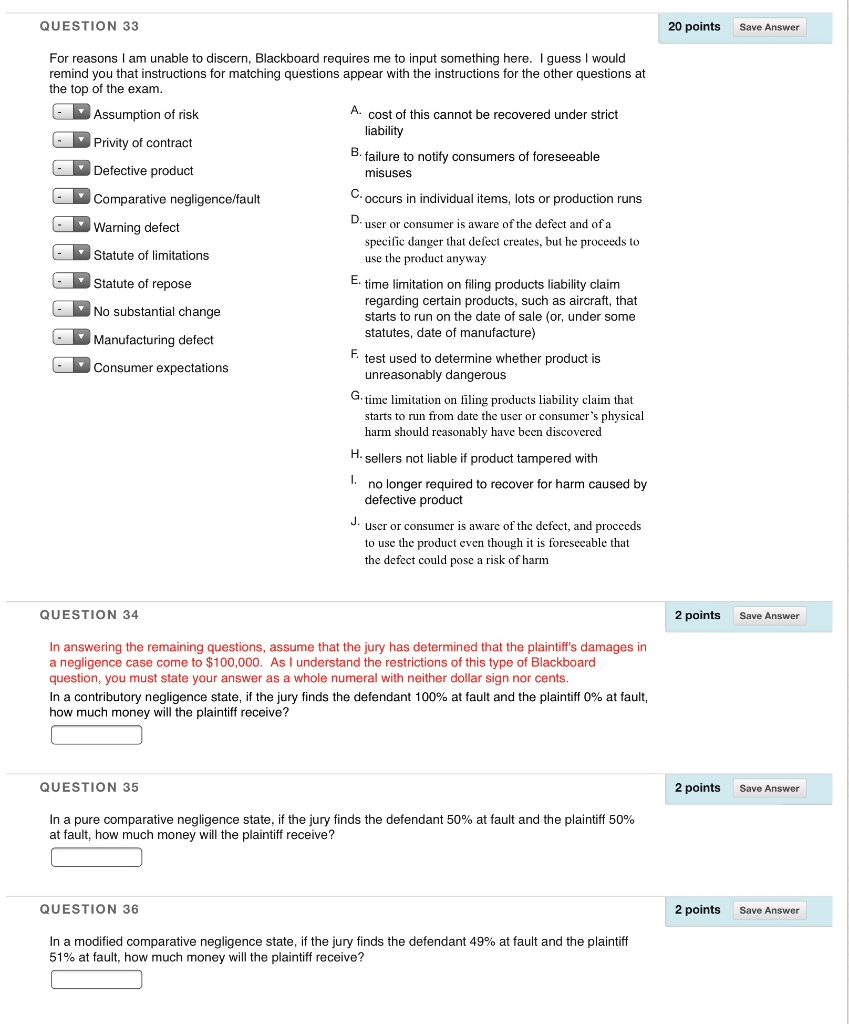
QUESTION 33 20 points Save Answer For reasons I am unable to discern, Blackboard requires me to input something here. I guess I would remind you that instructions for matching questions appear with the instructions for the other questions at the top of the exam. - Assumption of risk A. cost of this cannot be recovered under strict liability Privity of contract B. failure to notify consumers of foreseeable Defective product misuses Comparative negligence/fault C.occurs in individual items, lots or production runs Warning defect D.user or consumer is aware of the defect and of a specific danger that defect creates, but he proceeds to Statute of limitations use the product anyway Statute of repose E. time limitation on filing products liability claim regarding certain products, such as aircraft, that No substantial change starts to run on the date of sale (or, under some statutes, date of manufacture) Manufacturing defect F. test used to determine whether product is Consumer expectations unreasonably dangerous G. time limitation on filing products liability claim that starts to run from date the user or consumer's physical harm should reasonably have been discovered H. sellers not liable if product tampered with no longer required to recover for harm caused by defective product J. user or consumer is aware of the defect, and proceeds to use the product even though it is foreseeable that the defect could pose a risk of harm QUESTION 34 2 points Save Answer In answering the remaining questions, assume that the jury has determined that the plaintiff's damages in a negligence case come to $100,000. As I understand the restrictions of this type of Blackboard question, you must state your answer as a whole numeral with neither dollar sign nor cents. In a contributory negligence state, if the jury finds the defendant 100% at fault and the plaintiff 0% at fault, how much money will the plaintiff receive? QUESTION 35 2 points Save Answer In a pure comparative negligence state, if the jury finds the defendant 50% at fault and the plaintiff 50% at fault, how much money will the plaintiff receive? QUESTION 36 2 points Save Answer In a modified comparative negligence state, if the jury finds the defendant 49% at fault and the plaintiff 51% at fault, how much money will the plaintiff receive? QUESTION 33 20 points Save Answer For reasons I am unable to discern, Blackboard requires me to input something here. I guess I would remind you that instructions for matching questions appear with the instructions for the other questions at the top of the exam. - Assumption of risk A. cost of this cannot be recovered under strict liability Privity of contract B. failure to notify consumers of foreseeable Defective product misuses Comparative negligence/fault C.occurs in individual items, lots or production runs Warning defect D.user or consumer is aware of the defect and of a specific danger that defect creates, but he proceeds to Statute of limitations use the product anyway Statute of repose E. time limitation on filing products liability claim regarding certain products, such as aircraft, that No substantial change starts to run on the date of sale (or, under some statutes, date of manufacture) Manufacturing defect F. test used to determine whether product is Consumer expectations unreasonably dangerous G. time limitation on filing products liability claim that starts to run from date the user or consumer's physical harm should reasonably have been discovered H. sellers not liable if product tampered with no longer required to recover for harm caused by defective product J. user or consumer is aware of the defect, and proceeds to use the product even though it is foreseeable that the defect could pose a risk of harm QUESTION 34 2 points Save Answer In answering the remaining questions, assume that the jury has determined that the plaintiff's damages in a negligence case come to $100,000. As I understand the restrictions of this type of Blackboard question, you must state your answer as a whole numeral with neither dollar sign nor cents. In a contributory negligence state, if the jury finds the defendant 100% at fault and the plaintiff 0% at fault, how much money will the plaintiff receive? QUESTION 35 2 points Save Answer In a pure comparative negligence state, if the jury finds the defendant 50% at fault and the plaintiff 50% at fault, how much money will the plaintiff receive? QUESTION 36 2 points Save Answer In a modified comparative negligence state, if the jury finds the defendant 49% at fault and the plaintiff 51% at fault, how much money will the plaintiff receive









 Study Help