







Question: Question 4 (20 points) Consider a CPU with two parallel integer execution units. An addition instruction requires 2 clock pulses to complete execution, and a
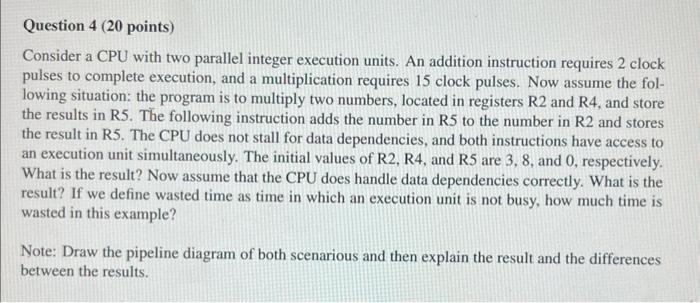
Question 4 (20 points) Consider a CPU with two parallel integer execution units. An addition instruction requires 2 clock pulses to complete execution, and a multiplication requires 15 clock pulses. Now assume the following situation: the program is to multiply two numbers, located in registers R2 and R4, and store the results in R5. The following instruction adds the number in R5 to the number in R2 and stores the result in R5. The CPU does not stall for data dependencies, and both instructions have access to an execution unit simultaneously. The initial values of R2, R4, and R5 are 3,8, and 0 , respectively. What is the result? Now assume that the CPU does handle data dependencies correctly. What is the result? If we define wasted time as time in which an execution unit is not busy, how much time is wasted in this example? Note: Draw the pipeline diagram of both scenarious and then explain the result and the differences between the results
Step by Step Solution
There are 3 Steps involved in it

Get step-by-step solutions from verified subject matter experts
 Study Help