







Question: Question 4 4 . ( a ) For the RLC circuit shown in Figure 4 . 1 , the input current, ( boldsymbol
Question
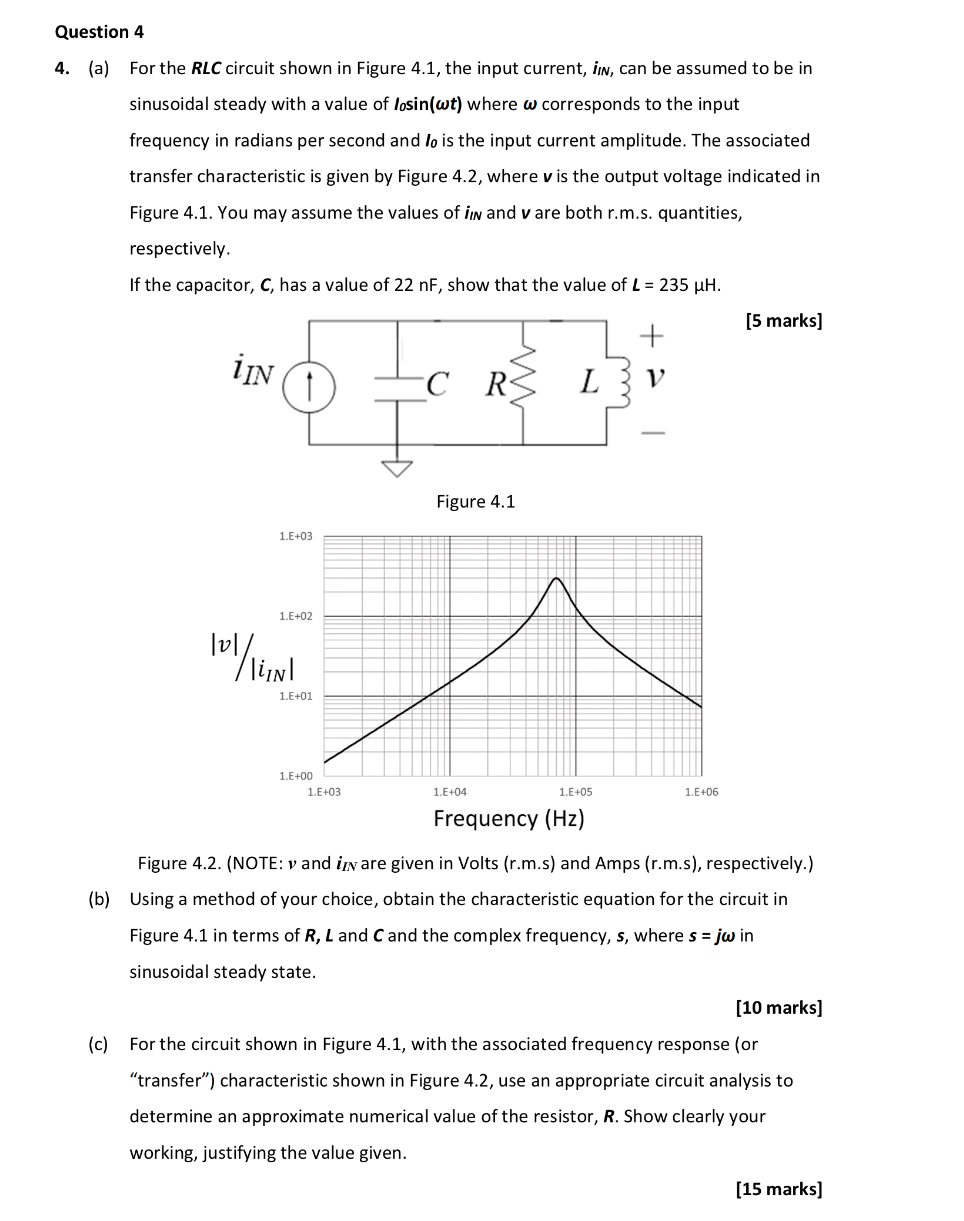
a For the RLC circuit shown in Figure the input current, boldsymboliboldsymbolI can be assumed to be in sinusoidal steady with a value of operatornamelosinomega t where omega corresponds to the input frequency in radians per second and I is the input current amplitude. The associated transfer characteristic is given by Figure where boldsymbolv is the output voltage indicated in Figure You may assume the values of boldsymboliboldsymbolI and boldsymbolv are both rms quantities, respectively.
If the capacitor, boldsymbolC has a value of nF show that the value of boldsymbolLmu mathrmH
marks
Figire
Figure NOTE: boldsymbolv and iI N are given in Volts rms and Amps rms respectively.
b Using a method of your choice, obtain the characteristic equation for the circuit in Figure in terms of boldsymbolRboldsymbolL and boldsymbolC and the complex frequency, boldsymbols where boldsymbolsboldsymboljboldsymbolomega in sinusoidal steady state.
c For the circuit shown in Figure with the associated frequency response or "transfer" characteristic shown in Figure use an appropriate circuit analysis to determine an approximate numerical value of the resistor, boldsymbolR Show clearly your working, justifying the value given.
Step by Step Solution
There are 3 Steps involved in it
1 Expert Approved Answer
Step: 1 Unlock

Question Has Been Solved by an Expert!
Get step-by-step solutions from verified subject matter experts
Step: 2 Unlock
Step: 3 Unlock
 Study Help