Question: Question 4 (Base b expansions). In number theory and computer science we often nd it helpful to express numbers in different bases. If we x
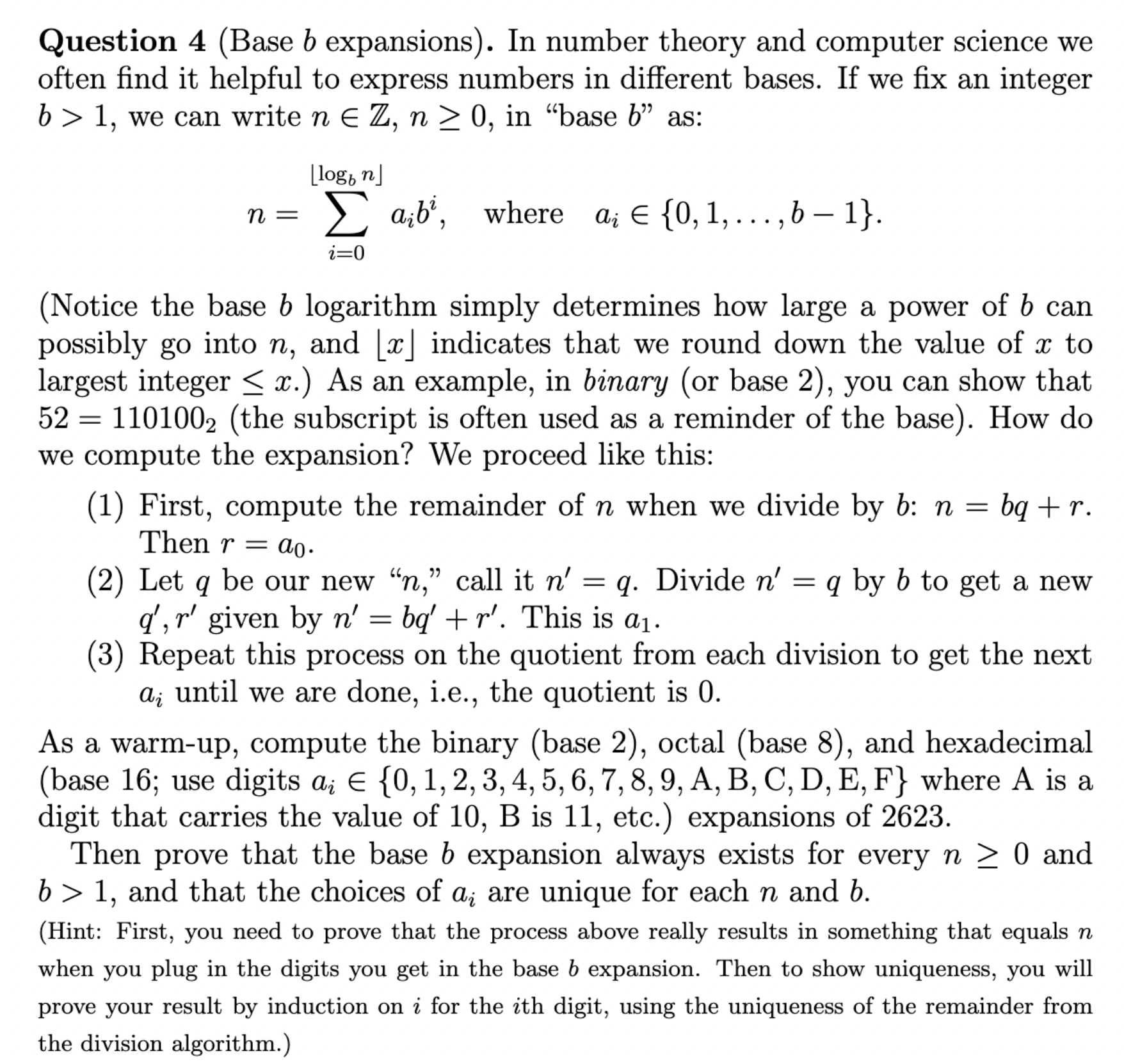
Question 4 (Base b expansions). In number theory and computer science we often nd it helpful to express numbers in different bases. If we x an integer b > 1, we can write n E Z, n 2 O, in \"base b\" as: Llogbni _ n: 2 aib', where a,{0,1,...,b1}. i=0 (Notice the base b logarithm simply determines how large a power of b can possibly go into n, and [:13] indicates that we round down the value of :r to largest integer S 51:.) As an example, in binary (or base 2), you can show that 52 = 1101002 (the subscript is often used as a reminder of the base). How do we compute the expansion? We proceed like this: (1) First, compute the remainder of 77. when we divide by b: n = bq + 9". Then 7\" = a0. (2) Let q be our new \"72.,\" call it n' = q. Divide n' = q by b to get a new q', 7" given by n' = bq' + 7". This is al. (3) Repeat this process on the quotient from each division to get the next at,- until we are done, i.e., the quotient is 0. As a warmup, compute the binary (base 2), octal (base 8), and hexadecimal (base 16; use digits a, E {0, 1,2, 3,4,5, 6, 7,8,9,A,B,C, D,E,F} where A is a digit that carries the value of 10, B is 11, etc.) expansions of 2623. Then prove that the base b expansion always exists for every n 2 0 and b > 1, and that the choices of a,- are unique for each n and b. (Hint: First, you need to prove that the process above really results in something that equals n when you plug in the digits you get in the base b expansion. Then to show uniqueness, you will prove your result by induction on 2' for the ith digit, using the uniqueness of the remainder from the division algorithm.)
Step by Step Solution
There are 3 Steps involved in it
1 Expert Approved Answer
Step: 1 Unlock
Question Has Been Solved by an Expert!
Get step-by-step solutions from verified subject matter experts
Step: 2 Unlock
Step: 3 Unlock
Students Have Also Explored These Related Mathematics Questions!









 Study Help