



Question: QUESTION 4 Consider the following information for Stocks A, B, and C. The returns on the three stocks are positively correlated, but they are not
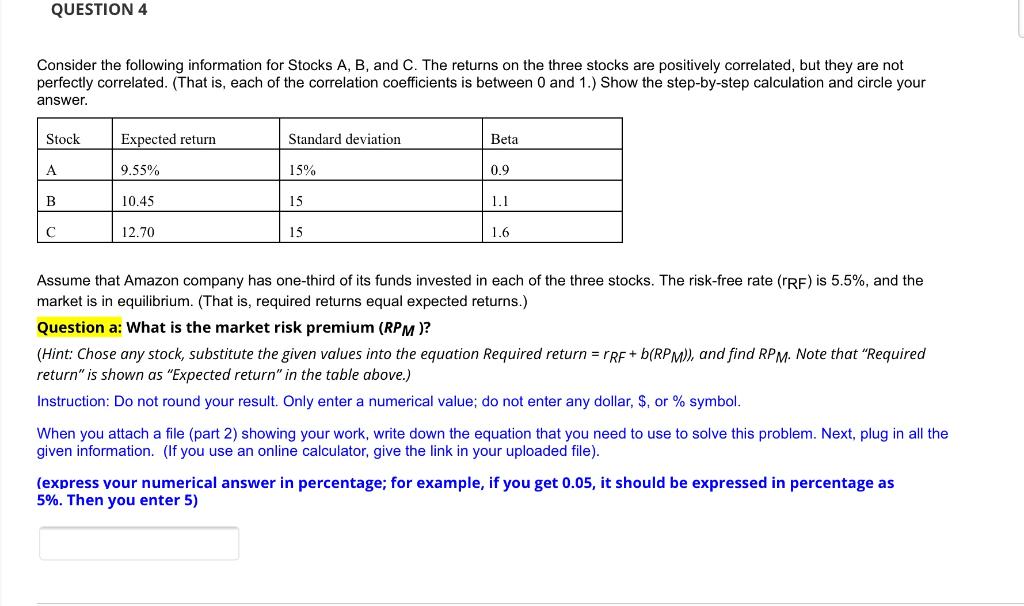
QUESTION 4 Consider the following information for Stocks A, B, and C. The returns on the three stocks are positively correlated, but they are not perfectly correlated. (That is, each of the correlation coefficients is between 0 and 1.) Show the step-by-step calculation and circle your answer. Stock Expected return Standard deviation Beta A 9.55% 15% 0.9 B 10.45 15 1.1 12.70 15 1.6 Assume that Amazon company has one-third of its funds invested in each of the three stocks. The risk-free rate (TRF) is 5.5%, and the market is in equilibrium. (That is, required returns equal expected returns.) Question a: What is the market risk premium (RPM)? (Hint: Chose any stock, substitute the given values into the equation Required return = TRF + b(RPM)), and find RPM. Note that "Required return" is shown as "Expected return" in the table above.) Instruction: Do not round your result. Only enter a numerical value; do not enter any dollar, $, or % symbol. When you attach a file (part 2) showing your work, write down the equation that you need to use to solve this problem. Next, plug in all the given information. (If you use an online calculator, give the link in your uploaded file). (express your numerical answer in percentage; for example, if you get 0.05, it should be expressed in percentage as 5%. Then you enter 5)
Step by Step Solution
There are 3 Steps involved in it

Get step-by-step solutions from verified subject matter experts