







Question: Question 4 < > m =100 kg V = 30 m/s V2 m2 = 150 kg This is an inelastic collision problem. One 100kg
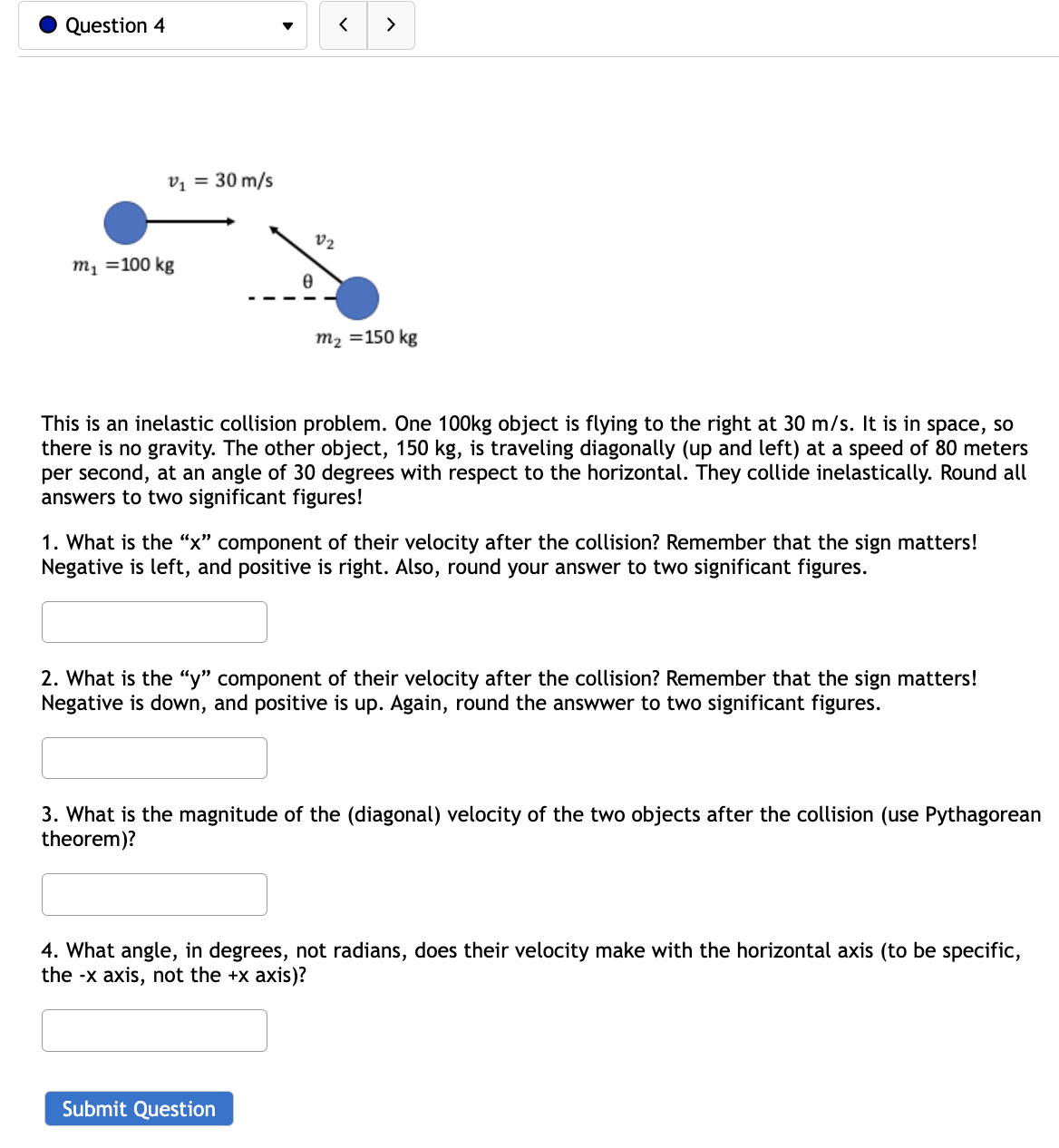
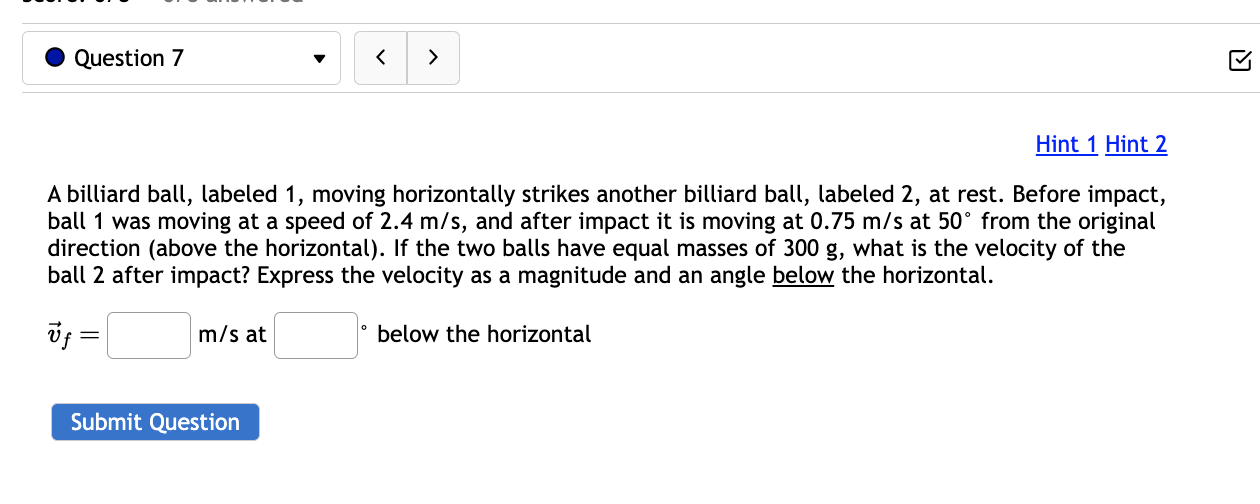
Question 4 < > m =100 kg V = 30 m/s V2 m2 = 150 kg This is an inelastic collision problem. One 100kg object is flying to the right at 30 m/s. It is in space, so there is no gravity. The other object, 150 kg, is traveling diagonally (up and left) at a speed of 80 meters per second, at an angle of 30 degrees with respect to the horizontal. They collide inelastically. Round all answers to two significant figures! 1. What is the "x" component of their velocity after the collision? Remember that the sign matters! Negative is left, and positive is right. Also, round your answer to two significant figures. 2. What is the "y" component of their velocity after the collision? Remember that the sign matters! Negative is down, and positive is up. Again, round the answwer to two significant figures. 3. What is the magnitude of the (diagonal) velocity of the two objects after the collision (use Pythagorean theorem)? 4. What angle, in degrees, not radians, does their velocity make with the horizontal axis (to be specific, the x axis, not the +x axis)? Submit Question Question 7 > Hint 1 Hint 2 A billiard ball, labeled 1, moving horizontally strikes another billiard ball, labeled 2, at rest. Before impact, ball 1 was moving at a speed of 2.4 m/s, and after impact it is moving at 0.75 m/s at 50 from the original direction (above the horizontal). If the two balls have equal masses of 300 g, what is the velocity of the ball 2 after impact? Express the velocity as a magnitude and an angle below the horizontal. = m/s at Submit Question below the horizontal
Step by Step Solution
There are 3 Steps involved in it
1 Finding the xcomponent of ... View full answer

Get step-by-step solutions from verified subject matter experts
 Study Help