



Question: Question #4. MBA or Ph.D. You just completed BT321 and you discovered a love of finance. After raduation and having worked in the finance industry
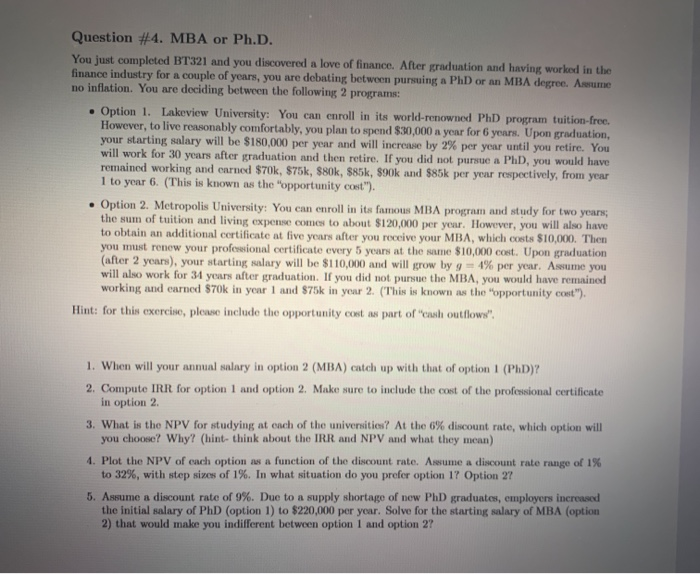
Question #4. MBA or Ph.D. You just completed BT321 and you discovered a love of finance. After raduation and having worked in the finance industry for a couple of years, you are debating between pursuing a PhD or an MBA degree. Asume no inflation. You are deciding between the following 2 programs Option 1. Lakeview University: You can enroll in its world-renowned PhD program tuition-free. However, to live reasonably comfortably, you plan to spend $30,000 a year for 6 years. Upon graduation, your starting salary will be $150,000 per year and will increase by 2% per year until you retire. You will work for 30 years after graduation and then retire. If you did not pursue a PhD, you would have remained working and earned $70k, $75k, $80k, 885k, 890k and $85k per your respectively, from year 1 to year 6. (This is known as the opportunity cost"). Option 2. Metropolis University: You can enroll in its famous MBA program and study for two years; the sum of tuition and living expense comes to about $120,000 per year. However, you will also have to obtain an additional certificate at five years after you receive your MBA, which costs $10,000. Then you must renew your professional certificate every 5 years at the same $10,000 cost. Upon graduation (after 2 years), your starting salary will be $110,000 and will grow by g = 4% per year. Assume you will also work for 34 years after graduation. If you did not pursue the MBA, you would have remained working and earned $70k in year and $75k in year 2. (This is known as the opportunity cont"). Hint: for this exercise, please include the opportunity cost as part of outflows". 1. When will your annual salary in option 2 (MBA) catch up with that of option 1 (PhD)? 2. Compute IRR for option 1 and option 2. Make sure to include the cost of the professional certificate in option 2 3. What is the NPV for studying at each of the universities? At the 6% discount rate, which option will you choose? Why? (hint-think about the IRR and NPV and what they mean) 4. Plot the NPV of each option function of the discount rate. Asume a discount rate of 1% to 32%, with step sizes of 1%. In what situation do you prefer option 17 Option 27 5. Assume a discount rate of 9%. Due to a supply shortage of new PhD graduates, employers increased the initial salary of PhD (option 1) to $220,000 per year. Solve for the starting salary of MBA (option 2) that would make you indifferent between option 1 and option 27 Question #4. MBA or Ph.D. You just completed BT321 and you discovered a love of finance. After raduation and having worked in the finance industry for a couple of years, you are debating between pursuing a PhD or an MBA degree. Asume no inflation. You are deciding between the following 2 programs Option 1. Lakeview University: You can enroll in its world-renowned PhD program tuition-free. However, to live reasonably comfortably, you plan to spend $30,000 a year for 6 years. Upon graduation, your starting salary will be $150,000 per year and will increase by 2% per year until you retire. You will work for 30 years after graduation and then retire. If you did not pursue a PhD, you would have remained working and earned $70k, $75k, $80k, 885k, 890k and $85k per your respectively, from year 1 to year 6. (This is known as the opportunity cost"). Option 2. Metropolis University: You can enroll in its famous MBA program and study for two years; the sum of tuition and living expense comes to about $120,000 per year. However, you will also have to obtain an additional certificate at five years after you receive your MBA, which costs $10,000. Then you must renew your professional certificate every 5 years at the same $10,000 cost. Upon graduation (after 2 years), your starting salary will be $110,000 and will grow by g = 4% per year. Assume you will also work for 34 years after graduation. If you did not pursue the MBA, you would have remained working and earned $70k in year and $75k in year 2. (This is known as the opportunity cont"). Hint: for this exercise, please include the opportunity cost as part of outflows". 1. When will your annual salary in option 2 (MBA) catch up with that of option 1 (PhD)? 2. Compute IRR for option 1 and option 2. Make sure to include the cost of the professional certificate in option 2 3. What is the NPV for studying at each of the universities? At the 6% discount rate, which option will you choose? Why? (hint-think about the IRR and NPV and what they mean) 4. Plot the NPV of each option function of the discount rate. Asume a discount rate of 1% to 32%, with step sizes of 1%. In what situation do you prefer option 17 Option 27 5. Assume a discount rate of 9%. Due to a supply shortage of new PhD graduates, employers increased the initial salary of PhD (option 1) to $220,000 per year. Solve for the starting salary of MBA (option 2) that would make you indifferent between option 1 and option 27
Step by Step Solution
There are 3 Steps involved in it

Get step-by-step solutions from verified subject matter experts