







Question: First estimation of atomic mass based on PhET simulation average mass of chlorine listed in the periodic table: number of chlorine-35 atoms: number of
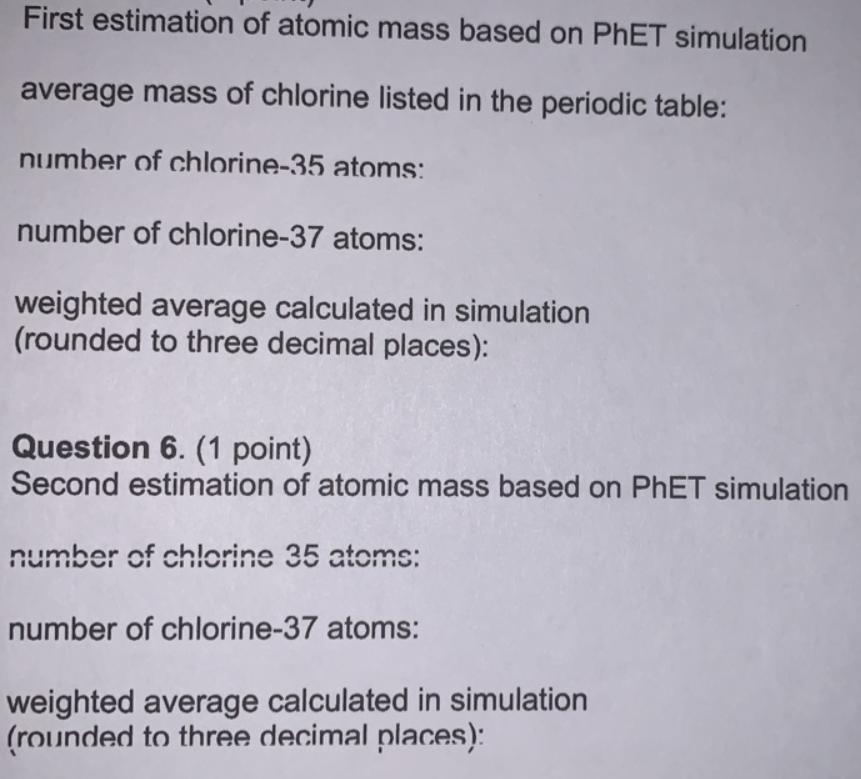
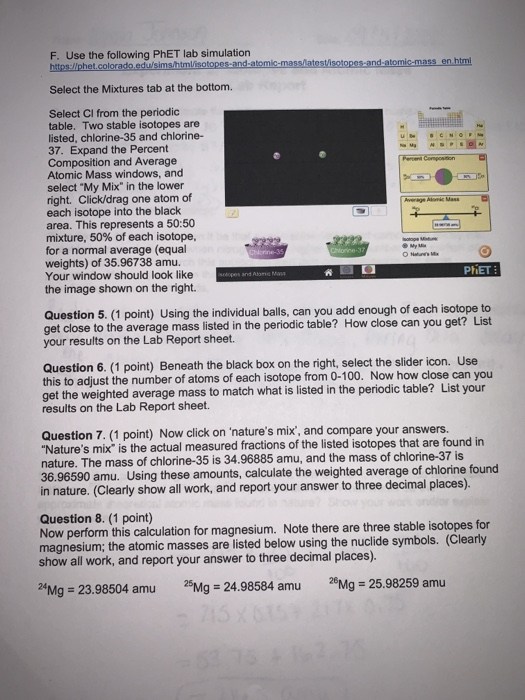
First estimation of atomic mass based on PhET simulation average mass of chlorine listed in the periodic table: number of chlorine-35 atoms: number of chlorine-37 atoms: weighted average calculated in simulation (rounded to three decimal places): Question 6. (1 point) Second estimation of atomic mass based on PhET simulation number of chlorine 35 atoms: number of chlorine-37 atoms: weighted average calculated in simulation (rounded to three decimal places): F. Use the following PhET lab simulation https://phet.colorado.edu/sims/html/isotopes-and-atomic-mass/latest/isotopes-and-atomic-mass en.html Select the Mixtures tab at the bottom. Select Cl from the periodic table. Two stable isotopes are listed, chlorine-35 and chlorine- 37. Expand the Percent Composition and Average Atomic Mass windows, and select "My Mix" in the lower right. Click/drag one atom of each isotope into the black area. This represents a 50:50 mixture, 50% of each isotope, for a normal average (equal weights) of 35.96738 amu. Your window should look like the image shown on the right. Chierine-3 solopes and Atomic Mass Chlorine-37 24Mg CNOF Percent Composition = 23.98504 amu Average Atomic Mass Isotope Mu My Mix ON M Question 5. (1 point) Using the individual balls, can you add enough of each isotope to get close to the average mass listed in the periodic table? How close can you get? List your results on the Lab Report sheet. PHET Question 6. (1 point) Beneath the black box on the right, select the slider icon. Use this to adjust the number of atoms of each isotope from 0-100. Now how close can you get the weighted average mass to match what is listed in the periodic table? List your results on the Lab Report sheet. Question 7. (1 point) Now click on 'nature's mix', and compare your answers. "Nature's mix" is the actual measured fractions of the listed isotopes that are found in nature. The mass of chlorine-35 is 34.96885 amu, and the mass of chlorine-37 is 36.96590 amu. Using these amounts, calculate the weighted average of chlorine found in nature. (Clearly show all work, and report your answer to three decimal places). Question 8. (1 point) Now perform this calculation for magnesium. Note there are three stable isotopes for magnesium; the atomic masses are listed below using the nuclide symbols. (Clearly show all work, and report your answer to three decimal places). 25 Mg = 24.98584 amu 26Mg = 25.98259 amu 715 53.75 * 162.75 E. What is found in nature. Since most radioactive isotopes decay in a matter of seconds or less, most of what we find in nature is comprised of stable isotopes. You have just been exploring the percentages of the stable isotopes of carbon. The periodic table lists the mass of carbon in nature as 12.01 amu. This represents the average mass considering the amounts of carbon-12 and carbon-13 in nature. Usually, people think of an average as sum of the individual values divided by the number of values. This is valid when the things you're measuring are present in equal proportions, or when you're measuring the same quantity multiple times. That is, each value carries the same weight, or impact (not weight as in the product of mass and gravity!). For example, when you're measuring three values, each with equal weight (impact) on the result, you would typically use the following calculation: A+B+C 3 Rearranging, this is exactly the same as: A(0.33) + B(0.33) + C(0.33) The individual carbon isotopes are NOT present in equal amounts. But the calculation is the same, except that now the fractions (weight, or impact) of each isotope in the measurement is different: (mass carbon 12)(fraction) + (mass carbon-13)(fraction) Using the values you found in Part D, the average mass calculation becomes: (12.00000 amu)(0.9893) + (13.00335 amu)(0.0107) = 12.01 amu This is called a weighted averago, where "weight" refers to the fraction of each quantity being measured. The general formula looks like this: (A)(fraction of A) + (B)(fraction of B) + (C)(fraction of C) ... + (n)(fraction of n) Question 4. (1 point) Imagine you've identified a new element, let's call it X that has two stable isotopes, 215x present at 25%, and 217X present at 75%. What would be the approximate atomic mass found in nature? Show your work and/or explain your reasoning. Questions are answered on the Lab Report associated with this document.
Step by Step Solution
3.32 Rating (161 Votes )
There are 3 Steps involved in it

Get step-by-step solutions from verified subject matter experts
 Study Help