







Question: Question 5 (6 points) The city is contemplating constructing a freeway that allows the residents in its catchment area (which consists of locations where use
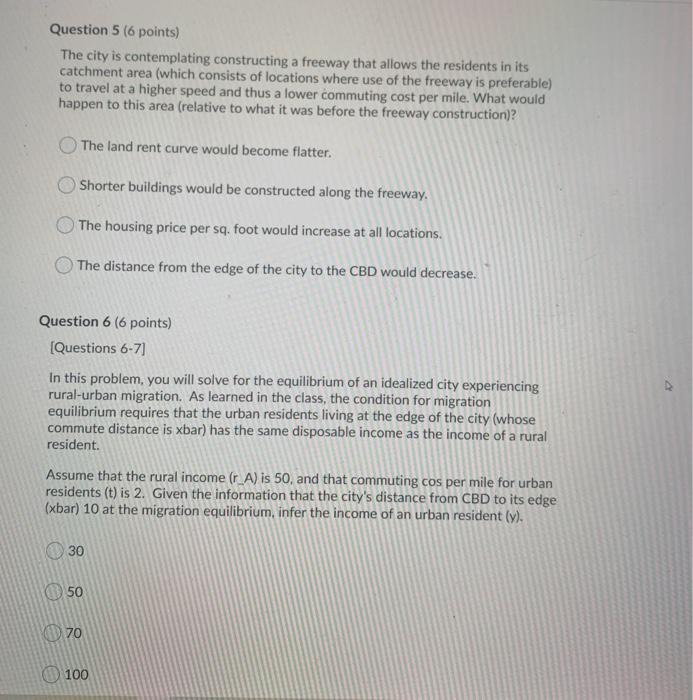
Question 5 (6 points) The city is contemplating constructing a freeway that allows the residents in its catchment area (which consists of locations where use of the freeway is preferable) to travel at a higher speed and thus a lower commuting cost per mile. What would happen to this area (relative to what it was before the freeway construction)? The land rent curve would become flatter. Shorter buildings would be constructed along the freeway. The housing price per sq. foot would increase at all locations. The distance from the edge of the city to the CBD would decrease. Question 6 (6 points) [Questions 6-7] In this problem, you will solve for the equilibrium of an idealized city experiencing rural-urban migration. As learned in the class, the condition for migration equilibrium requires that the urban residents living at the edge of the city (whose commute distance is xbar) has the same disposable income as the income of a rural resident. Assume that the rural income (r_A) is 50, and that commuting cos per mile for urban residents (t) is 2. Given the information that the city's distance from CBD to its edge (xbar) 10 at the migration equilibrium, infer the income of an urban resident (y). 30 50 V70 100
Step by Step Solution
There are 3 Steps involved in it

Get step-by-step solutions from verified subject matter experts
 Study Help