Question: QUESTION 55 Same Walden's Home Appliance Store case. Question: Most would say that the Director of HR's proposal to the CFO (Chief Financial Officer) was
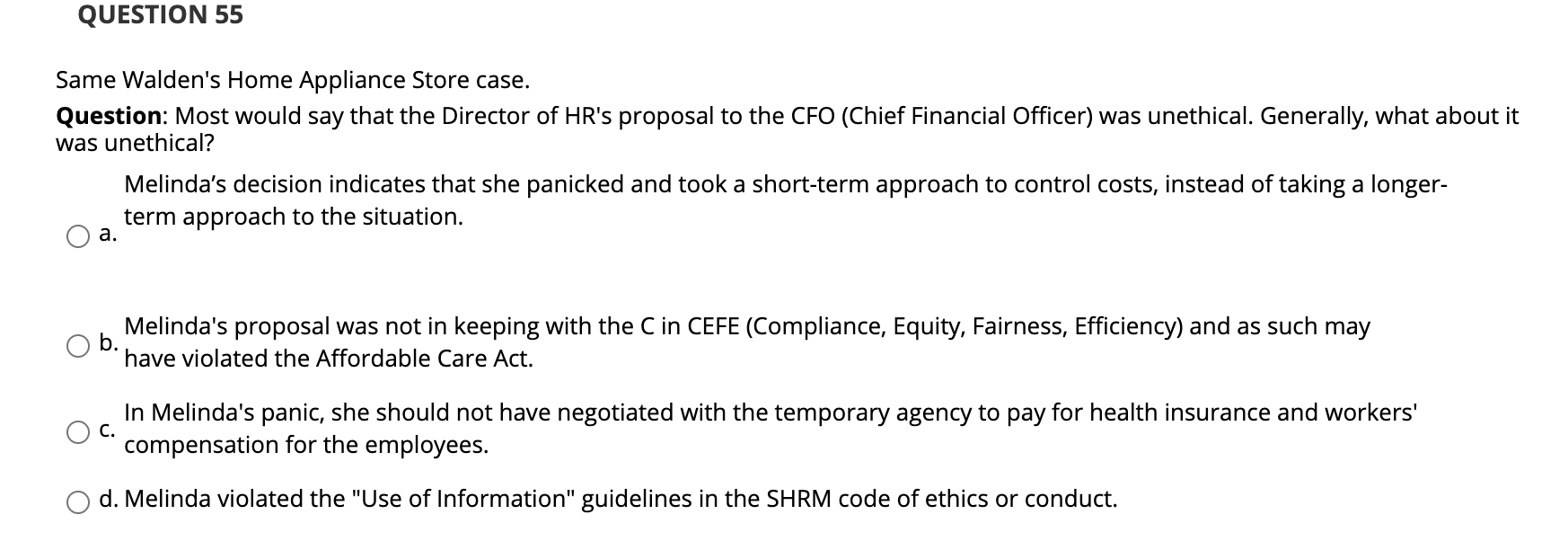
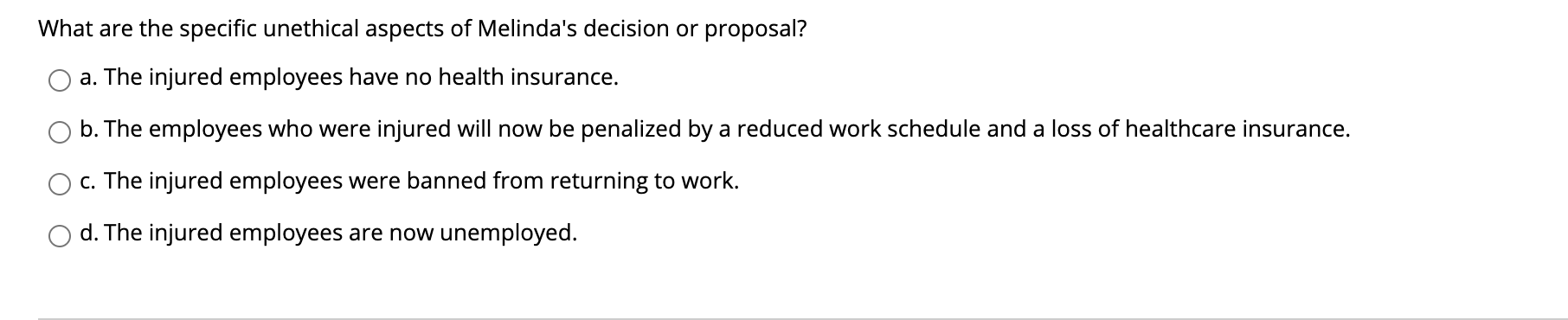
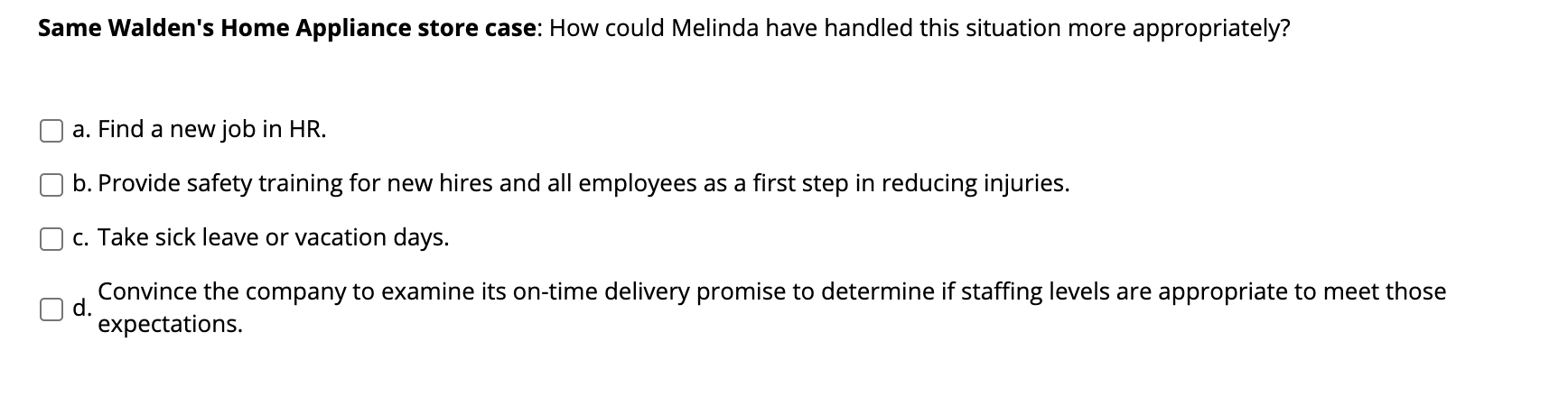
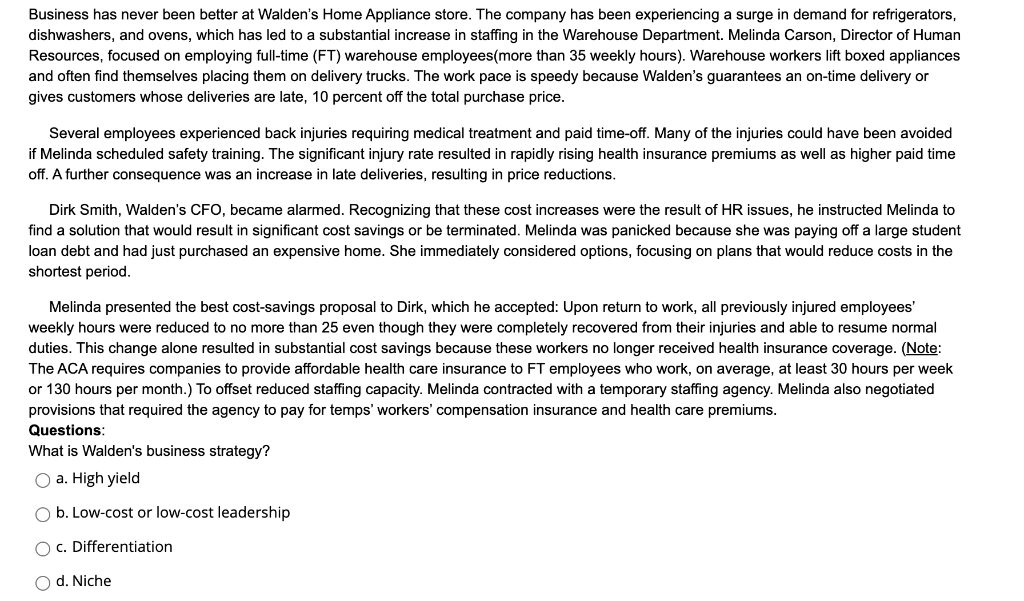
QUESTION 55 Same Walden's Home Appliance Store case. Question: Most would say that the Director of HR's proposal to the CFO (Chief Financial Officer) was unethical. Generally, what about it was unethical? Melinda's decision indicates that she panicked and took a short-term approach to control costs, instead of taking a longer- term approach to the situation. a. Melinda's proposal was not in keeping with the C in CEFE (Compliance, Equity, Fairness, Efficiency) and as such may b. have violated the Affordable Care Act. C. In Melinda's panic, she should not have negotiated with the temporary agency to pay for health insurance and workers' compensation for the employees. d. Melinda violated the "Use of Information" guidelines in the SHRM code of ethics or conduct. What are the specific unethical aspects of Melinda's decision or proposal? a. The injured employees have no health insurance. b. The employees who were injured will now be penalized by a reduced work schedule and a loss of healthcare insurance. c. The injured employees were banned from returning to work. d. The injured employees are now unemployed. Same Walden's Home Appliance store case: How could Melinda have handled this situation more appropriately? a. Find a new job in HR. b. Provide safety training for new hires and all employees as a first step in reducing injuries. c. Take sick leave or vacation days. Convince the company to examine its on-time delivery promise to determine if staffing levels are appropriate to meet those d. expectations. Business has never been better at Walden's Home Appliance store. The company has been experiencing a surge in demand for refrigerators, dishwashers, and ovens, which has led to a substantial increase in staffing in the Warehouse Department. Melinda Carson, Director of Human Resources, focused on employing full-time (FT) warehouse employees(more than 35 weekly hours). Warehouse workers lift boxed appliances and often find themselves placing them on delivery trucks. The work pace is speedy because Walden's guarantees an on-time delivery or gives customers whose deliveries are late, 10 percent off the total purchase price. Several employees experienced back injuries requiring medical treatment and paid time-off. Many of the injuries could have been avoided if Melinda scheduled safety training. The significant injury rate resulted in rapidly rising health insurance premiums as well as higher paid time off. A further consequence was an increase in late deliveries, resulting in price reductions. Dirk Smith, Walden's CFO, became alarmed. Recognizing that these cost increases were the result of HR issues, he instructed Melinda to find a solution that would result in significant cost savings or be terminated. Melinda was panicked because she was paying off a large student loan debt and had just purchased an expensive home. She immediately considered options, focusing on plans that would reduce costs in the shortest period. Melinda presented the best cost-savings proposal to Dirk, which he accepted: Upon return to work, all previously injured employees' weekly hours were reduced to no more than 25 even though they were completely recovered from their injuries and able to resume normal duties. This change alone resulted in substantial cost savings because these workers no longer received health insurance coverage. (Note: The ACA requires companies to provide affordable health care insurance to FT employees who work, on average, at least 30 hours per week or 130 hours per month.) To offset reduced staffing capacity. Melinda contracted with a temporary staffing agency. Melinda also negotiated provisions that required the agency to pay for temps' workers' compensation insurance and health care premiums. Questions: What is Walden's business strategy? a. High yield b. Low-cost or low-cost leadership c. Differentiation d. Niche









 Study Help