Question: Question 6 0/2 pts In section 8.1.4, equation 8.9 is: u = where u is utilization, Ip is number of customer in service and c
Question 6 0/2 pts In section 8.1.4, equation 8.9Question 6 0/2 pts In section 8.1.4, equation 8.9Question 6 0/2 pts In section 8.1.4, equation 8.9Question 6 0/2 pts In section 8.1.4, equation 8.9

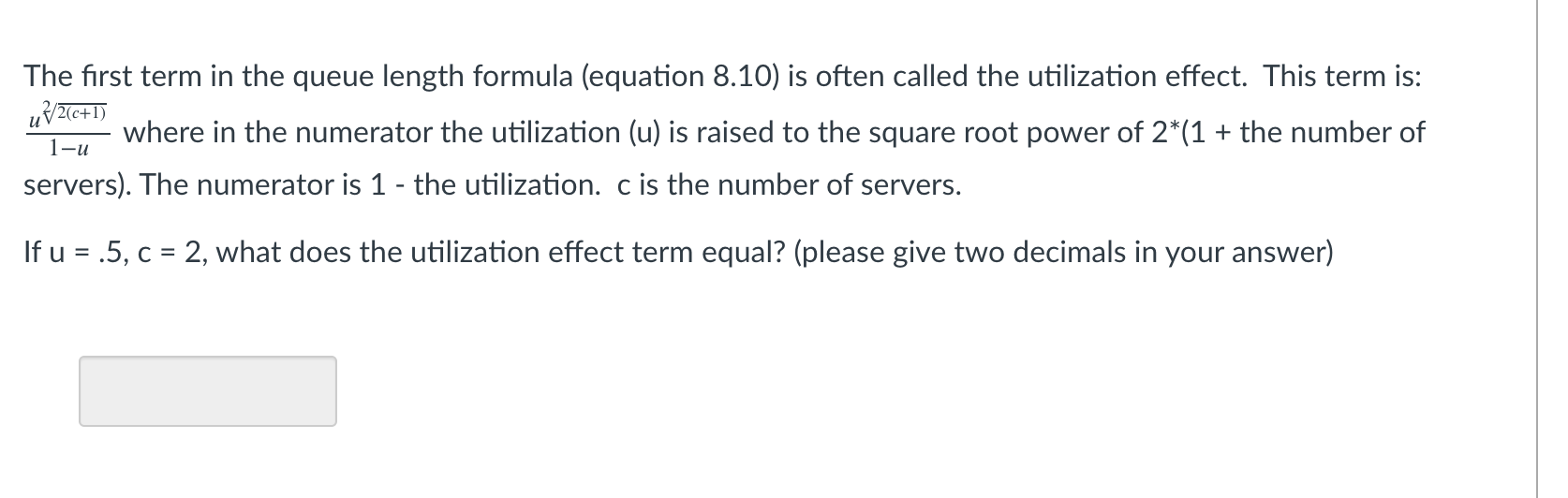
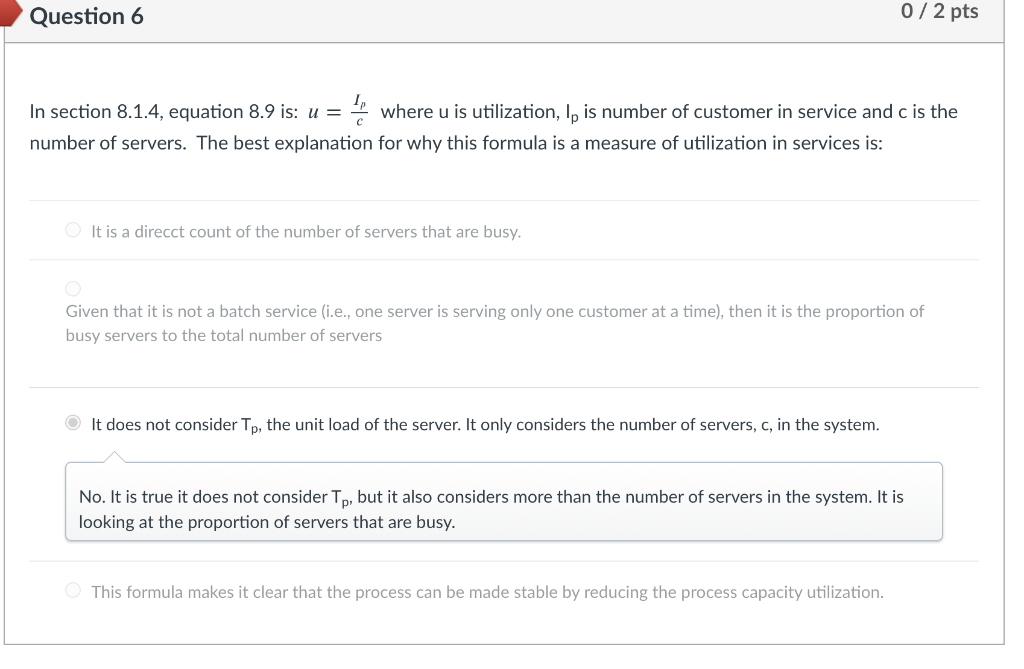
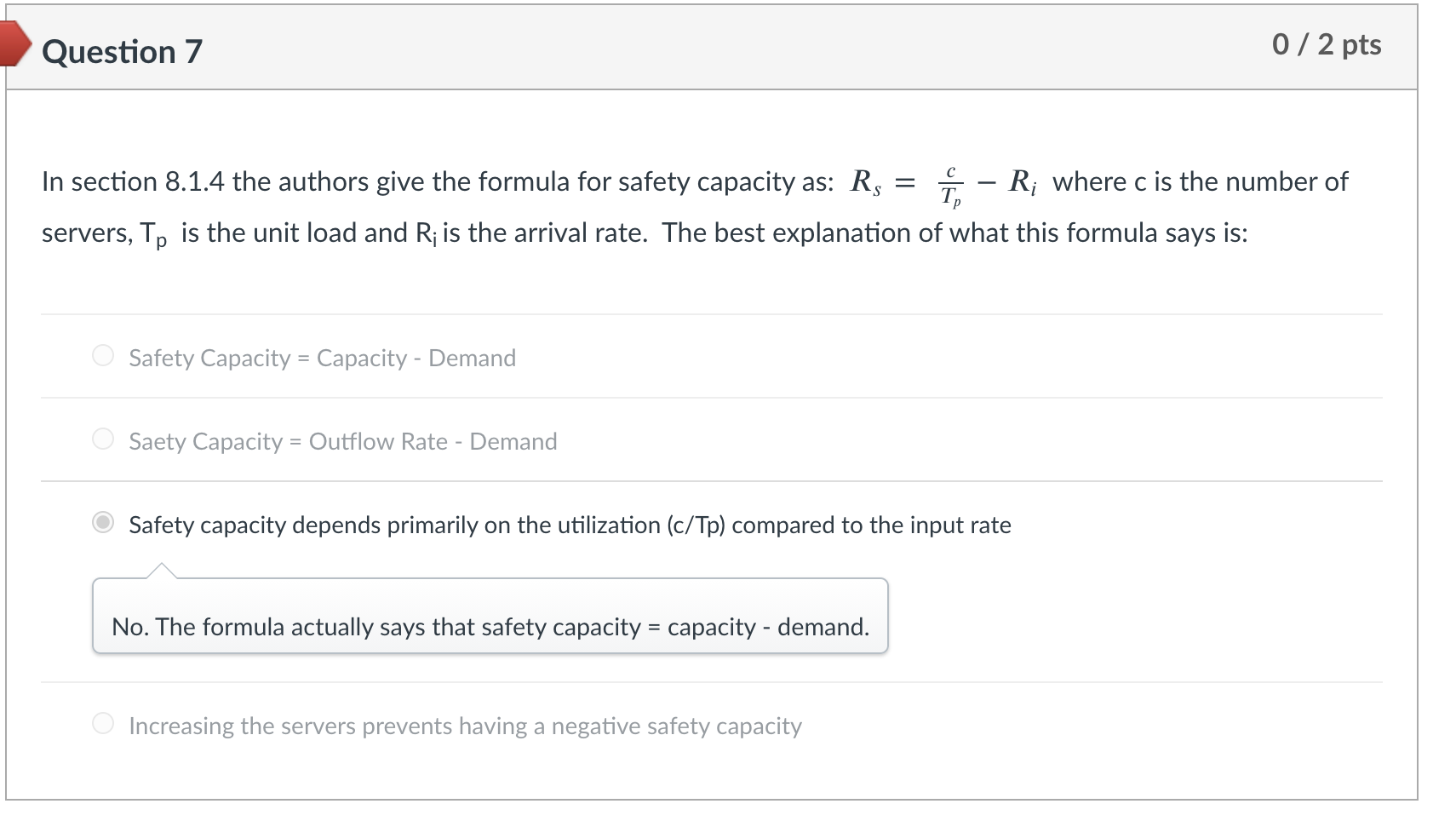
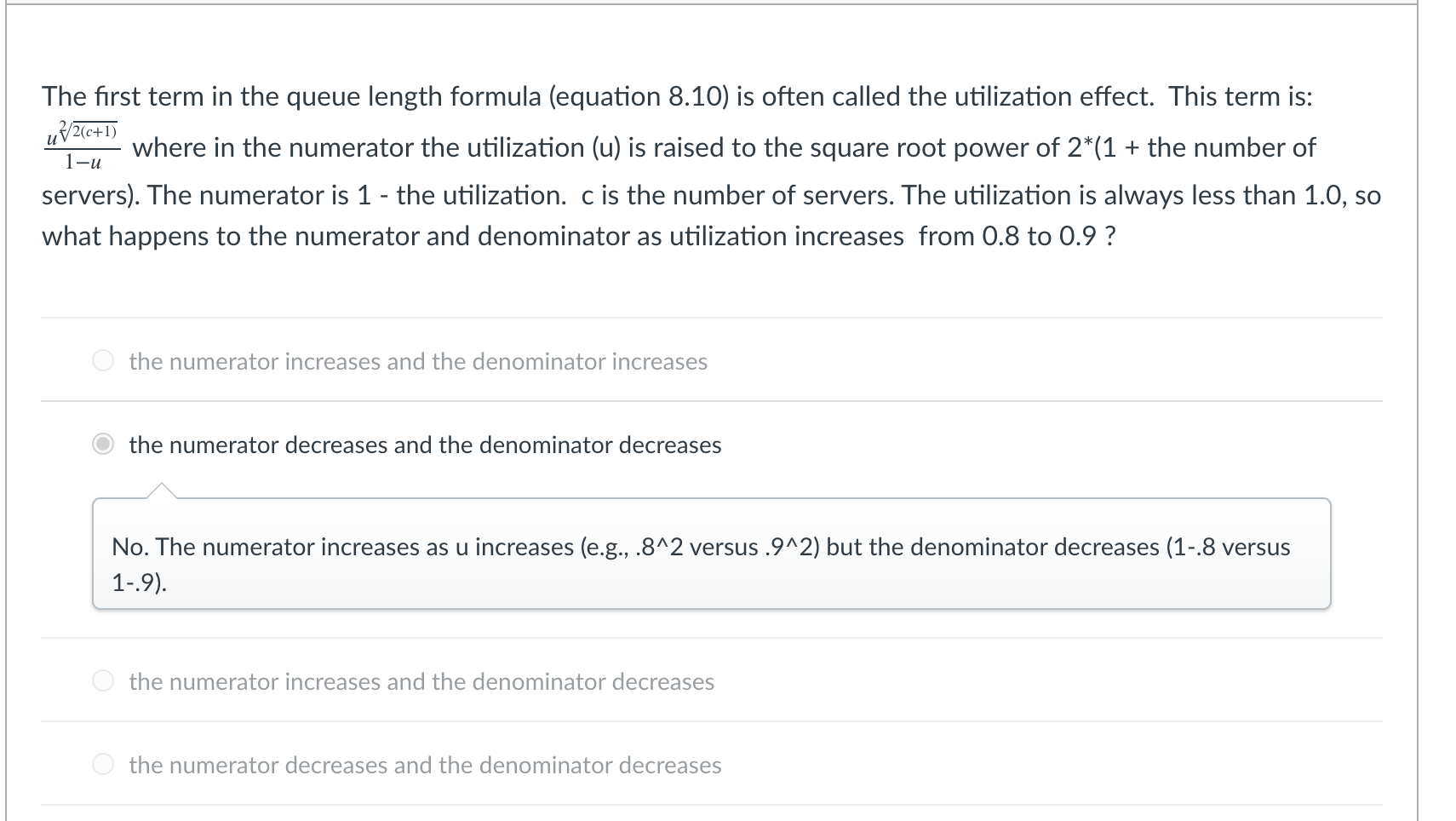
Question 6 0/2 pts In section 8.1.4, equation 8.9 is: u = where u is utilization, Ip is number of customer in service and c is the number of servers. The best explanation for why this formula is a measure of utilization in services It is a direcct count of the number of servers that are busy. Given that it is not a batch service (i.e., one server is serving only one customer at a time), then it is the proportion of busy servers to the total number of servers It does not consider Tp, the unit load of the server. It only considers the number of servers, c, in the system. No. It is true it does not consider Tp, but it also considers more than the number of servers in the system. It is looking at the proportion of servers that are busy. This formula makes it clear that the process can be made stable by reducing the process capacity utilization. Question 7 0 / 2 pts In section 8.1.4 the authors give the formula for safety capacity as: R. , - R; where c is the number of servers, Tp is the unit load and R; is the arrival rate. The best explanation of what this formula says is: Safety Capacity = Capacity - Demand Saety Capacity = Outflow Rate - Demand Safety capacity depends primarily on the utilization (c/Tp) compared to the input rate No. The formula actually says that safety capacity = capacity - demand. Increasing the servers prevents having a negative safety capacity 1-u The first term in the queue length formula (equation 8.10) is often called the utilization effect. This term is: u/2{c+1) where in the numerator the utilization (u) is raised to the square root power of 2*(1 + the number of servers). The numerator is 1 - the utilization. c is the number of servers. The utilization is always less than 1.0, so what happens to the numerator and denominator as utilization increases from 0.8 to 0.9 ? the numerator increases and the denominator increases the numerator decreases and the denominator decreases No. The numerator increases as u increases (e.g., .8^2 versus .9^2) but the denominator decreases (1-.8 versus 1-.9). the numerator increases and the denominator decreases the numerator decreases and the denominator decreases u/2(c+1) The first term in the queue length formula (equation 8.10) is often called the utilization effect. This term is: where in the numerator the utilization (u) is raised to the square root power of 2*(1 + the number of servers). The numerator is 1 - the utilization. c is the number of servers. 1- If u = .5, C = 2, what does the utilization effect term equal? (please give two decimals in your answer)
Step by Step Solution

There are 3 Steps involved in it

1 Expert Approved Answer
Step: 1 Unlock blur-text-image

Question Has Been Solved by an Expert!

Get step-by-step solutions from verified subject matter experts

Step: 2 Unlock
Step: 3 Unlock

Students Have Also Explored These Related General Management Questions!