







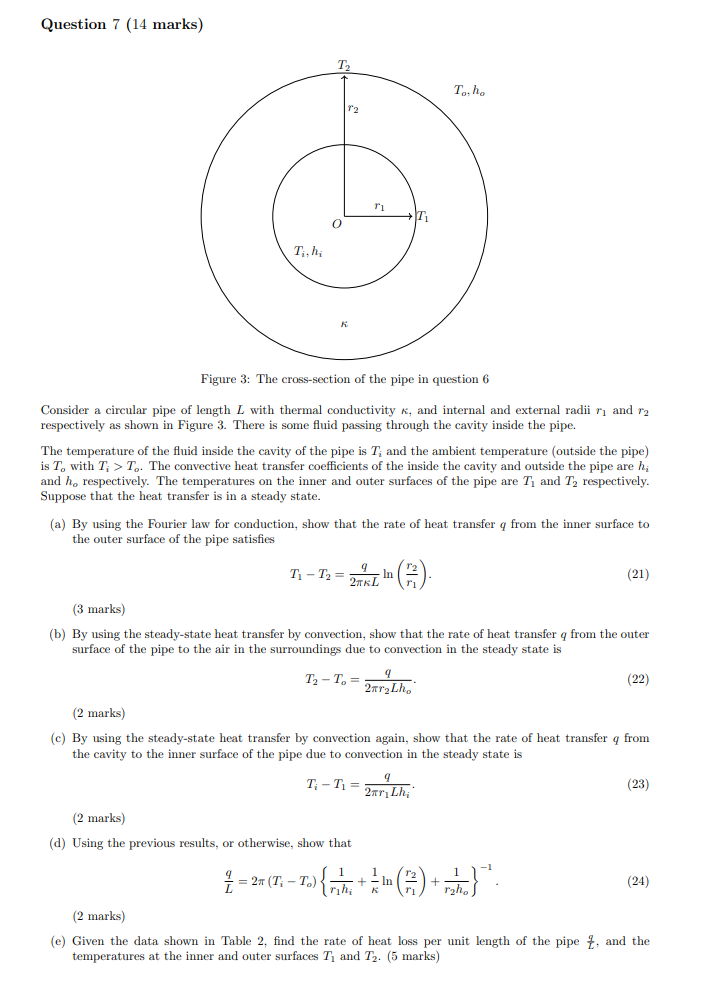
Question: Question 7 ( 1 4 marks ) Figure 3 : The cross - section of the pipe in question 6 Consider a circular pipe of
Question marks
Figure : The crosssection of the pipe in question
Consider a circular pipe of length with thermal conductivity and internal and external radii and
respectively as shown in Figure There is some fluid passing through the cavity inside the pipe.
The temperature of the fluid inside the cavity of the pipe is and the ambient temperature outside the pipe
is with The convective heat transfer coefficients of the inside the cavity and outside the pipe are
and respectively. The temperatures on the inner and outer surfaces of the pipe are and respectively.
Suppose that the heat transfer is in a steady state.
a By using the Fourier law for conduction, show that the rate of heat transfer from the inner surface to
the outer surface of the pipe satisfies
marks
b By using the steadystate heat transfer by convection, show that the rate of heat transfer from the outer
surface of the pipe to the air in the surroundings due to convection in the steady state is
marks
c By using the steadystate heat transfer by convection again, show that the rate of heat transfer from
the cavity to the inner surface of the pipe due to convection in the steady state is
marks
d Using the previous results, or otherwise, show that
marks
e Given the data shown in Table find the rate of heat loss per unit length of the pipe and the
temperatures at the inner and outer surfaces and marks
Step by Step Solution
There are 3 Steps involved in it
1 Expert Approved Answer
Step: 1 Unlock

Question Has Been Solved by an Expert!
Get step-by-step solutions from verified subject matter experts
Step: 2 Unlock
Step: 3 Unlock
 Study Help