Question: Question 7 2 pts Consider a government training program that provides low income, low-skilled, disadvantaged persons job-specific training. To evaluate this program, researchers compared the
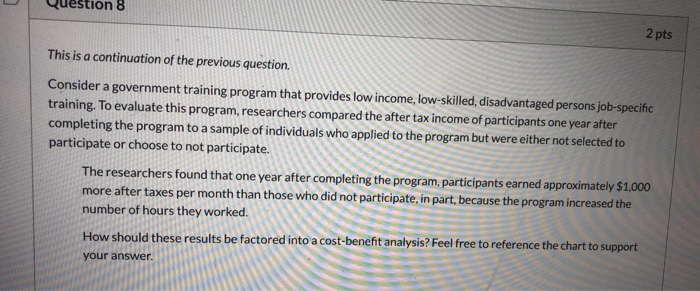
Question 7 2 pts Consider a government training program that provides low income, low-skilled, disadvantaged persons job-specific training. To evaluate this program, researchers compared the after tax income of participants one year after completing the program to a sample of individuals who applied to the program but were either not selected to participate or choose to not participate. Based on the information given, what methodological concerns exist? Question 8 2 pts This is a continuation of the previous question. Consider a government training program that provides low income, low-skilled, disadvantaged persons job-specific training. To evaluate this program, researchers compared the after tax income of participants one year after completing the program to a sample of individuals who applied to the program but were either not selected to participate or choose to not participate. The researchers found that one year after completing the program, participants earned approximately $1.000 more after taxes per month than those who did not participate, in part, because the program increased the number of hours they worked. How should these results be factored into a cost-benefit analysis? Feel free to reference the chart to support your answer. Question 7 2 pts Consider a government training program that provides low income, low-skilled, disadvantaged persons job-specific training. To evaluate this program, researchers compared the after tax income of participants one year after completing the program to a sample of individuals who applied to the program but were either not selected to participate or choose to not participate. Based on the information given, what methodological concerns exist? Question 8 2 pts This is a continuation of the previous question. Consider a government training program that provides low income, low-skilled, disadvantaged persons job-specific training. To evaluate this program, researchers compared the after tax income of participants one year after completing the program to a sample of individuals who applied to the program but were either not selected to participate or choose to not participate. The researchers found that one year after completing the program, participants earned approximately $1.000 more after taxes per month than those who did not participate, in part, because the program increased the number of hours they worked. How should these results be factored into a cost-benefit analysis? Feel free to reference the chart to support your










 Study Help