







Question: Let (Xn)neN be independent and identically distributed random variables satisfying P(Xn = 1) = P(Xn Consider the stochastic process (Sn)neN defined by setting So
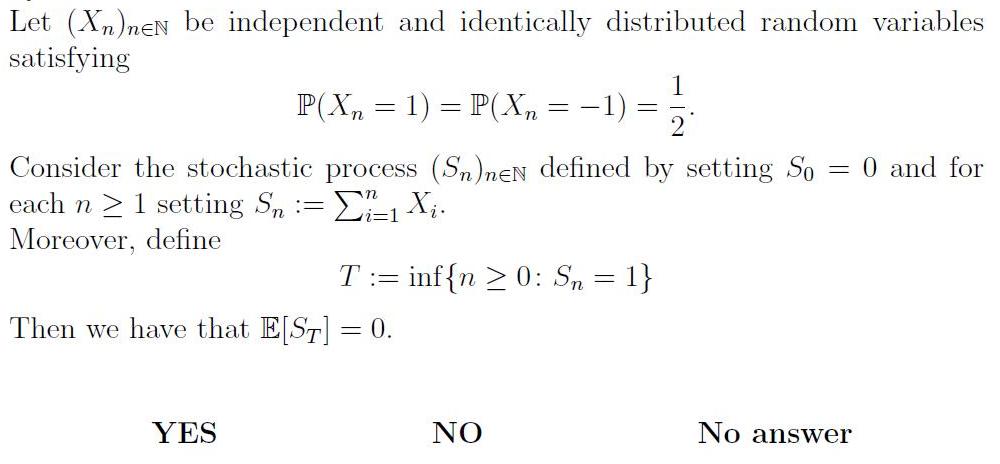
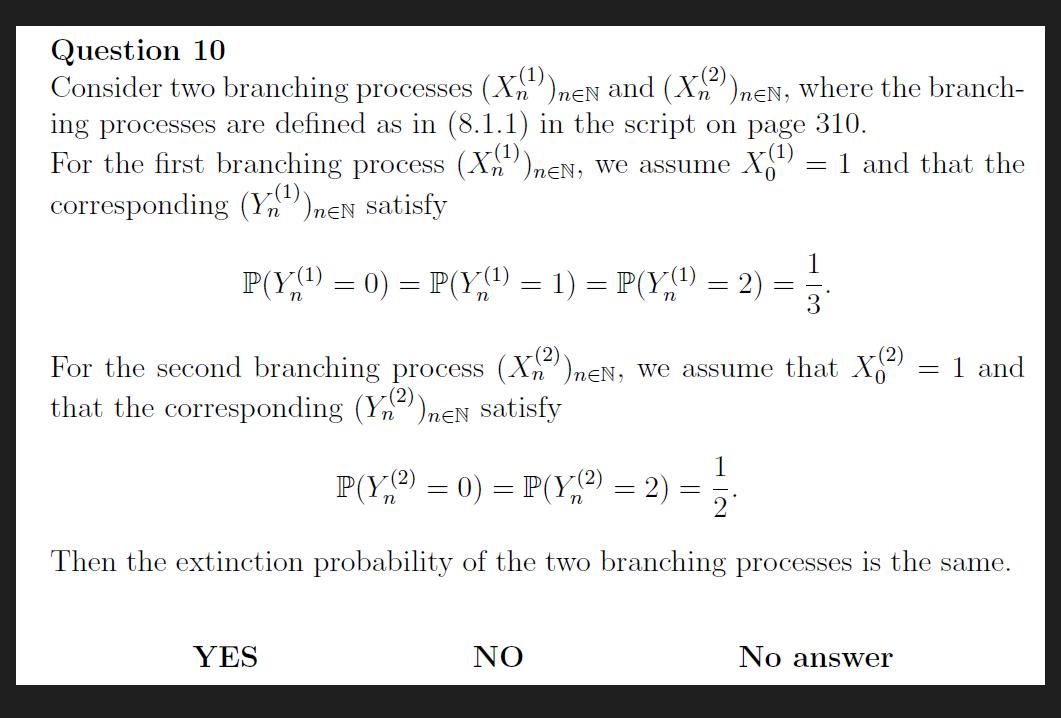
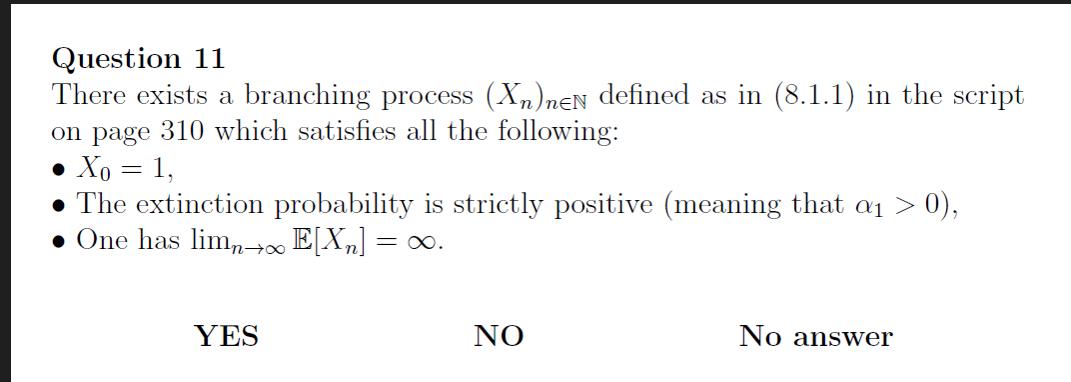
Let (Xn)neN be independent and identically distributed random variables satisfying P(Xn = 1) = P(Xn Consider the stochastic process (Sn)neN defined by setting So each n 1 setting Sn = 1 X. Moreover, define Then we have that E[ST] = 0. YES - -1) =1/4 2 Tinf{n > 0: Sn=1} NO = 0 and for No answer Question 10 -(1) Consider two branching processes (X))neN and (X))neN, where the branch- ing processes are defined as in (8.1.1) in the script on page 310. v(1) For the first branching process (X)neN, we assume X() = 1 and that the corresponding (())neN satisfy P(Y() = 0) = P(Y() = 1) = P(Y() = 2) = -(2) For the second branching process (X))neN, we assume that X() = 1 and that the corresponding (Y))neN satisfy P(Y() = 0) = P(Y() = 2) = Then the extinction probability of the two branching processes is the same. YES 1 NO No answer Question 11 There exists a branching process (Xn)neN defined as in (8.1.1) in the script on page 310 which satisfies all the following: Xo = 1, The extinction probability is strictly positive (meaning that a > 0), One has limn E[Xn] =. YES NO No answer
Step by Step Solution
3.44 Rating (160 Votes )
There are 3 Steps involved in it
The detailed answer f... View full answer

Get step-by-step solutions from verified subject matter experts
 Study Help