







Question: Question : please read case 6.8 -Nestle: Products That Don't Fit Cultures in your Jennings textbook (pages 407-409). After you have read the case, please
Question : please read case 6.8 -"Nestle: Products That Don't Fit Cultures" in your Jennings textbook (pages 407-409). After you have read the case, please document a brief summary of the overall case, identifying key organizational concerns. In your analysis of the case, please make sure to highlight the key ethical issues faced and the negative outcomes of those unethical behaviors or decisions.Make sure to incorporate insights you have gained from your readings, specifically highlighting different ethical and/or management models. As possible, please relate these ethical challenges and/or outcomes to your own professional experience.
please check below attachments that is case 6.8
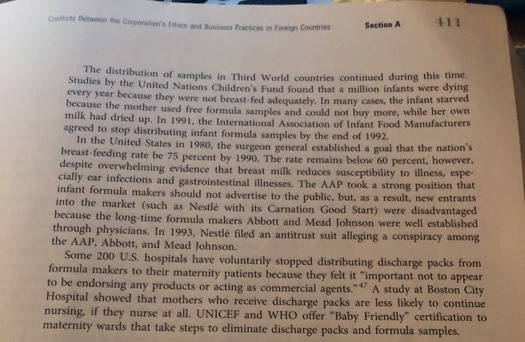
porthers Between the Corporation's Ethics and Business Praction in Forvign Countries Section A The distribution of samples in Third World countries continued during this time. Studies by the United Nations Children's Fund found that a million infants were dying every year because they were not breast-fed adequately. In many cases, the infant starved because the mother used free formula samples and could not buy more, while her own milk had dried up, In 1991, the International Association of Infant Food Manufacturers agreed to stop distributing infant formula samples by the end of 1992. In the United States in 1980, the surgeon general established a goal that the nation's breast-feeding rate be 75 percent by 1990. The rate remains below 60 percent, however, despite overwhelming evidence that breast milk reduces susceptibility to illness, espe- cially ear infections and gastrointestinal illnesses. The AAP took a strong position that infant formula makers should not advertise to the public, but, as a result, new entrants into the market (such as Nestle with its Carnation Good Start) were disadvantaged because the long-time formula makers Abbott and Mead Johnson were well established through physicians. In 1993, Nestle filed an antitrust suit alleging a conspiracy among the AAP, Abbott, and Mead Johnson. Some 200 U.S. hospitals have voluntarily stopped distributing discharge packs from formula makers to their maternity patients because they felt it "important not to appear to be endorsing any products or acting as commercial agents."A study at Boston City Hospital showed that mothers who receive discharge packs are less likely to continue nursing, if they nurse at all. UNICEF and WHO offer "Baby Friendly" certification to maternity wards that take steps to eliminate discharge packs and formula samples
Step by Step Solution
There are 3 Steps involved in it

Get step-by-step solutions from verified subject matter experts
 Study Help