Question: For this assignment, please read Case 6.8 - Nestle: Products That Don't Fit Cultures in your Jennings textbook (pages 407409). 1. Please document a brief
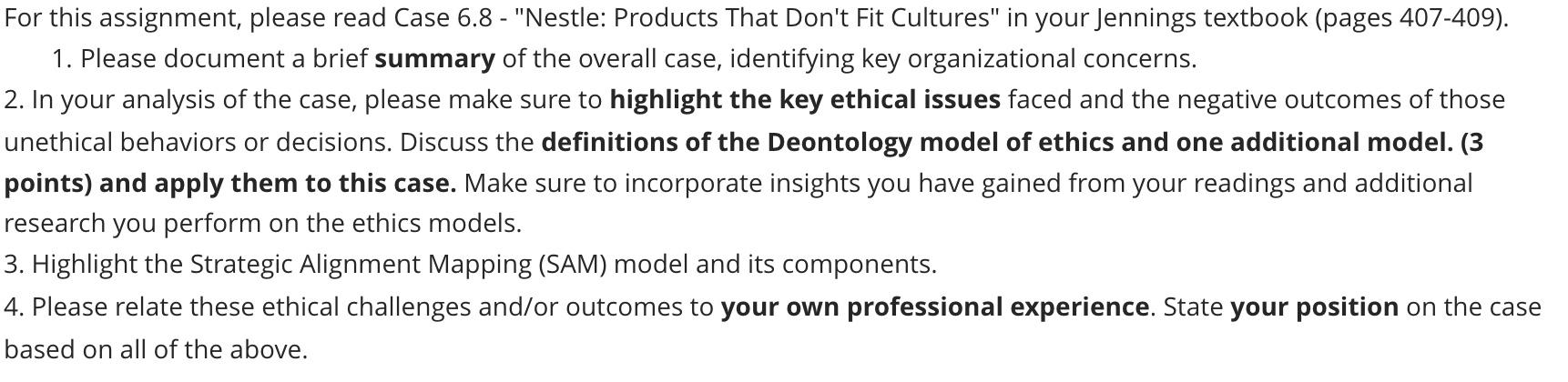
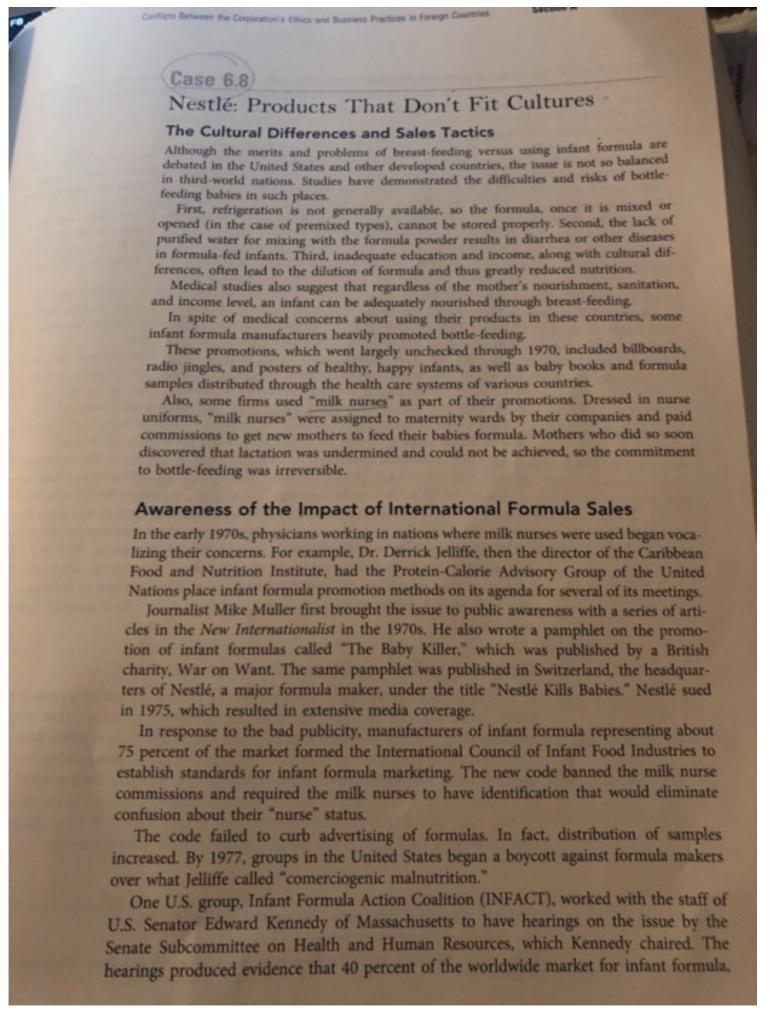
For this assignment, please read Case 6.8 - "Nestle: Products That Don't Fit Cultures" in your Jennings textbook (pages 407409). 1. Please document a brief summary of the overall case, identifying key organizational concerns. 2. In your analysis of the case, please make sure to highlight the key ethical issues faced and the negative outcomes of those unethical behaviors or decisions. Discuss the definitions of the Deontology model of ethics and one additional model. (3 points) and apply them to this case. Make sure to incorporate insights you have gained from your readings and additional research you perform on the ethics models. 3. Highlight the Strategic Alignment Mapping (SAM) model and its components. 4. Please relate these ethical challenges and/or outcomes to your own professional experience. State your position on the case oased on all of the above. Case 6.8 Nestl: Products That Don't Fit Cultures The Cultural Differences and Sales Tactics Although the merits and problems of breas-feeding vernus using infant formula are debated in the United States and other developed coantries, the iswe is not so balanced in third-world nations. Studies have demonstrated the difficulties and risks of bottlefeeding babies in such places. First, refrigeration is not generally available, so the formula, once it is mixed or opened (in the case of premixed types), cannot be stored properly. Second, the lack of purified water for mixing with the formula ponder results in diarries or other diseases in formula-fed infants. Third, inadequate education and income, along with cultural differences, often lead to the dilution of formula and thus greatly reduced nutrition. Medical studies also suggest that regardless of the mother's nourishment, sanitation. and income level, an infant can be adequately nourished through breast-feeding In spite of medical concerns about using their products in these countries, some infant formula manufacturers heavily promoted bottle-feeding. These promotions, which went largely unchecked through 1970 , induded billboards, radio jingles, and posters of healthy, happy infants, as well as baby books and formula samples distributed through the health care systems of various countries. Also, some firms used "milk nurse" as part of their promotions. Dressed in nurse uniforms, "milk nurses" were assigned to maternity wards by their companies and paid commissions to get new mothers to feed their babies formula. Mothers who did so soon discovered that lactation was undermined and could not be achieved, so the commitment to bottle-feeding was irreversible. Awareness of the Impact of International Formula Sales In the early 1970s, physicians working in nations where milk nurses were used began vocalizing their concerns. For example. Dr. Derrick Jelliffe, then the director of the Caribbean Food and Nutrition Institute, had the Protein-Calorie Advisory Group of the United Nations place infant formula promotion methods on its agenda for several of its meetings. Journalist Mike Muller first brought the issue to public awareness with a series of articles in the New Internationalist in the 1970s. He also wrote a pamphlet on the promotion of infant formulas called "The Baby Killer," which was published by a British charity, War on Want. The same pamphlet was published in Switzerland, the headquarters of Nestl, a major formula maker, under the title "Nestl Kills Babies." Nestl sued in 1975, which resulted in extensive media coverage. In response to the bad publicity, manufacturers of infant formula representing about 75 percent of the market formed the International Council of Infant Food Industries to establish standards for infant formula marketing. The new code banned the milk nurse commissions and required the milk nurses to have identification that would eliminate confusion about their "nurse" status. The code failed to curb advertising of formulas. In fact, distribution of samples increased. By 1977, groups in the United States began a boycott against formula makers over what Jelliffe called "comerciogenic malnutrition." One U.S. group, Infant Formula Action Coalition (INFACT), worked with the staff of U.S. Senator Edward Kennedy of Massachusetts to have hearings on the issue by the Senate Subcommittee on Health and Human Resources, which Kennedy chaired. The hearings produced evidence that 40 percent of the worldwide market for infant formula









 Study Help