







Question: QUESTION TWO 2.1 With reference to the case study, advise Executive Management at Steinhoff on how knowledge management and the Balanced Scorecard can be utilised
QUESTION TWO
2.1 With reference to the case study, advise Executive Management at Steinhoff on how knowledge management and the Balanced Scorecard can be utilised to address the human resource management related challenges at Steinhoff as well as the trending issues in South Africa. (Answer 150-180 words)
2.2 Advise Executive Management on the challenges that you foresee Steinhoff Limited facing when implementing Knowledge Management and the Balanced Scorecard and suggest interventions that could be used to address these challenges. (Answer in 100 words)
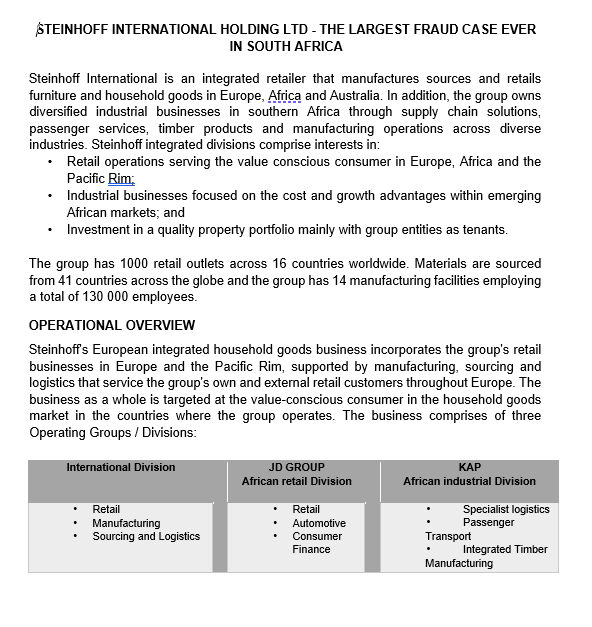
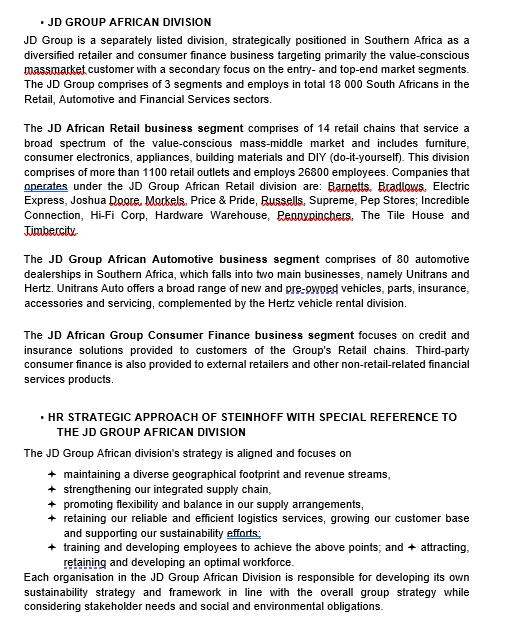
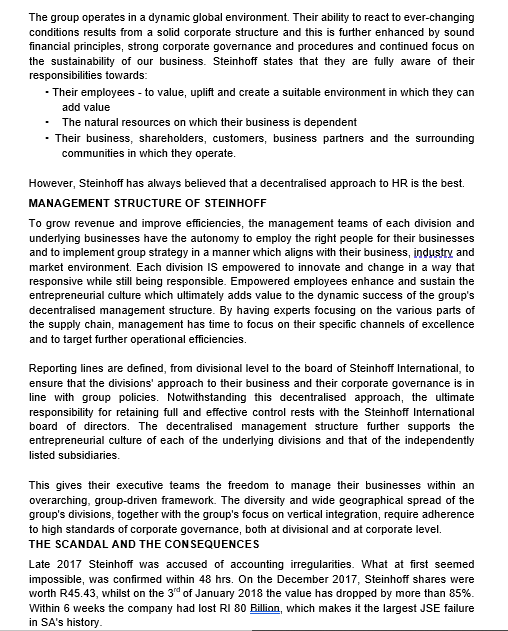
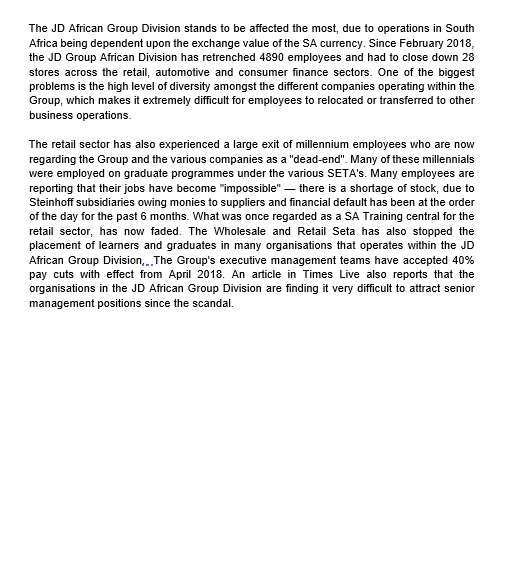
STEINHOFF INTERNATIONAL HOLDING LTD - THE LARGEST FRAUD CASE EVER IN SOUTH AFRICA Steinhoff International is an integrated retailer that manufactures sources and retails furniture and household goods in Europe, Africa and Australia. In addition, the group owns diversified industrial businesses in southern Africa through supply chain solutions, passenger services, timber products and manufacturing operations across diverse industries. Steinhoff integrated divisions comprise interests in: Retail operations serving the value conscious consumer in Europe, Africa and the Pacific Rim: Industrial businesses focused on the cost and growth advantages within emerging African markets, and Investment in a quality property portfolio mainly with group entities as tenants. The group has 1000 retail outlets across 16 countries worldwide. Materials are sourced from 41 countries across the globe and the group has 14 manufacturing facilities employing a total of 130 000 employees. OPERATIONAL OVERVIEW Steinhoff's European integrated household goods business incorporates the group's retail businesses in Europe and the Pacific Rim, supported by manufacturing, sourcing and logistics that service the group's own and external retail customers throughout Europe. The business as a whole is targeted at the value-conscious consumer in the household goods market in the countries where the group operates. The business comprises of three Operating Groups / Divisions: International Division JD GROUP African retail Division Retail Manufacturing Sourcing and Logistics Retail Automotive Consumer Finance KAP African industrial Division Specialist logistics Passenger Transport Integrated Timber Manufacturing JD GROUP AFRICAN DIVISION JD Group is a separately listed division, strategically positioned in Southern Africa as a diversified retailer and consumer finance business targeting primarily the value-conscious massmarket customer with a secondary focus on the entry- and top-end market segments. The JD Group comprises of 3 segments and employs in total 18 000 South Africans in the Retail, Automotive and Financial Services sectors. The JD African Retail business segment comprises of 14 retail chains that service a broad spectrum of the value-conscious mass-middle market and includes furniture, consumer electronics, appliances, building materials and DIY (do-it-yourself). This division comprises of more than 1100 retail outlets and employs 26800 employees. Companies that operates under the JD Group African Retail division are: Barnetts. Bradlous. Electric Express, Joshua Doore. Merkels. Price & Pride, Russels, Supreme, Pep Stores; Incredible Connection, Hi-Fi Corp, Hardware Warehouse, Pennypinchers. The Tile House and Timbercity The JD Group African Automotive business segment comprises of 80 automotive dealerships in Southern Africa, which falls into two main businesses, namely Unitrans and Hertz. Unitrans Auto offers a broad range of new and pre-owoed vehicles, parts, insurance, accessories and servicing, complemented by the Hertz vehicle rental division. The JD African Group Consumer Finance business segment focuses on credit and insurance solutions provided to customers of the Group's Retail chains. Third-party consumer finance is also provided to external retailers and other non-retail-related financial services products. .HR STRATEGIC APPROACH OF STEINHOFF WITH SPECIAL REFERENCE TO THE JD GROUP AFRICAN DIVISION The JD Group African division's strategy is aligned and focuses on + maintaining a diverse geographical footprint and revenue streams, + strengthening our integrated supply chain, promoting flexibility and balance in our supply arrangements, + retaining our reliable and efficient logistics services, growing our customer base and supporting our sustainability efforts + training and developing employees to achieve the above points; and + attracting, retaining and developing an optimal workforce. Each organisation in the JD Group African Division is responsible for developing its own sustainability strategy and framework in line with the overall group strategy while considering stakeholder needs and social and environmental obligations. The group operates in a dynamic global environment. Their ability to react to ever-changing conditions results from a solid corporate structure and this is further enhanced by sound financial principles, strong corporate governance and procedures and continued focus on the sustainability of our business. Steinhoff states that they are fully aware of their responsibilities towards: - Their employees - to value, uplift and create a suitable environment in which they can add value The natural resources on which their business is dependent Their business, shareholders, customers, business partners and the surrounding communities in which they operate. However, Steinhoff has always believed that a decentralised approach to HR is the best. MANAGEMENT STRUCTURE OF STEINHOFF To grow revenue and improve efficiencies, the management teams of each division and underlying businesses have the autonomy to employ the right people for their businesses and to implement group strategy in a manner which aligns with their business, industry and market environment. Each division IS empowered to innovate and change in a way that responsive while still being responsible. Empowered employees enhance and sustain the entrepreneurial culture which ultimately adds value to the dynamic success of the group's decentralised management structure. By having experts focusing on the various parts of the supply chain, management has time to focus on their specific channels of excellence and to target further operational efficiencies. Reporting lines are defined, from divisional level to the board of Steinhoff International, to ensure that the divisions' approach to their business and their corporate governance is in line with group policies. Notwithstanding this decentralised approach, the ultimate responsibility for retaining full and effective control rests with the Steinhoff International board of directors. The decentralised management structure further supports the entrepreneurial culture of each of the underlying divisions and that of the independently listed subsidiaries. This gives their executive teams the freedom to manage their businesses within an overarching, group-driven framework. The diversity and wide geographical spread of the group's divisions, together with the group's focus on vertical integration, require adherence to high standards of corporate governance, both at divisional and at corporate level. THE SCANDAL AND THE CONSEQUENCES Late 2017 Steinhoff was accused of accounting irregularities. What at first seemed impossible, was confirmed within 48 hrs. On the December 2017, Steinhoff shares were worth R45.43, whilst on the 3rd of January 2018 the value has dropped by more than 85%. Within 6 weeks the company had lost RI 80 Billion, which makes it the largest JSE failure in SA's history The JD African Group Division stands to be affected the most, due to operations in South Africa being dependent upon the exchange value of the SA currency. Since February 2018, the JD Group African Division has retrenched 4890 employees and had to close down 28 stores across the retail, automotive and consumer finance sectors. One of the biggest problems is the high level of diversity amongst the different companies operating within the Group, which makes it extremely difficult for employees to relocated or transferred to other business operations. The retail sector has also experienced a large exit of millennium employees who are now regarding the Group and the various companies as a "dead-end". Many of these millennials were employed on graduate programmes under the various SETA's. Many employees are reporting that their jobs have become "impossible" there is a shortage of stock, due to Steinhoff subsidiaries owing monies to suppliers and financial default has been at the order of the day for the past 6 months. What was once regarded as a SA Training central for the ret sector, has now faded. The Wholesale and Re Seta has also stopped the placement of learners and graduates in many organisations that operates within the JD African Group Division. The Group's executive management teams have accepted 40% pay cuts with effect from April 2018. An article in Times Live also reports that the organisations in the JD African Group Division are finding it very difficult to attract senior management positions since the scandal
Step by Step Solution
There are 3 Steps involved in it
1 Expert Approved Answer
Step: 1 Unlock

Question Has Been Solved by an Expert!
Get step-by-step solutions from verified subject matter experts
Step: 2 Unlock
Step: 3 Unlock
 Study Help