







Question: Question : What should be the average ticket price for the KFBS concert if the?fixed-pay fee is?$200,000 and the Pavilion expects to sell?7,000 tickets and
Question : What should be the average ticket price for the KFBS concert if the?fixed-pay fee is?$200,000 and the Pavilion expects to sell?7,000 tickets and wants to earn?$30,000 after 40 percent in?taxes?
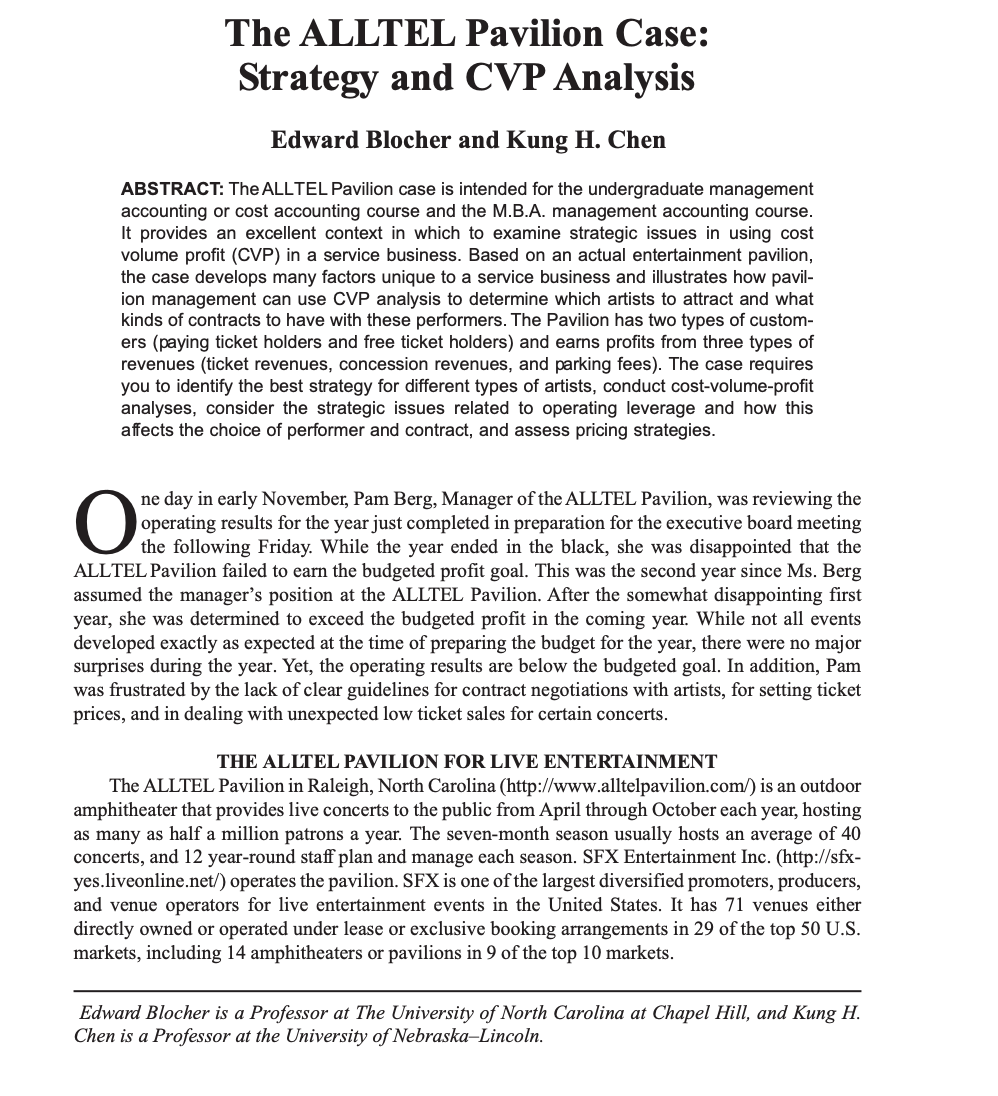
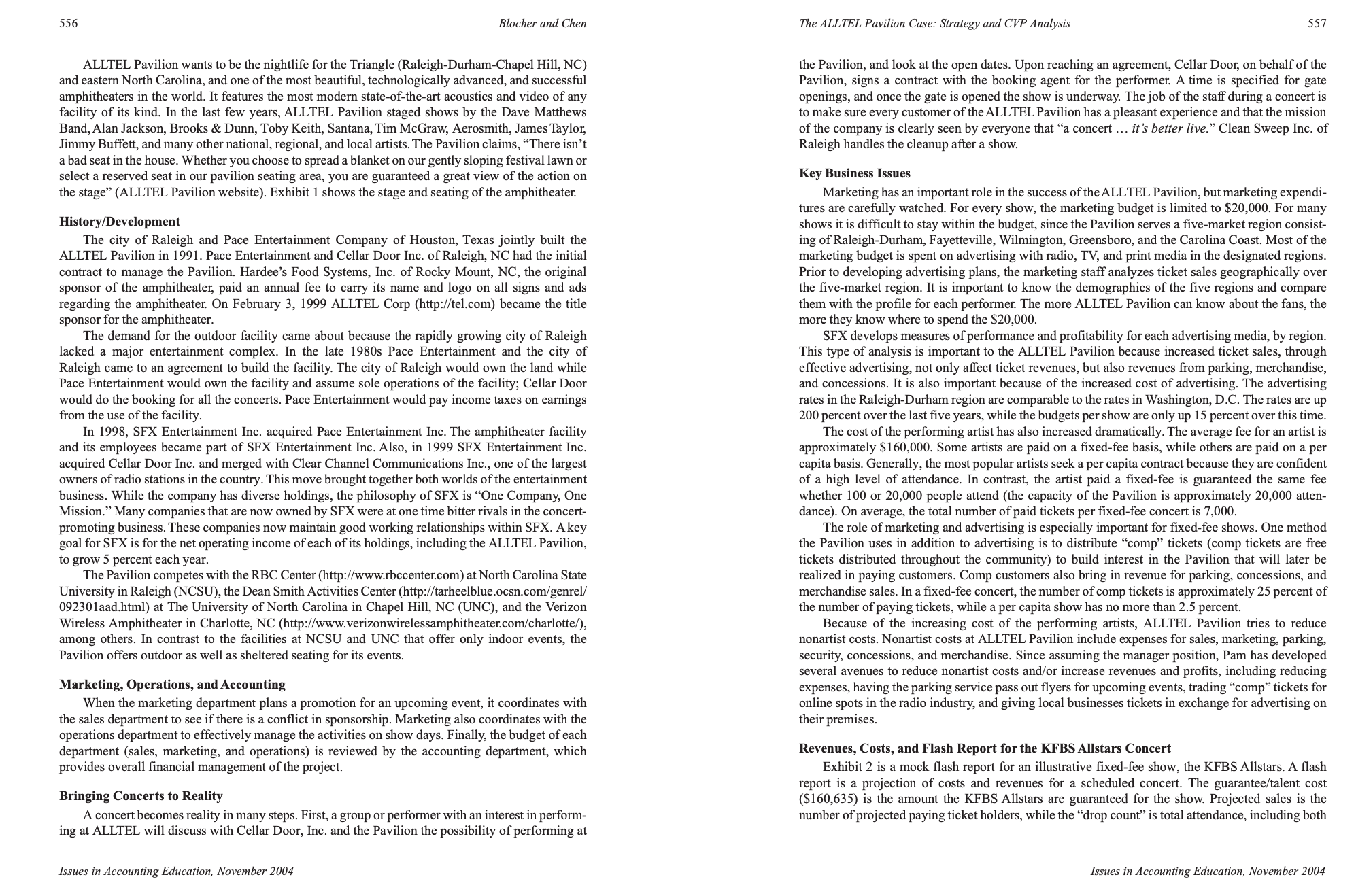
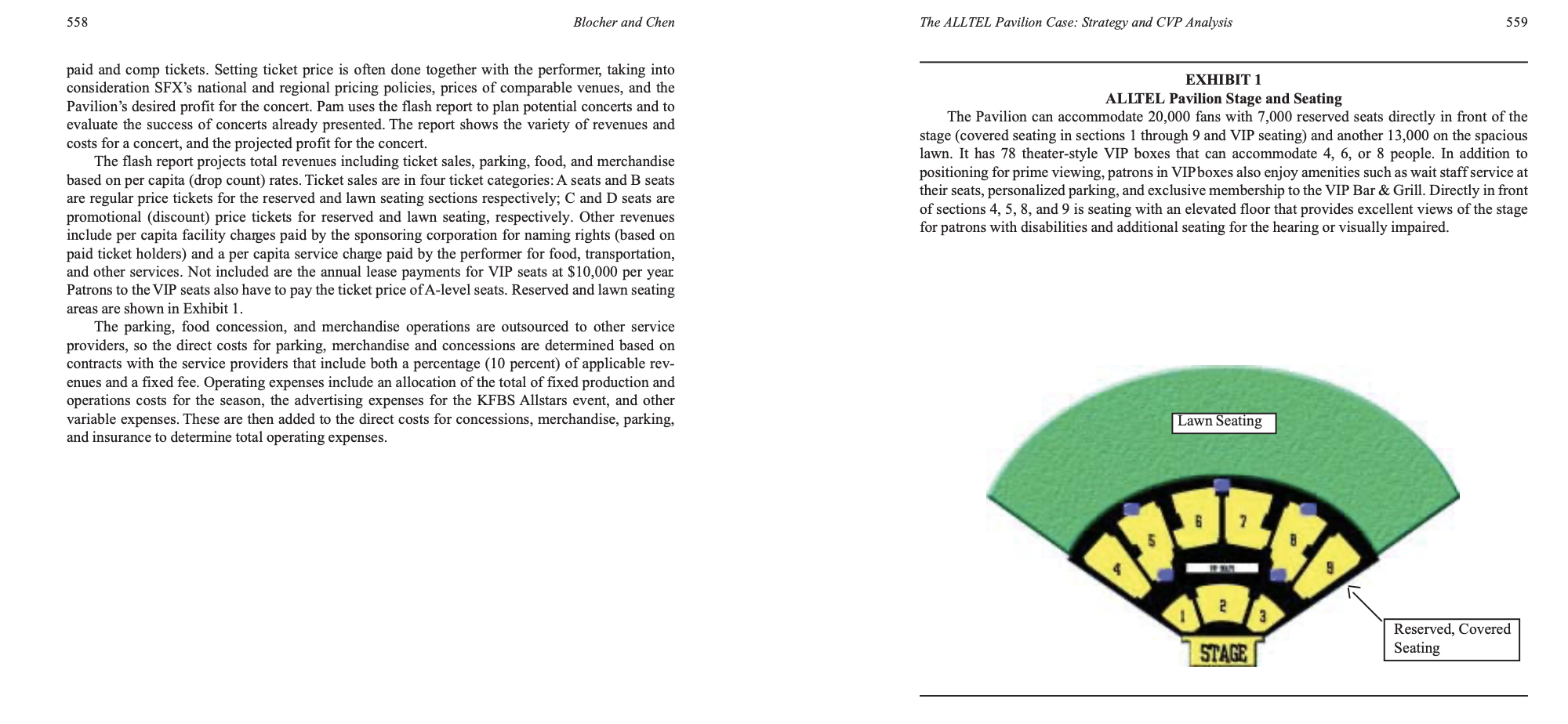
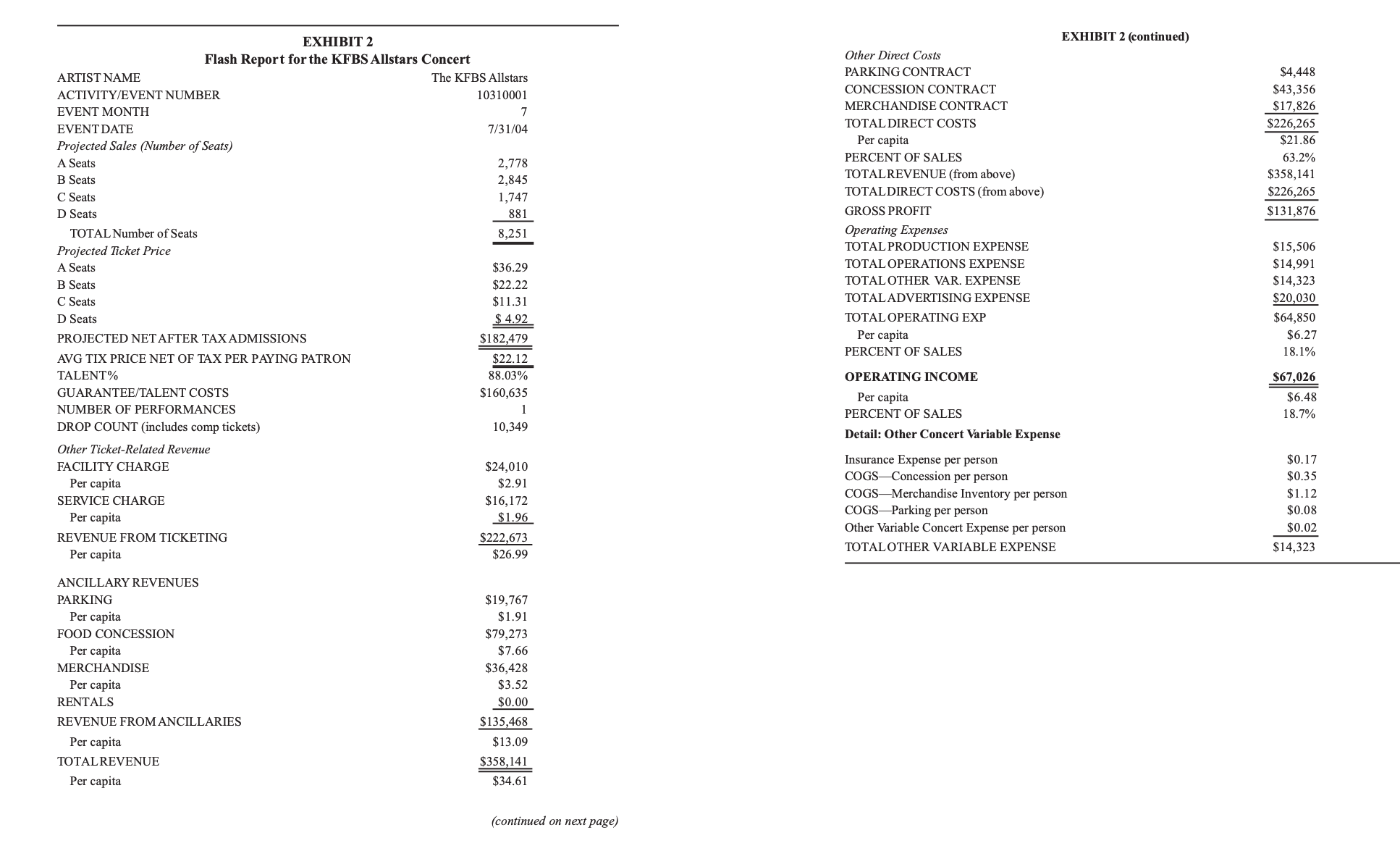
The ALLTEL Pavilion Case: Strategy and CVP Analysis Edward Blocher and Kung H. Chen ABSTRACT: The ALLTEL Pavilion case is intended for the undergraduate management accounting or cost accounting course and the MBA. management accounting course. It provides an excellent context in which to examine strategic issues in using cost volume prot (CVP) in a service business. Based on an actual entertainment pavilionI the case develops many factors unique to a service business and illustrates how pavil- ion management can use CVP analysis to determine which artists to attract and what kinds of contracts to have with these performers. The Pavilion has two types of custom- ers (paying ticket holders and free ticket holders) and earns prots from three types of revenues (ticket revenues, concession revenues, and parking fees). The case requires you to identify the best strategy for different types of artists, conduct cost-volume-prot analyses, consider the strategic issues related to operating leverage and how this atfects the choice of performer and contract, and assess pricing strategies. operating results for the year just completed in preparation for the executive board meeting the following Friday. While the year ended in the black, she was disappointed that the ALLTEL Pavilion failed to earn the budgeted prot goal. This was the second year since Ms. Berg assumed the manager's position at the ALLTEL Pavilion. After the somewhat disappointing rst year, she was determined to exceed the budgeted prot in the coming year. While not all events developed exactly as expected at the time of preparing the budget for the year, there were no major surprises during the year. Yet, the operating results are below the budgeted goal. In addition, Pam was 'ustrated by the lack of clear guidelines for contract negotiations with artists, for setting ticket prices, and in dealing with unexpected low ticket sales for certain concerts. O ne day in early November, Pam Berg, Manager of the ALLTEL Pavilion, was reviewing the TI-[E ALIII'EL PAVILION FOR LIVE ENTERTAINMENT The ALLTEL Pavilion in Raleigh, North Carolina (http:ffwww.alltelpavilion_comf) is an outdoor amphitheater that provides live concerts to the public from April through October each year, hosting as many as half a million patrons a year. The seven-month season usually hosts an average of 40 concerts, and 12 year-round staff plan and manage each season. SFX Entertainment Inc. (https'a'sfx- yes.1iveonline.netl') operates the pavilion. SFX is one of the largest diversied promoters, producers, and venue operators for live entertainment events in the United States. It has 71 venues either directly owned or operated under lease or exclusive booking arrangements in 29 of the top 50 U.S. markets, including 14 amphitheaters or pavilions in 9 of the top 10 markets. Edward Blocher is a Professor at The University of North Carolina at Chapel Hill, and Kong H. Chen is a Prozssor at the University of NebraskaLincoln. 556 Blacker and Chen ALLTEL Pavilion Wants to be the nirtlife for the Triangle (Raleigh-Durham-Chapel Hill, NC) and eastern North Carolina, and one of the most beautiful, technologically adwnced, and. successrl amphitheaters in the world. It features the most modern state-of-the-art acoustics and video of any facility of its kind. In the last few years, ALLTEL Pavilion staged shows by the Dave Matthews Band,Alan Jackson, Brooks 8: Dunn, Toby Keith, Santana, Tim McGraw, Aerosmith, JamesTaylor, Jimmy Buffett, and many other national, regional, and local artists. The Pavilion claims, \"There isn't abad seat inthe house. W'hetheryou choose to spread a blanket on our gently sloping festival lawn or select a reserved seat in our pavilion seating area, you are guaranteed a great view of the action on the stage\" (ALLTEL Pavilion website). Exhibit 1 shows the stage and seating of the amphitheater. l-Iistorymevelopment The city of Raleigh and Pace Entertainment Company of Houston, Texas jointly built the ALLTEL Pavilion in 1991. Pace Entertainment and Cellar Door Inc. of Raleigh, NC had the initial contract to manage the Pavilion. Hardee's Food Systems, Inc. of Rocky Mount, NC, the original sponsor of the amphitheater, paid an annual fee to carry its name and logo on all signs and ads regarding the amphitheater. On Febnrary 3, 1999 ALLTEL Corp (http://tel.com) became the title sponsor for the amphitheater. The demand for the outdoor facility came about because the rapidly growing city of Raleigh lacked a major entertainment complex. In the late 1980: Pace Entertainment and the city of Raleigh came to an agreement to build the facility. The city of Raleigh would own the land while Pace Entertainment would own the facility and assume sole operations of the facility; Cellar Door would do the booking for all the concerts. Pace Entertainment would pay income taxes on earnings from the use of the facility. In 1998, SFX Entertainment Inc. acquired Pace Entertainment Inc. The amphitheater facility and its employees became part of SFX Entertainment Inc. Also, in 1999 SFX Entertainment Inc. acquired Cellar Door Inc. and merged with Clear Channel Communications Inc., one of the largest owners of radio stations in the country. This move brought together both worlds of the entertainment business. while the company has diverse holdings, the philosophy of SFX is \"One Company, One Mission.\" Many companies that are now owned by SFX were at one time bitter rivals in the concert- promoting business. These companies now maintain good working relationships within SFX. Akey goal for SFX is for the net operating income of each of its holdings, including the ALLTEL Pavilion, to grow 5 percent each year. The Pavilion competes with the RBC Center (http://wwwrbccentercom) at North Carolina State University in Raleigh (N CSU), the Dean Smith Activities Center (http://tarheelblue.ocsn.com/genrel/ 092301aadhtml) at The University of North Carolina in Chapel Hill, NC (UNC), and the Verizon Wireless Amphitheater in Charlotte, NC (http://www.verizonwirelessamphitheater.com/charlottef), among others. In contrast to the facilities at NCSU and UNC that offer only indoor events, the Pavilion offers outdoor as well as sheltered seating for its events. Marketing, Operations, and Accounting When the marketing department plans a promotion for an upcoming event, it coordinates with the sales department to see if there is a conict in sponsorship. Marketing also coordinates with the operations department to effectively manage the activities on show days. Finally, the budget of each department (sales, marketing, and operations) is reviewed by the accounting department, which provides overall nancial management of the project. Bringing Concerts to Reality A concertbecomes reality in many steps. First, a group or performer with an intere in perform- ing at ALLTEL will discuss with Cellar Door, Inc. and the Pavilion the possibility of performing at Issues in Accounting Educurilm. November 2004 The ALLTEL Pavilion Care: Strategy and CVP Analysis 557 the Pavilion, and look at the open dates. Upon reaching an agreement, Cellar Door, on behalf of the Pavilion, signs a contract with the booking agent for the performer. A me is specied for @te openings, and once the gate is opened the show is underway. The job of the statf during a concert is to make sure every customer of the ALLTEL Pavilion has a pleasant experience and that the mission of the company is clearly seen by everyone that "a concert it's better live." Clean Sweep Inc. of Raleigh handles the cleanup aer a show. Key Business Issues Marketing has an important role in the success of theALLTEL Pavilion, but marketing expendi- tures are carefully watched. For every show, the marketing budget is limited to $20,000. For many shows it is difcult to stay within the budget, since the Pavilion serves a five-market region consist- ing of Raleigh-Durham, Fayetteville, Wilmington, Greensboro, and the Carolina Coast. Most of the marketing budget is spent on advertising with radio, TV, and print media in the designated regions. Prior to developing advertising plans, the marketing staff analyzes ticket sales geographically over the ve-market region. It is important to know the demographics of the ve regions and compare them with the prole for each performer. The more ALLTEL Pavilion can know about the fans, the more they know where to spend the $20,000. SFX develops measures of performance and protability for each advertising media, by region. This type of analysis is important to the ALLTEL Pavilion because increased ticket sales, through effective advertising, not only affect ticket revenues, but also revenues from parking, merchandise, and concessions. It is also important because of the increased cost of advertising. The advertising rates in the Raleigh-Durham region are comparable to the rates in Washington, D.C. The rates are up 200 percent over the last ve years, while the budgets per show are only up 15 percent over this time. The cost of the performing artist has also increased dramatically. The average fee for an artist is approximately $160,000. Some artists are paid on a fixed-fee basis, while others are paid on a per capita basis. Generally, the most popular artists seek a per capita contract because they are condent of a high level of attendance. In contrast, the artist paid a xed-fee is guaranteed the same fee whether 100 or 10,000 people attend (the capacity of the Pavilion is approximately 20,000 atten- dance). On average, the total number of paid tickets per fixed-fee concert is 7,000. The role of marketing and advertising is especially important for fixed-fee shows. One method the Pavilion uses in addition to advertising is to distribute \"comp" tickets (comp tickets are free tickets distributed throughout the community) to build interest in the Pavilion that will later be realized in paying customers. Comp customers also bring in revenue for parking, concessions, and merchandise sales. In a xed-fee concert, the number of comp tickets is approximately 25 percent of the number of paying tickets, while a per capita show has no more than 2.5 percent. Because of the increasing cost of the perfonning artists, ALLTEL Pavilion tries to reduce nonartist costs. Nonartist costs at ALLTEL Pavilion include expenses for sales, marketing, parking, security, concessions, and merchandise. Since assuming the manager position, Pam has developed several avenues to reduce nonartist costs and/or increase revenues and prots, including reducing expenses, having the parking service pass out yers for upcoming events, trading \"comp\" tickets for online spots in the radio industry, and giving local businesses tickets in exchange for advertising on their premises. Revenues, Costs, and Flash Report for the KFBS Allstars Concert Exhibit 2 is a mock ash report for an illustrative fixed-fee show, the KFBS Allstars. A ash report is a projection of costs and revenues for a scheduled concert. The guarantee/talent cost ($160,635) is the amount the KFBS Allstars are guaranteed for the show. Projected sales is the rrumber of projected paying ticket holders, while the \"drop count\" is total attendance, including both Issues in Accounting Education. November 2004 5 5 8 Slasher and Chen paid and comp tickets. Setting ticket price is oen done together with the performer, taking into consideration SFX's national and regional pricing policies, prices of comparable venues, and the Pavilion's desired prot for the Concert. Pam uses the ash report to plan potential concerts and to evaluate the success of concerts already presented. The report shows the variety of revenues and costs for a concert, and the projected prot for the concert. The ash report projects total revenues including ticket sales, parking, food, and merchandise based on per capita (drop count) rates. Ticket sales are in four ticket categories:A seats and B seats are regular price tickets for the reserved and lawn seating sections respecvely; C and D seats are promotional (discount) price tickets for reserved and lawn seating, respectively. Other revenues include per capita facility chalges paid by the sponsoring corporation for naming rights (based on paid ticket holders) and a per capita service charge paid by the performer for food, transportation, and other services. Not included are the annual lease payments for VIP seats at $10,000 per year: Patrons to the VIP seats also have to pay the ticket price ofA-level seats. Reserved and lawn seating areas are shown in Exhibit 1. The parking, food concession, and merchandise operations are outsourced to other service providers, so the direct costs for parking, merchandise and concessions are determined based on Conn-acts with the service providers that include both a percentage (10 percent) of applicable rev- enues and a xed fee. Operating expenses include an allocation of the total of xed production and operations costs for the season, the advertising expenses for the KFBS Allstars event, and other variable expenses. These are then added to the direct costs for concessions, merchandise, parking, and insurance to determine total operating expenses. The ALLTEL Pavilion Case: Strategy and CVPAuaIys'u 559 EmBIT l ALLTEL PaviJion Stage and Seating The Pavilion can accommodate 20,000 fans with 7,000 reserved seats directly in ont of the mge (covered seating in sections 1 through 9 and VIP seating) and another 13,000 on the spacious lawn. It has 78 theater-style VIP hoxes that can accommodate 4, 6, or 8 people. In addition to positioning for prime viewing, patrons in VIPhoxes also enjoy amenities such as wait staff service at their seats, personalized parking, and exclusive membership to the VIP Bar & Grill. Directly in front of sections 4, 5, 8, and 9 is seating with an elevated oor that provides excellent views of the stage for patrons with disabilities and additional seating for the hearing or visually impaired. EXHIBIT 2 EXHIBIT 2 (continued) Flash Report for the KFBS Allstars Concert Other Direct Costs PARKING CONTRACT $4,448 ARTIST NAME The KFBS Allstars CONCESSION CONTRACT $43,356 ACTIVITY/EVENT NUMBER 10310001 EVENT MONTH MERCHANDISE CONTRACT $17,826 TOTAL DIRECT COSTS $226,265 EVENT DATE 7/31/04 Per capita $21.86 Projected Sales (Number of Seats) 63.2% A Seats 2,778 PERCENT OF SALES TOTALREVENUE (from above) $358, 141 B Seats 2,845 C Seats 1,747 TOTALDIRECT COSTS (from above) $226,265 D Seat 881 GROSS PROFIT $131,876 TOTAL Number of Seats 8,251 Operating Expenses $15,506 Projected Ticket Price TOTAL PRODUCTION EXPENSE $36.29 TOTAL OPERATIONS EXPENSE $14,991 A Seat $22.22 TOTAL OTHER VAR. EXPENSE $14,323 B Seats $20,030 C Seats $11.31 TOTAL ADVERTISING EXPENSE D Seats $ 4.92 TOTAL OPERATING EXP $64,850 PROJECTED NET AFTER TAX ADMISSIONS $182,479 Per capita $6.27 PERCENT OF SALES 18.1% AVG TIX PRICE NET OF TAX PER PAYING PATRON $22.12 TALENT% 88.03% OPERATING INCOME $67,026 GUARANTEE/TALENT COSTS $160,635 Per capita $6.48 NUMBER OF PERFORMANCES PERCENT OF SALES 18.7% DROP COUNT (includes comp tickets) 10,349 Detail: Other Concert Variable Expense Other Ticket-Related Revenue Insurance Expense per person $0.17 FACILITY CHARGE $24,010 COGS-Concession per person $0.35 Per capita $2.91 $1.12 $16,172 COGS-Merchandise Inventory per person SERVICE CHARGE COGS-Parking per person $0.08 Per capita $1.96 Other Variable Concert Expense per person $0.02 REVENUE FROM TICKETING $222,673 $14,323 Per capita $26.99 TOTAL OTHER VARIABLE EXPENSE ANCILLARY REVENUES PARKING $19,767 Per capita $1.91 FOOD CONCESSION $79,273 Per capita $7.66 MERCHANDISE $36,428 Per capita $3.52 RENTALS $0.00 REVENUE FROM ANCILLARIES $135,468 Per capita $13.09 TOTALREVENUE $358,141 Per capita $34.61 (continued on next page)
Step by Step Solution
There are 3 Steps involved in it

Get step-by-step solutions from verified subject matter experts
 Study Help