







Question: QUESTIONS 1-5 please will give thumbs up! Scenario E Intel and AMD strategies Intel and AMD have been competing in the computer microprocessor space since
QUESTIONS 1-5 please
Scenario E Intel and AMD strategies Intel and AMD have been competing in the computer microprocessor space since the early 1980s, after both companies were founded by separate groups leaving Fairchild Semiconductor in the late 1960s. Initially, AMD was a second licensed manufacturer of processors compatible with the Intel 8086 and 8088. That arrangement was driven by IBM's requirement that Intel have a second source manufacturer if IBM was to adopt Intel's x86 architecture for the IBM PC Their competition heated up in the mid-1990s. The market grew from both increasing use of PCs in businesses and a rapidly growing home PC market made possible, in part, by the more user-friendly Windows 95 and consumer interest in using the internet. At the same time, AMD began producing their own x86 compatible processor designs, rather than simply using licensed designs from Intel. This competition was great for computer users in the early 1990s, the fastest computer you could buy was still painfully slow for a number of common tasks. A few years later, processors in the budget to midrange were plenty for all but the most demanding games and scientific applications The world is a different place now. Though Intel and AMD continue to dominate the desktop and notebook PC markets, they have very little traction in the market for mobile processors used by smartphones, tablets, and wearable devices. Discuss the issues raised in the questions below. You may find gaming benchmarks for processors and graphics cards helpful, as it is a class of computer use that is both computationally demanding and thoroughly covered by tech websites 1. In the desktop and notebook processor markets, which general strategy is cach of Intel and AMD using? Can you see that reflected in the price and features of computers using processors from one company or the other? 2. How does the price and performance compare for Intel's Core i3, i5, and i7 processors? 3. Intel and AMD also make graphics processors for computing devices. How do their strategies differ in that market? 4. Do Intel and AMD make their own processors or develop the technology for doing so? How does this affect their strategies? 5. What companies lead in mobile processors? How did the computer microprocessor incumbents (1.c. Intel and AMD) miss this market
will give thumbs up! 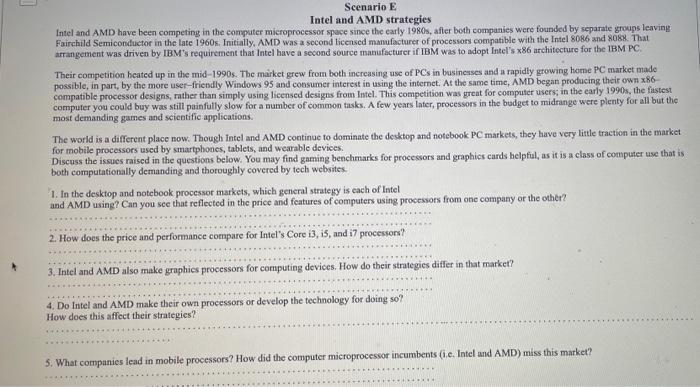
Step by Step Solution
There are 3 Steps involved in it
1 Expert Approved Answer
Step: 1 Unlock

Question Has Been Solved by an Expert!
Get step-by-step solutions from verified subject matter experts
Step: 2 Unlock
Step: 3 Unlock
 Study Help