







Question: Questions 2 through 6. I would please need help with the correct answers plus a brief explanation as to why it is that answer. Thank
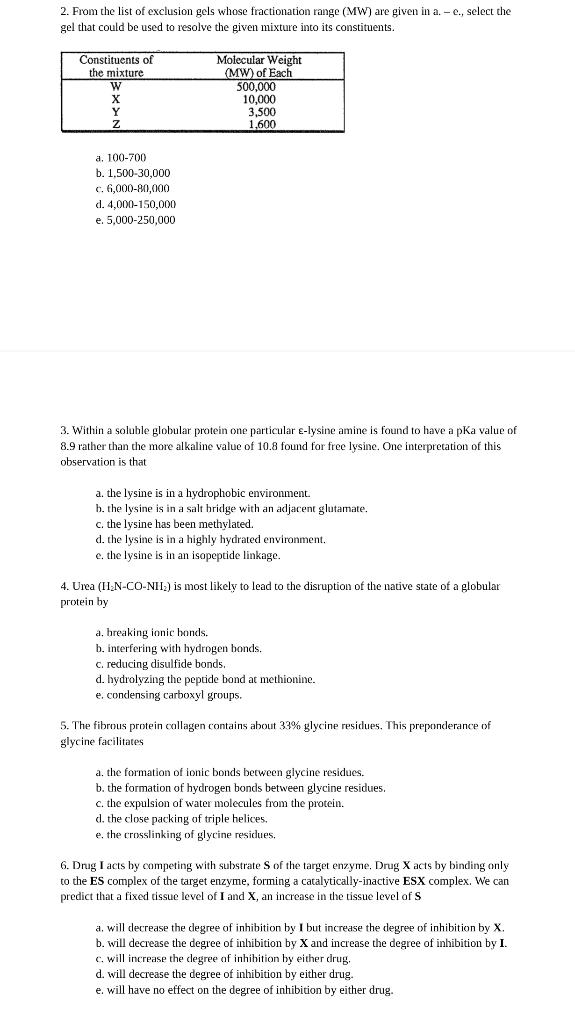
Questions 2 through 6. I would please need help with the correct answers plus a brief explanation as to why it is that answer. Thank you very much!
2. From the list of exclusion gels whose fractionation range (MW) are given in a. - e., select the gel that could be used to resolve the given mixture into its constituents. Constituents of the mixture W X Y Z Molecular Weight (MW) of Each 500.000 10,000 3.500 1,600 a. 100-700 b. 1.500-30,000 C. 6.000-80.000 d. 4,000-150,000 e. 5,000-250,000 3. Within a soluble globular protein one particular e-lysine amine is found to have a pKa value of 8.9 rather than the more alkaline value of 10.8 found for free lysine. One interpretation of this observation is that a. the lysine is in a hydrophobic environment. b. the lysine is in a salt bridge with an adjacent glutamate. c. the lysine has been methylated. d. the lysine is in a highly hydrated environment. e.the lysine is in an isopeptide linkage. 4. Urea (II:N-CO-NII:) is most likely to lead to the disruption of the native state of a globular protein by a, breaking ionic bonds. b. interfering with hydrogen bonds, C. reducing disulfide bonds. d. hydrolyzing the peptide bond at methionine. e condensing carboxyl groups. 5. The fibrous protein collagen contains about 33% glycine residues. This preponderance of glycine facilitates a. the formation of ionic bonds between glycine residues. b. the formation of hydrogen bonds between glycine residues. c. the expulsion of water molecules from the protein. d. the close packing of triple helices. e, the crosslinking of glycine residues. 6. Drug I acts by competing with substrate S of the target enzyme. Drug X acts by binding only to the ES complex of the target enzyme, forming a catalytically-inactive ESX complex. We can predict that a fixed tissue level of I and X, an increase in the tissue level of S a. will decrease the degree of inhibition by I but increase the degree of inhibition by X. b. will decrease the degree of inhibition by X and increase the degree of inhibition by I. c. will increase the clegree of inhibition by either drug. d. will decrease the degree of inhibition by either drug. e will have no effect on the degree of inhibition by either drug
Step by Step Solution
There are 3 Steps involved in it

Get step-by-step solutions from verified subject matter experts
 Study Help