







Question: Questions 2,3,4,5,6? Answer for number 1 is 0.799A u dont have to answer a,b Figure A series circuit like the circuit in (Figure 1) consists
Questions 2,3,4,5,6? Answer for number 1 is 0.799A u dont have to answer a,b
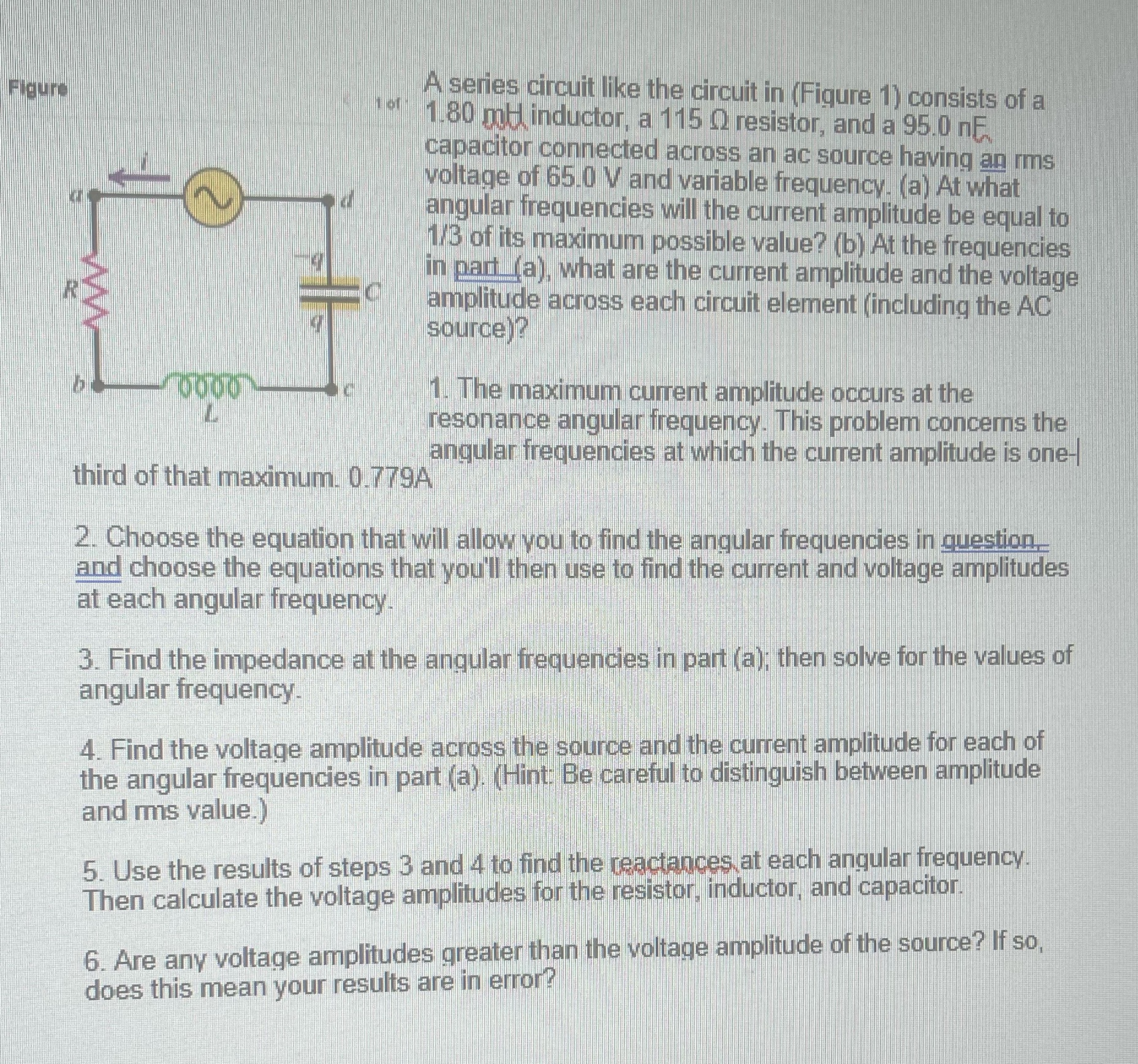
Figure A series circuit like the circuit in (Figure 1) consists of a 1.80 mH inductor, a 115 0 resistor, and a 95.0 nE capacitor connected across an ac source having an rms voltage of 65.0 V and variable frequency. (a) At what angular frequencies will the current amplitude be equal to 1/3 of its maximum possible value? (b) At the frequencies in part (a), what are the current amplitude and the voltage amplitude across each circuit element (including the AC source)? 1. The maximum current amplitude occurs at the resonance angular frequency, This problem concerns the angular frequencies at which the current amplitude is one-| third of that maximum. 0.779A 2. Choose the equation that will allow you to find the angular frequencies in question, and choose the equations that you'll then use to find the current and voltage amplitudes at each angular frequency. 3. Find the impedance at the angular frequencies in part (a); then solve for the values of angular frequency. 4. Find the voltage amplitude across the source and the current amplitude for each of the angular frequencies in part (a). (Hint: Be careful to distinguish between amplitude and rms value.) 5. Use the results of steps 3 and 4 to find the reactances at each angular frequency Then calculate the voltage amplitudes for the resistor, inductor, and capacitor. 6. Are any voltage amplitudes greater than the voltage amplitude of the source? If so, does this mean your results are in error
Step by Step Solution
There are 3 Steps involved in it

Get step-by-step solutions from verified subject matter experts
 Study Help