





Question: Questions for Discussion 1. Comment on this statement: A competitive retail sector, facing an uncertain economic future, is being challenged by consumers to compete for
Questions for Discussion 1. Comment on this
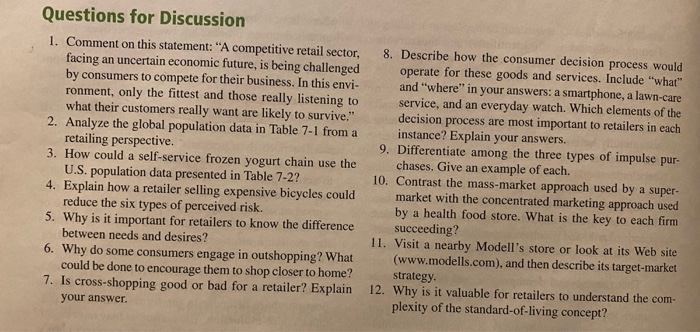
Questions for Discussion 1. Comment on this statement: "A competitive retail sector, facing an uncertain economic future, is being challenged by consumers to compete for their business. In this envi- ronment, only the fittest and those really listening to what their customers really want are likely to survive." 2. Analyze the global population data in Table 7-1 from a retailing perspective. 3. How could a self-service frozen yogurt chain use the U.S. population data presented in Table 7-2? 4. Explain how a retailer selling expensive bicycles could reduce the six types of perceived risk. 5. Why is it important for retailers to know the difference between needs and desires? 6. Why do some consumers engage in outshopping? What could be done to encourage them to shop closer to home? 7. Is cross-shopping good or bad for a retailer? Explain your answer. 8. Describe how the consumer decision process would operate for these goods and services. Include "what" and "where" in your answers: a smartphone, a lawn-care service, and an everyday watch. Which elements of the decision process are most important to retailers in each instance? Explain your answers. 9. Differentiate among the three types of impulse pur chases. Give an example of each. 10. Contrast the mass-market approach used by a super- market with the concentrated marketing approach used by a health food store. What is the key to each firm succeeding? 11. Visit a nearby Modell's store or look at its Web site (www.modells.com), and then describe its target-market strategy. 12. Why is it valuable for retailers to understand the com plexity of the standard-of-living concept? Questions for Discussion 1. Comment on this statement: "A competitive retail sector, facing an uncertain economic future, is being challenged by consumers to compete for their business. In this envi- ronment, only the fittest and those really listening to what their customers really want are likely to survive." 2. Analyze the global population data in Table 7-1 from a retailing perspective. 3. How could a self-service frozen yogurt chain use the U.S. population data presented in Table 7-2? 4. Explain how a retailer selling expensive bicycles could reduce the six types of perceived risk. 5. Why is it important for retailers to know the difference between needs and desires? 6. Why do some consumers engage in outshopping? What could be done to encourage them to shop closer to home? 7. Is cross-shopping good or bad for a retailer? Explain your answer. 8. Describe how the consumer decision process would operate for these goods and services. Include "what" and "where" in your answers: a smartphone, a lawn-care service, and an everyday watch. Which elements of the decision process are most important to retailers in each instance? Explain your answers. 9. Differentiate among the three types of impulse pur chases. Give an example of each. 10. Contrast the mass-market approach used by a super- market with the concentrated marketing approach used by a health food store. What is the key to each firm succeeding? 11. Visit a nearby Modell's store or look at its Web site (www.modells.com), and then describe its target-market strategy. 12. Why is it valuable for retailers to understand the com plexity of the standard-of-living concept

Step by Step Solution

There are 3 Steps involved in it

1 Expert Approved Answer
Step: 1 Unlock blur-text-image

Question Has Been Solved by an Expert!

Get step-by-step solutions from verified subject matter experts

Step: 2 Unlock
Step: 3 Unlock

Students Have Also Explored These Related General Management Questions!