Question: Questions for Spotify's Direct-Listing IPO (Please use document for answer) Evaluate Spotify's past financial performance. What are some of the takeaways from your analysis? CLEARY
Questions for Spotify's Direct-Listing IPO (Please use document for answer)
Evaluate Spotify's past financial performance. What are some of the takeaways from your analysis?
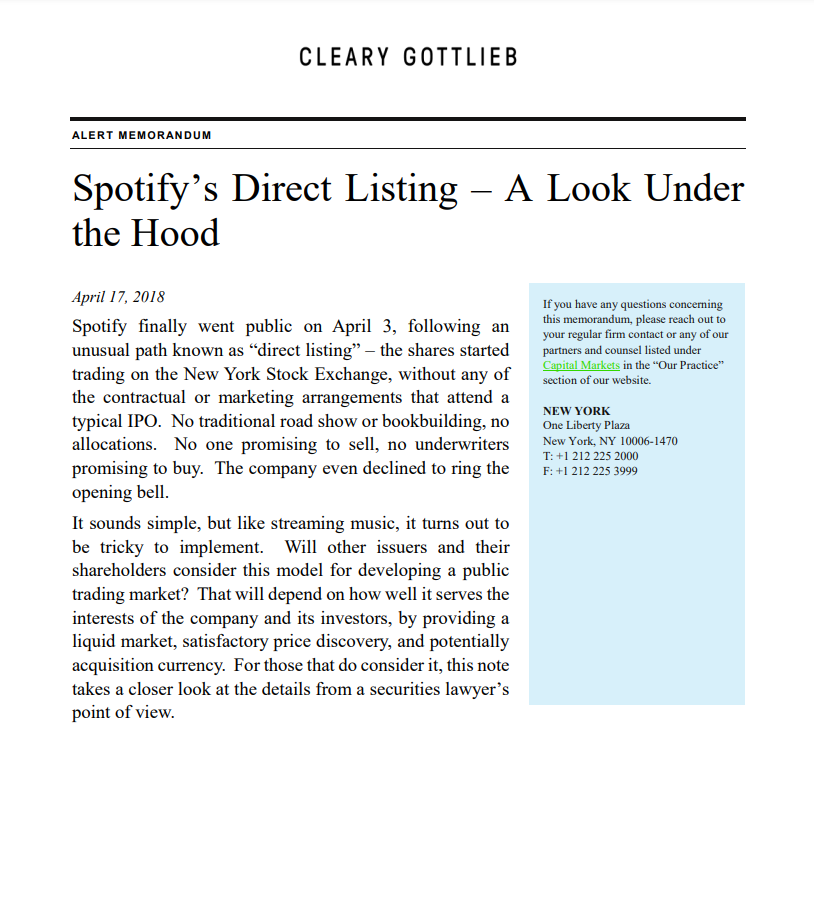
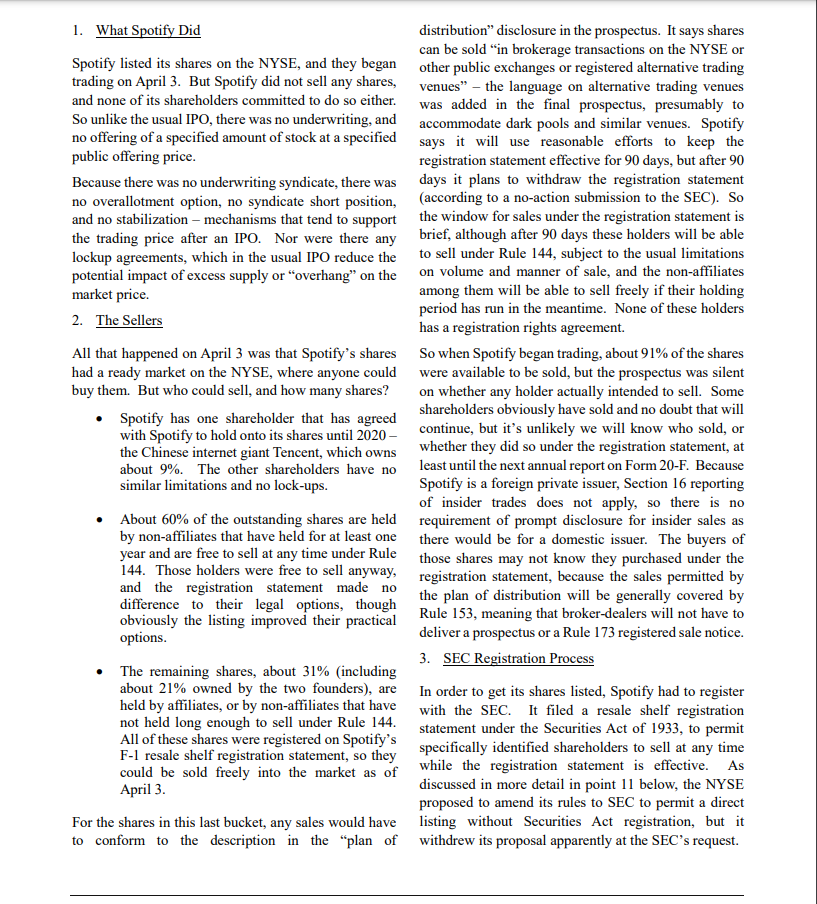
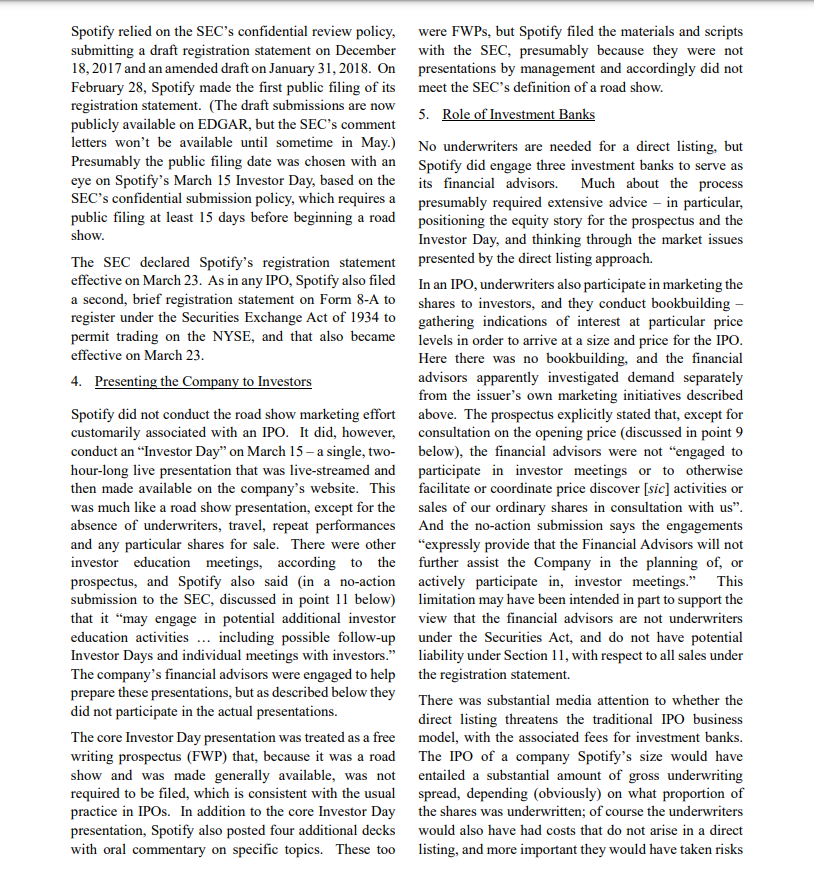
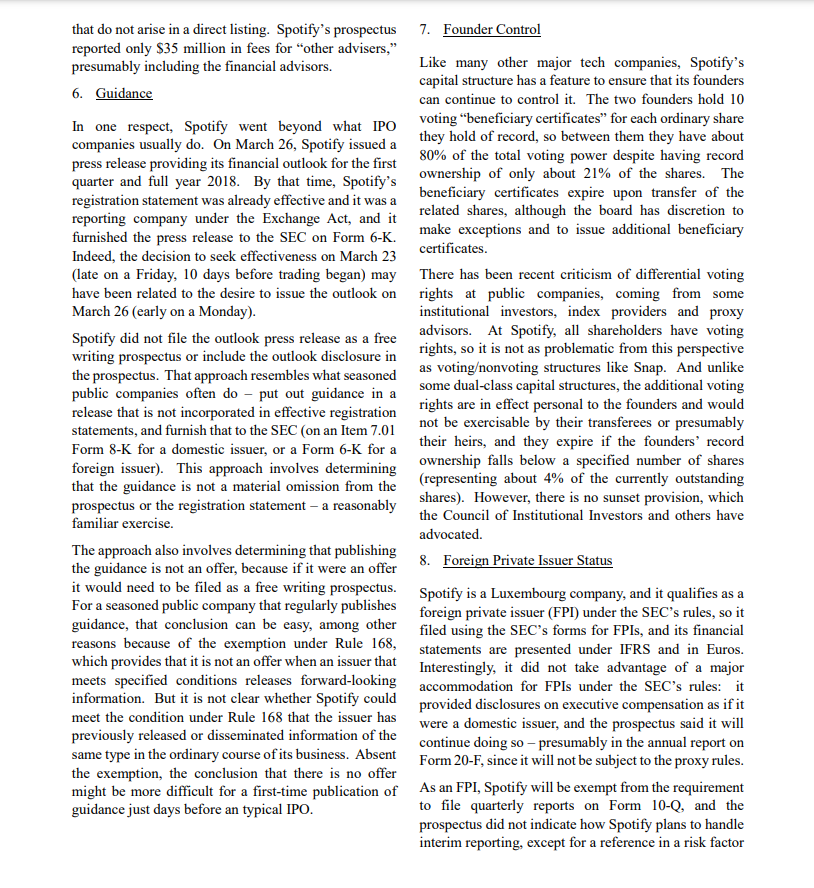
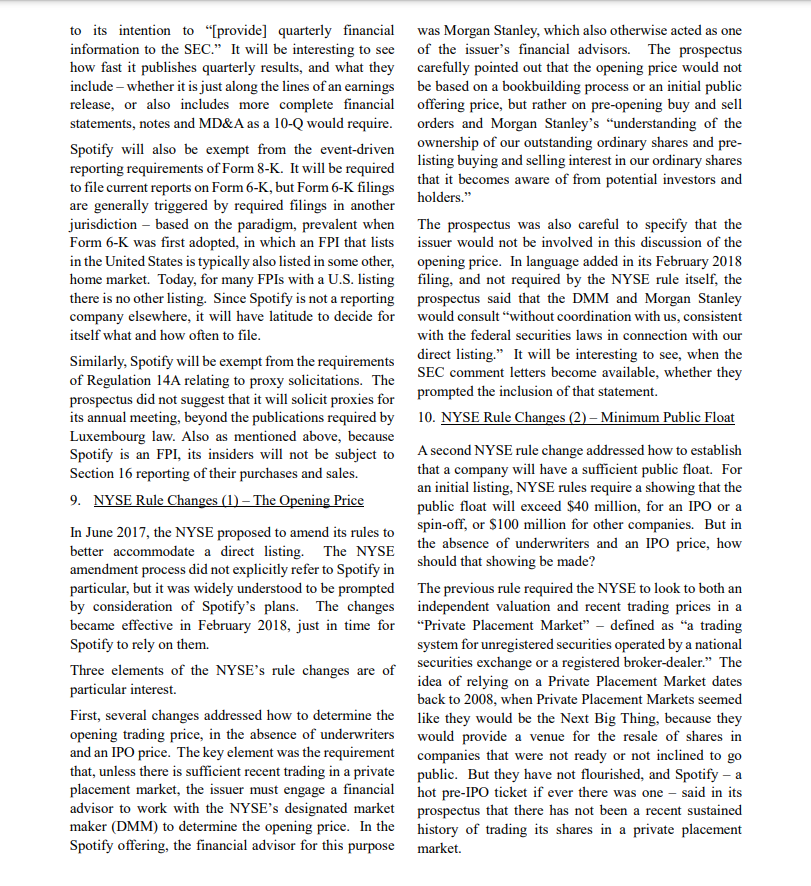
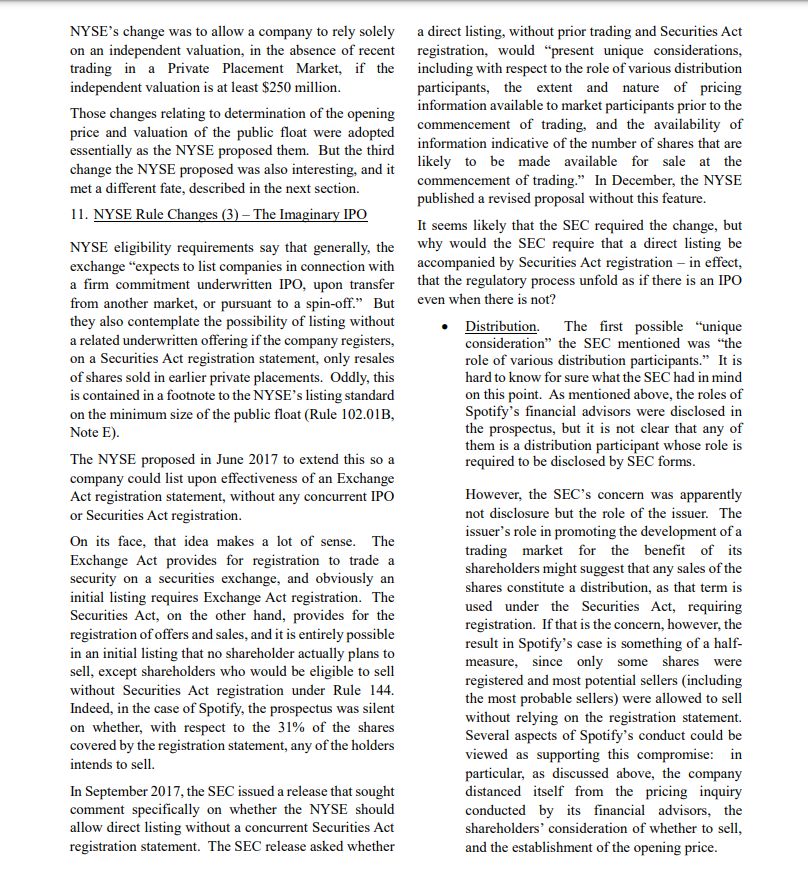
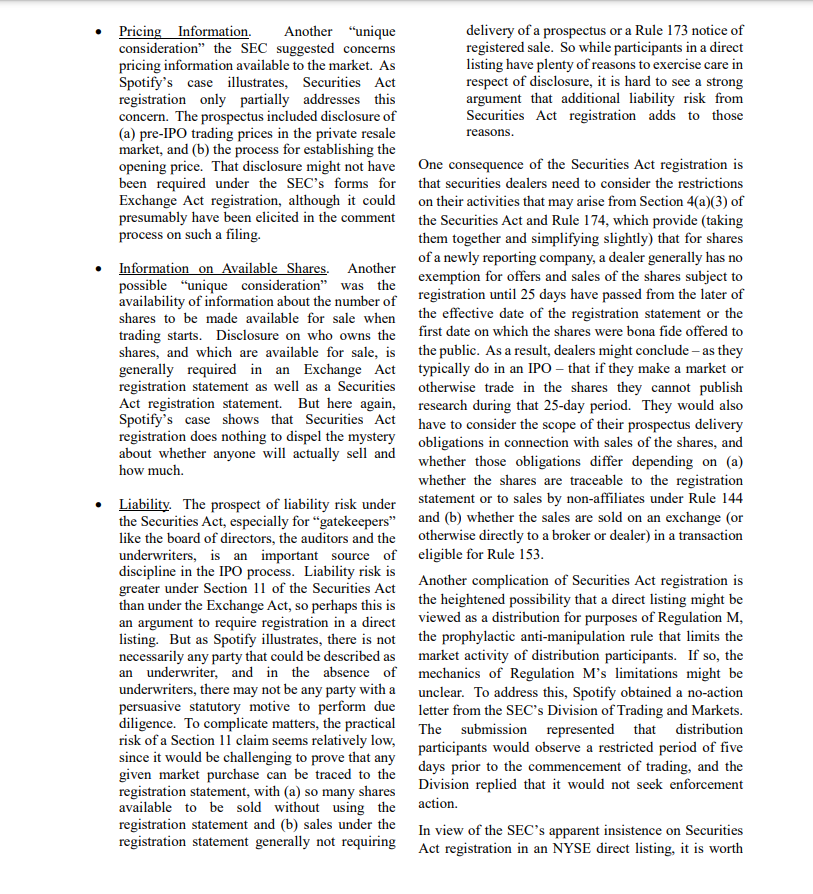
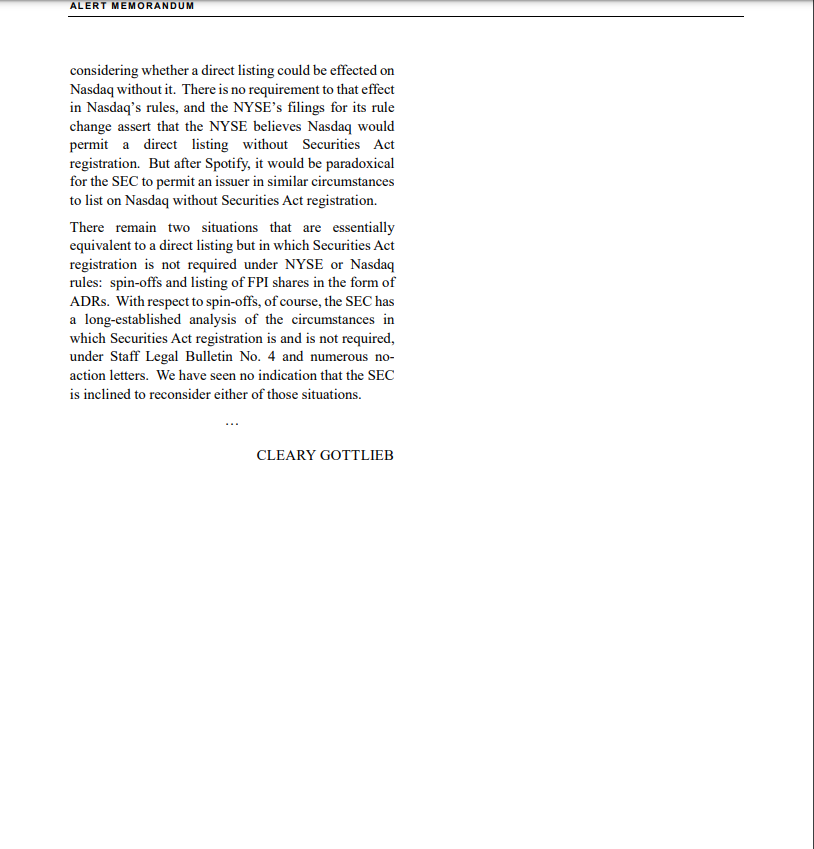
CLEARY GOTTLIEB ALERT MEMORANDUM Spotify's Direct Listing - A Look Under the Hood April 17, 2018 If you have any questions concerning Spotify finally went public on April 3, following an this memorandum, please reach out to your regular firm contact or any of our unusual path known as "direct listing" - the shares started partners and counsel listed under trading on the New York Stock Exchange, without any of Capital Markets in the "Our Practice" section of our website. the contractual or marketing arrangements that attend a NEW YORK typical IPO. No traditional road show or bookbuilding, no One Liberty Plaza allocations. No one promising to sell, no underwriters New York, NY 10006-1470 T: +1 212 225 2000 promising to buy. The company even declined to ring the F: +1 212 225 3999 opening bell. It sounds simple, but like streaming music, it turns out to be tricky to implement. Will other issuers and their shareholders consider this model for developing a public trading market? That will depend on how well it serves the interests of the company and its investors, by providing a liquid market, satisfactory price discovery, and potentially acquisition currency. For those that do consider it, this note takes a closer look at the details from a securities lawyer's point of view.1. What S i Did Spotify listed its shares on the NYSE, and they began trading on April 3. But Spotify did not sell any shares, and none of its shareholders committed to do so either. So unlike the usual [P0, there was no underwriting, and no offering of a specified amount of stock at a specied public o'ering price. Because there was no underwriting syndicate, there was no overallotment option, no syndicate short position, and no stabilization mechanisms that tend to support the trading price after an IPO. Nor were there any lockup agreements. which in the usual [PO reduce the potential impact of excess supply or \"overhang" on the market price. 2. The Sellers All that happened on April 3 was that Spotify's shares had a ready market on the NYSE, where anyone could buy them. But who could sell, and how many shares? 0 Spotify has one shareholder that has agreed with Spotify to hold onto its shares until 2020 the Chinese internet giant Tencent, which owns about 9%. The other shareholders have no similar limitations and no lockups. II About 60% of the outstanding shares are held by non-afliates that have held for at least one year and are free to sell at anytime under Rule 144. Those holders were free to sell anyway, and the registration statement made no difference to their legal options, though obviously the listing improved their practical options. a The remaining shares, about 31% {including about 21% owned by the two founders), are held by ailiates, or by nonaffiliates that have not held long enough to sell under Rule 144. All of these shares were registered on Spotify's F~1 resale shelf registration statement, so they could be sold freely into the market as of April3. For the shares in this last bucket, any sales would have to conform to the description in the I'plan of distribution" disclosure in the prospectus. It says shares can be sold \"'in brokerage transactions on the NYSE or other public exchanges or registered alternative trading venues" the language on alternative trading venues was added in the nal prospectus, presumably to accommodate dark pools and similar venues. Spotify says it will use reasonable efforts to keep the registration statement effective for 90 days. but after 90 days it plans to withdraw the registration statement (according to a nowaction submission to the SEC). So the window for sales under the registration statement is brief, although after 9|} days these holders will be able to sell under Rule 144, subject to the usual limitations on volume and manner of sale, and the non~affiliates among them will be able to sell freely if their holding period has run in the meantime. None of these holders has a registration rights agreement. So when Spotify began trading, about 9 1% of the shares were available to be sold, but the prospectus was silent on whether any holder actually intended to sell. Some shareholders obviously have sold and no doubt that will continue, but it's unlikely we will know who sold, or whether they did so under the registration statement, at least until the next annual report on Form 20F. Because Spotify is a foreign private issuer, Section 16 reporting of insider trades does not apply, so there is no requirement of prompt disclosure for insider sales as there would be for a domestic issuer. The buyers of those shares may not know they purchased under the registration statement, because the sales permitted by the plan of distribution will be generally covered by Rule 153, meaning that broker-dealers will not have to delivera prospectus or a Rule 173 registered sale notice. 3. SEC Registration Process In order to get its shares listed, Spotify had to register with the SEC. It led a resale shelf registration statement under the Securities Act of 1933, to permit specifically identied shareholders to sell at any time while the registration statement is effective. As discussed in more detail in point 11 below, the NYSE proposed to amend its rules to SEC to permit a direct listing without Securities Act registration, but it withdrew its proposal apparently at the SEC's request. Spotify relied on the SEC's condential review policy, suhrnitting a draft registration statement on December 18,2013" andanarnendeddraonJanuary3l,2[HS. On February 28, Spotify made the first public filing of its registration statement. (The draft submissions are now publicly available on EDGAR, but the SEC's comment letters won't be available until sometime in May.) Presumably the public ling date was chosen with an eye on Spotify's March 15 Investor Day, based on the SBC's confidential submission policy, which requires a public ling at least 15 days before beginning a road show. The SEC declared Spotify's registration statement effective on March 23-. As in any [P0, Spotify also filed a second, brief registration statement on Form SHA to register under the Securities Exchange Act of 1934 to permit trading on the NYSE, and that also became effective on March 23. 4. Presenting the Cow to Investors Spotify did not conduct the road show marketing effort customarily associated with an IPO. It did, however, conduct an \"Investor Day" on March [5 a single, two~ hourvlong live presentation that was livestreamed and then made available on the company's website. This was much like a road show presentation, except for the absence of underwriters, travel, repeat performances and any particular shares for sale. There were other investor education meetings, according to the prospectus, and Spoti'f'y also said (in a no~action submission to the SEC, discussed in point 11 below) that it \"may engage in potential additional investor education activities including possible followvup Investor Days and individual meetings with investors." The company's nancial advisors were engaged to help prepare these presentations, but as described below they did not participate in the actual presentations. The core Investor Day presentation was treated as a free writing prospectus (FWP) that, because it was a road show and was made generally available, was not required to be filed, which is consistent with the usual practice in [POs. In addition to the core Investor Day presentation, Spotify also posted four additional decks with oral commentary on specic topics. These too were FWPs, but Spotify filed the materials and scripts with the SEC, presumably because they were not presentations by management and accordingly did not meet the SEC's denition of a road show. 5. Role o'FInvestment Banks No underwriters are needed for a direct listing, but Spotify did engage three investment banks to serve as its financial advisors. Much about the process presumably required extensive advice in particular. positioning the equity story for the prospectus and the Investor Day, and thinking through the market issues presentedby the direct listing approach. In an IPO, underwriters also participate in marketing the shares to investors, and they conduct bookbuilding gathering indications of interest at particular price levels in order to arrive at a size and price for the [PO. Here there was no bookbuilding, and the nancial advisors apparently investigated demand separately from the issuer's own marketing initiatives described above. The prospectus explicitly stated that, except for consultation on the opening price (discussed in point 9 below), the nancial advisors were not \"engaged to participate in investor meetings or to otherwise facilitate or coordinate price discover [sic] activities or sales of our ordinary shares in consultation with us". And the no~action submission says the engagements \"expressly provide that the Financial Advisors will not further assist the Company in the planning of, or actively participate in, investor meetings." This limitation may have been intended in part to support the view that the nancial advisors are not underwriters under the Securities Act, and do not have potential liability under Section 1 i, with respect to all sales under the registration statement. There was substantial media attention to whether the direct listing threatens the traditional [PO business model, with the associated fees for investment banks. The 1P0 of a company Spotify's size would have entailed a substantial amount of gross underwriting spread, depending (obviously) on what proportion of the shares was underwritten; of course the underwriters would also have had costs that do not arise in a direct listing, and more important they would have taken risks that do not arise in a direct listing. Spotify's prospectus 7. Founder Control reported only $35 million in fees for "other advisers," presumably including the financial advisors. Like many other major tech companies, Spotify's capital structure has a feature to ensure that its founders 6. Guidance can continue to control it. The two founders hold 10 In one respect, Spotify went beyond what IPO voting "beneficiary certificates" for each ordinary share companies usually do. On March 26, Spotify issued a they hold of record, so between them they have about press release providing its financial outlook for the first 80% of the total voting power despite having record quarter and full year 2018. By that time, Spotify's ownership of only about 21% of the shares. The registration statement was already effective and it was a beneficiary certificates expire upon transfer of the reporting company under the Exchange Act, and it related shares, although the board has discretion to furnished the press release to the SEC on Form 6-K. make exceptions and to issue additional beneficiary Indeed, the decision to seek effectiveness on March 23 certificates. (late on a Friday, 10 days before trading began) may There has been recent criticism of differential voting have been related to the desire to issue the outlook on rights at public companies, coming from some March 26 (early on a Monday). institutional investors, index providers and proxy Spotify did not file the outlook press release as a free advisors. At Spotify, all shareholders have voting writing prospectus or include the outlook disclosure in rights, so it is not as problematic from this perspective the prospectus. That approach resembles what seasoned as votingonvoting structures like Snap. And unlike public companies often do - put out guidance in a some dual-class capital structures, the additional voting release that is not incorporated in effective registration rights are in effect personal to the founders and would statements, and furnish that to the SEC (on an Item 7.01 not be exercisable by their transferees or presumably Form 8-K for a domestic issuer, or a Form 6-K for a their heirs, and they expire if the founders' record foreign issuer). This approach involves determining ownership falls below a specified number of shares that the guidance is not a material omission from the (representing about 4% of the currently outstanding prospectus or the registration statement - a reasonably shares). However, there is no sunset provision, which familiar exercise the Council of Institutional Investors and others have advocated. The approach also involves determining that publishing the guidance is not an offer, because if it were an offer 8. Foreign Private Issuer Status it would need to be filed as a free writing prospectus. Spotify is a Luxembourg company, and it qualifies as a For a seasoned public company that regularly publishes foreign private issuer (FPI) under the SEC's rules, so it guidance, that conclusion can be easy, among other filed using the SEC's forms for FPIs, and its financial reasons because of the exemption under Rule 168, statements are presented under IFRS and in Euros. which provides that it is not an offer when an issuer that Interestingly, it did not take advantage of a major meets specified conditions releases forward-looking accommodation for FPIs under the SEC's rules: it information. But it is not clear whether Spotify could provided disclosures on executive compensation as if it meet the condition under Rule 168 that the issuer has were a domestic issuer, and the prospectus said it will previously released or disseminated information of the continue doing so - presumably in the annual report on same type in the ordinary course of its business. Absent Form 20-F, since it will not be subject to the proxy rules. the exemption, the conclusion that there is no offer might be more difficult for a first-time publication of As an FPI, Spotify will be exempt from the requirement guidance just days before an typical IPO. to file quarterly reports on Form 10-Q, and the prospectus did not indicate how Spotify plans to handle interim reporting, except for a reference in a risk factorto its intention to \"[provide] quarterly nancial information to the SEC." It will be interesting to see how fast it publishes quarterly results, and what they include whether it isjust along the lines ot'an earnings release, or also includes more complete fmancial statements, notes and MA as a lOQ would require. Spotify will also be exempt from the event~driven reporting requirements of Form 8K. It will be required to le current reports on Form 6~K, but Fortn 6K lings are generally triggered by required filings in another jurisdiction based on the paradigm, prevalent when Form 6~K was first adopted, in which an FPI that lists in the United States is typically also listed in some other, home market. Today, for many FPIs with a US. listing there is no other listing. Since Spotify is not a reporting company elsewhere, it will have latitude to decide for itselfwhat and how often to le. S imilarly, Spotify will be exempt JErom the requirements of Regulation 14A relating to proxy solicitations. The prospectus did not suggest that it will solicit proxies for its annual meeting, beyond the publications required by Luxembourg law. Also as mentioned above, because Spotify is an FPI, its insiders will not be subject to Section 16 reporting oftheir purchases and sales. 9. NYSE Rule Changes (1] The Opening Price In June 2017, the NYSE proposed to amend its rules to better accommodate a direct listing. The NYSE amendment process did not explicitly refer to Spotify in particular, but it was widely understood to be prompted by consideration of Spotify's plans. The changes became effective in February 2018, just in time for Spotify to rely on them. Three elements of the NYSE's rule changes are of particular interest. First, several changes addressed how to determine the opening trading price, in the absence of underwriters and an IPO price. The key element was the requirement that, unless there is sufficient recent trading in a private placement market, the issuer must engage a f'mancial advisor to work with the NYSE's designated market maker [DMM} to determine the opening price. In the Spotify offering, the fmancial advisor for this purpose was Morgan Stanley. which also otherwise acted as one of the issuer's financial advisors. The prospectus careilly pointed out that the opening price would not be based on a bookbuilding process or an initial public offering price, but rather on prevopening buy and sell orders and Morgan Stanley's \"understanding of the ownership of our outstanding ordinary shares and pre listing buying and selling interest in our ordinary shares that it becomes aware of om potential investors and holders." The prospectus was also careful to specify that the issuer would not be involved in this discussion of the opening price. In language added in its February 2018 filing, and not required by the NYSE rule itself. the prospectus said that the DMM and Morgan Stanley would consult \"without coordination with us, consistent with the federal securities laws in connection with our direct listing." It will be interesting to see, when the SEC comment letters become available. whether they prompted the inclusion of that statement. 10. NYSE Rule Changes {2) Minimum Public Float A second NYSE rule change addressed how to establish that a company will have a suicient public float. For an initial listing, NYSE l'lllCS require a showing that the public oat will exceed $40 million, for an IPO or a spinwo', or $100 million for other companies. But in the absence of underwriters and an [PO price, how should that showing be made? The previous rule required the NYSE to look to both an independent valuation and recent trading prices in a \"Private Placement Market" defined as \"a trading system for unregistered securities operated by a national securities exchange or a registered brokerdealer." The idea of relying on a Private Placement Market dates back to 2008. when Private Placement Markets seemed like they would be the Next Big Thing, because they would provide a venue for the resale of shares in companies that were not ready or not inclined to go public. But they have not ourished, and Spotify a hot pre-[PO ticket if ever there was one said in its prospectus that there has not been a recent sustained history of trading its shares in a private placement market. NYSE's change was to allow a company to rely solely on an independent valuation, in the absence of recent trading in a Private Placement Market, if the independent valuation is at least $250 million. Those changes relating to determination ofthe opening price and valuation of the public oat were adopted essentially as the NYSE proposed them But the third change the NYSE proposed was also interesting. and it met a different fate, described in the next section. II. NYSE Rule Changes (3] The Imaginary [PO NYSE eligibility requirements say that generally, the exchange \"expects to list companies in connection with a firm commitment underwritten [P0, upon transfer om another market, or pursuant to a spin-off.\" But they also contemplate the possibility of listing without a related underwritten o'ering ifthe company registers, on a Securities Act registration statement, only resales of shares sold in earlier private placements. Oddly, this is contained in a footnote to the NYSE's listing standard on the minimum size ofthe public float (Rule 102.013, Note E). The NYSE proposed in June 2017 to extend this so a company could list upon effectiveness of an Exchange Act registration statement, without any conciu'rent I'PO or Securities Act registration. On its face. that idea makes a lot of sense. The Exchange Act provides for registration to trade a security on a securities exchange, and obviously an initial listing requires Exchange Act registration. The Securities Act, on the other hand, provides for the registration of offers and sales, and it is entirely possible in an initial listing that no shareholder actually plans to sell. except shareholders who would be eligible to sell without Securities Act registration under Rule 144. Indeed, in the case ofSpotify, the prospectus was silent on whether, with respect to the 31% of the shares covered by the registration statement, any of the holders intends to sell. In September 201?, the SEC issued a release that sought comment specically on whether the NYSE should allow direct listing without a concurrent Securities Act registration statement. The SEC release asked whether a direct listing, without prior trading and Securities Act registration. would \"present unique considerations. including with respect to the role of various distribution participants, the extent and nature of pricing information available to market participants prior to the commencement of trading, and the availability of information indicative of the number of shares that are likely to be made available for sale at the commencement of trading." In December, the NYSE published a revised proposal without this feature. It seems likely that the SEC required the change, but why would the SEC require that a direct listing be accompanied by Securities Act registration in effect, that the regulatory process unfold as if there is an [PO even when there is not? a Distribution. The rst possible \"unique consideration\" the SEC mentioned was \"the role of various distribution participants." It is hard to know for sure what the SEC had in mind on this point. As mentioned above, the roles of Spotify's nancial advisors were disclosed in the prospectus, but it is not clear that any of them is a distribution participant whose role is required to be disclosed by SEC forms. However, the SEC's concern was apparently not disclosure but the role of the issuer. The issuer's role in promoting the development of a trading market for the benet of its shareholders might suggest that any sales of the shares constitute a distribution, as that term is used under the Securities Act, requiring registration. If that is the concern, however. the result in Spotify's case is something ofa half measure, since only some shares were registered and most potential sellers (including the most probable sellers) were allowed to sell without relying on the registration statement. Several aspects of Spotify's conduct could be viewed as supporting this compromise: in particular, as discussed above, the company distanced itself from the pricing inquiry conducted by its financial advisors, the shareholders' consideration of whether to sell. and the establishment ofthe opening price. Pricing Information. Another \"unique consideration\" the SEC suggested concerns pricing information available to the market. As Spotify's case illustrates, Securities Act registration only partially addresses this concern. The prospectus included disclosure of (a) preIPO trading prices in the private resale market, and (b) the process for establishing the opening price. That disclosure might not have been required under the SEC's forms for Exchange Act registration, although it could presumably have been elicited in the comment process on such a filing. Information on Available Shares. Another possible \"unique consideration" was the availability of information about the number of shares to be made available for sale when trading starts. Disclosure on who owns the shares, and which are available for sale. is generally required in an Exchange Act registration statement as well as a Secm'ities Act registration statement. But here again, Spotify's case shows that Securities Act registration does nothing to dispel the mystery about whether anyone will actually sell and how much. Liability. The prospect of liability risk under the Securities Act, especially JFor \"gatekeepers" like the board of directors, the auditors and the underwriters, is an im t source of discipline in the [PO process. Liability risk is greater under Section 11 of the Securities Act than under the Exchange Act, so perhaps this is an argument to require registration in a direct listing. But as Spotify illustrates, there is not necessarily any party that could be described as an underwriter. and in the absence of underwriters, there may not be any party with a persuasive statutory motive to perform due diligence. To complicate matters, the practical risk ofa Section 11 claim seems relatively low, since it would be challenging to prove that any given market purchase can be traced to the registration statement, with (a) so many shares available to be sold without using the registration statement and (b} sales under the registration statement generally not requiring delivery ofa prospectus or a Rule 173 notice of registered sale. So while participants in a direct listing have plenty of reasons to exercise care in respect of disclosure, it is hard to see a strong argument that additional liability risk from Securities Act registration adds to those reasons. One consequence of the Securities Act registration is that securities dealers need to consider the restrictions on their activities that may arise from Section 4(a)(3) of the Securities Act and Rule 174. which provide (taking them together and simplifying slightly} that for shares of a newly reporting company, a dealer generally has no exemption for offers and sales of the shares subject to registration until 25 days have passed from the later of the effective date of the registration statement or the first date on which the shares were bona de offered to the public. As a result, dealers might conclude as they typically do in an [PO that ifthey make a market or otherwise trade in the shares they cannot publish research during that ZS'day period. They would also have to consider the scope of their prospectus delivery obligations in connection with sales of the shares. and whether these obligations differ depending on {a} whether the shares are traceable to the registration statement or to sales by non~ailiates under Rule 144 and (b) whether the sales are sold on an exchange {or otherwise directly to a broker or dealer) in a transaction eligible for Rule 153. Another complication of Securities Act registration is the heightened possibility that a direct listing might be viewed as a distribution for purposes of Regulation M. the prophylactic antiwmanipulation rule that limits the market activity of distribution participants. If so, the mechanics of Regulation M's limitations might be unclear. To address this, Spotify obtained a no-action letter fromthe SEC's Division of Trading and Markets. The submission represented that distribution participants would observe a restricted period of five days prior to the commencement of trading, and the Division replied that it would not seek enforcement action. In view of the SEC's apparent insistence on Securities Act registration in an NYSE direct listing, it is worth considering whether a direct listing could be effected on Nasdaq without it. There is no requirement to that e'FFect in Nasdaq's rules, and the NYSE's lings for its rule change assert that the NYSE believes Nasdaq would permit a direct listing without Securities Act registration. But aer Spotify, it would he paradoxical for the SEC to permit an issuer in similar circumstances to list on Nasdaq without Securities Act registration. There remain two situations that are essentially equivalent to a direct listing but in which Securities Act registration is not required under NYSE or Nasdaq rules: spin-offs and listing of FPI shares in the form of ADRs. With respect to spin-offs, of course, the SEC has a long-established analysis of the circumstances in which Securities Act registration is and is not required, under Staff Legal Bulletin No. 4 and numerous no~ action letters. We have seen no indication that the SEC is inclined to reconsider either of those situations. CLEARY GOTTL [EB
Step by Step Solution
There are 3 Steps involved in it
1 Expert Approved Answer
Step: 1 Unlock
Question Has Been Solved by an Expert!
Get step-by-step solutions from verified subject matter experts
Step: 2 Unlock
Step: 3 Unlock
Students Have Also Explored These Related Accounting Questions!









 Study Help