







Question: Questions from case study (Case study below) Assume that you have been hired as a marketing consultant by Muller's Farm. 1. Prepare a one-year (2023)
Questions from case study (Case study below)
Assume that you have been hired as a marketing consultant by Muller's Farm. 1. Prepare a one-year (2023) IMC plan for Muller's Farm. 2. As part of the plan identify and briefly profile three (3) target audiences for Muller's Farm. Please note your IMC plan must be directed towards these three target audience groups.
Case study: Muller's Farm
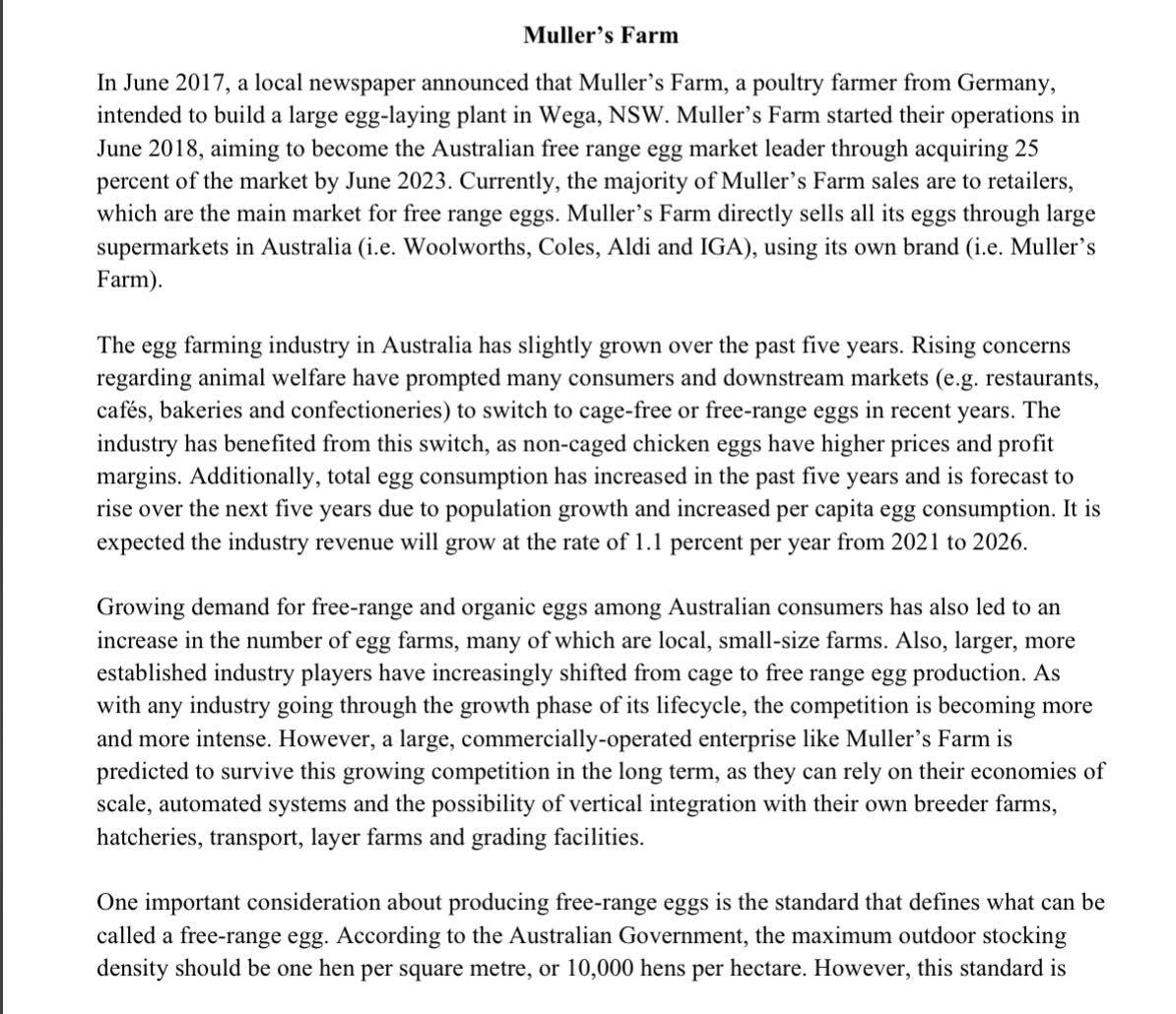
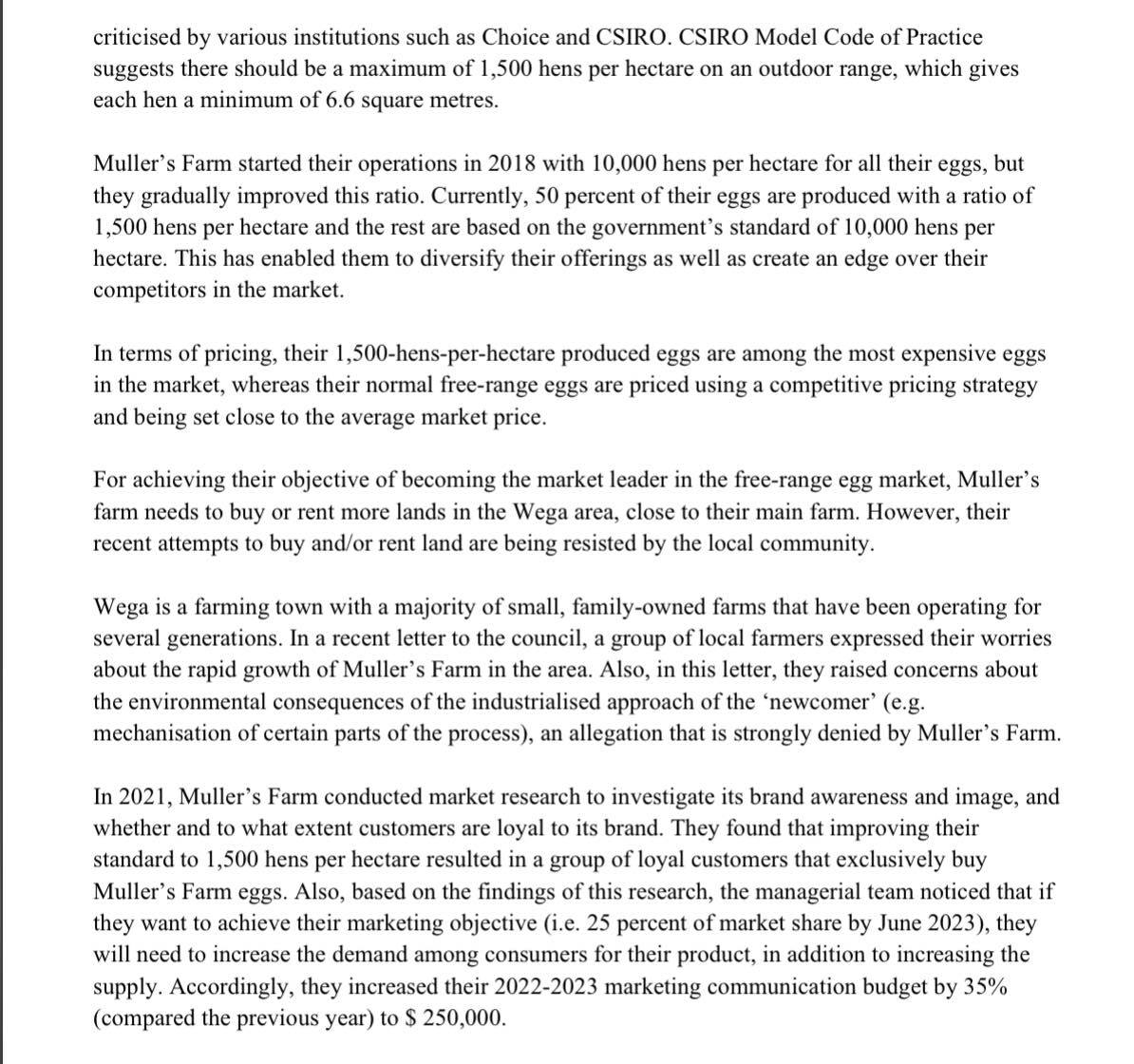
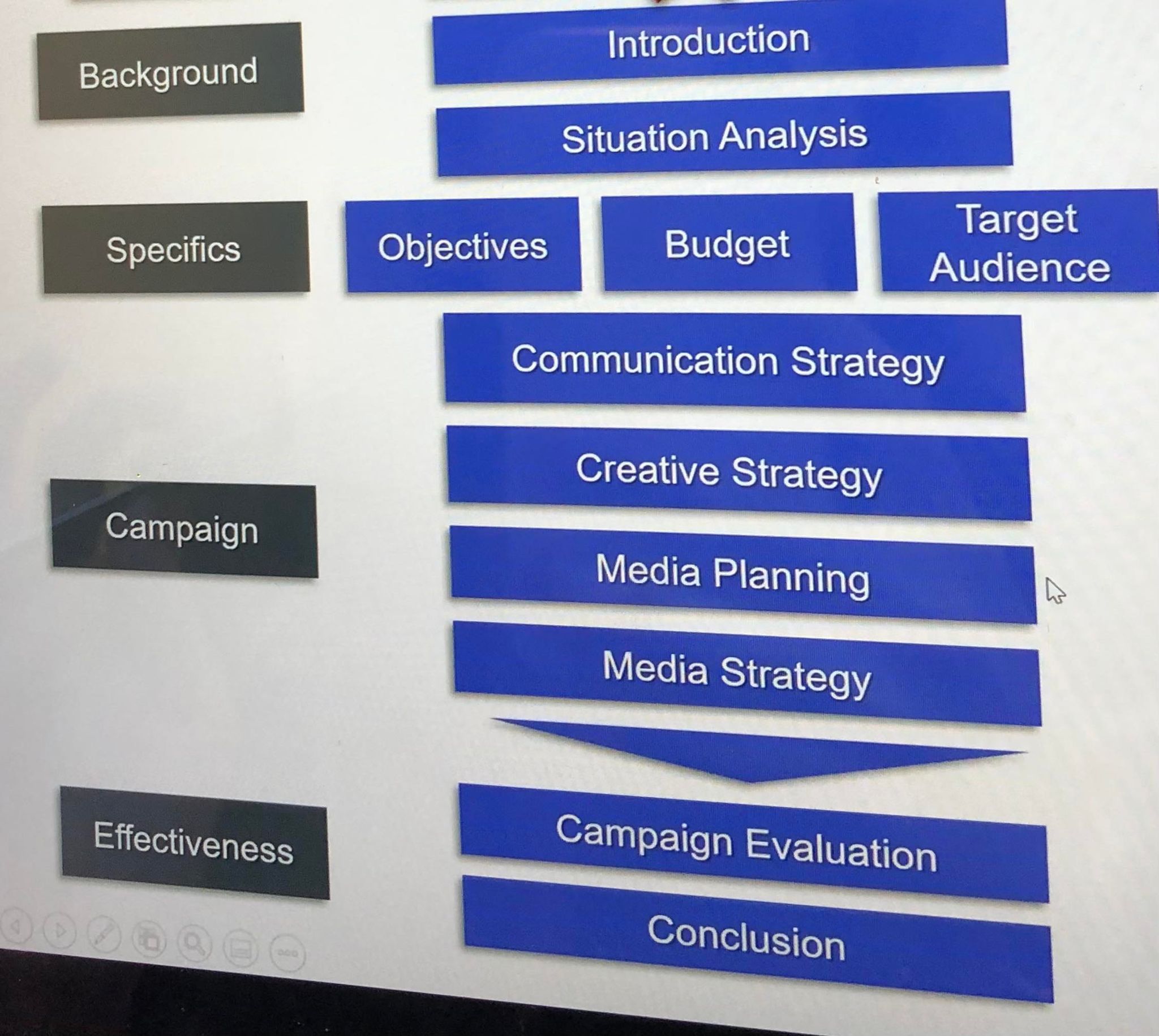
Muller's Farm In June 2017, a local newspaper announced that Muller's Farm, a poultry farmer from Germany, intended to build a large egg-laying plant in Wega, NSW. Muller's Farm started their operations in June 2018, aiming to become the Australian free range egg market leader through acquiring 25 percent of the market by June 2023. Currently, the majority of Muller's Farm sales are to retailers, which are the main market for free range eggs. Muller's Farm directly sells all its eggs through large supermarkets in Australia (i.e. Woolworths, Coles, Aldi and IGA), using its own brand (i.e. Muller's Farm). The egg farming industry in Australia has slightly grown over the past ve years. Rising concerns regarding animal welfare have prompted many consumers and downstream markets (e. g. restaurants, cafes, bakeries and confectioneries) to switch to cage-free or free-range eggs in recent years. The industry has beneted from this switch, as non-caged chicken eggs have higher prices and prot margins. Additionally, total egg consumption has increased in the past ve years and is forecast to rise over the next ve years due to population growth and increased per capita egg consumption. It is expected the industry revenue will grow at the rate of 1.! percent per year from 2021 to 2026. Growing demand for free-range and organic eggs among Australian consumers has also led to an increase in the number of egg farms, many of which are local, small-size farms. Also, larger, more established industry players have increasingly shifted from cage to free range egg production. As with any industry going through the growth phase of its lifecycle, the competition is becoming more and more intense. However, a large, commercially-operated enterprise like Muller's Farm is predicted to survive this growing competition in the long term, as they can rely on their economies of scale, automated systems and the possibility of vertical integration with their own breeder farms, hatcheries, transport, layer farms and grading facilities. One important consideration about producing free-range eggs is the standard that defines what can be called a free-range egg. According to the Australian Government, the maximum outdoor stocking density should be one hen per square metre, or 10,000 hens per hectare. However, this standard is criticised by various institutions such as Choice and CSIRO. CSIRO Model Code of Practice suggests there should be a maximum of 1,500 hens per hectare on an outdoor range, which gives each hen a minimum of 6.6 square metres. Muller's Farm started their operations in 2018 with 10,000 hens per hectare for all their eggs, but they gradually improved this ratio. Currently, 50 percent of their eggs are produced with a ratio of 1,500 hens per hectare and the rest are based on the government's standard of [0,000 hens per hectare. This has enabled them to diversify their offerings as well as create an edge over their competitors in the market. In terms of pricing, their 1,500-hens-perhectare produced eggs are among the most expensive eggs in the market, whereas their normal free-range eggs are priced using a competitive pricing strategy and being set close to the average market price. For achieving their objective of becoming the market leader in the free-range egg market, Muller's farm needs to buy or rent more lands in the Wega area, close to their main farm. However, their recent attempts to buy andfor rent land are being resisted by the local community. Wega is a fannin g town with a majority of small, family-owned farms that have been operating for several generations. In a recent letter to the council, a group of local farmers expressed their worries about the rapid growth of Muller's Farm in the area. Also, in this letter, they raised concerns about the environmental consequences of the industrialised approach of the 'newcomer' (e.g. mechanisation of certain parts of the process), an allegation that is strongly denied by Muller's Farm. In 2021, Muller's Farm conducted market research to investigate its brand awareness and image, and whether and to what extent customers are loyal to its brand. They found that improving their standard to 1,500 hens per hectare resulted in a group of loyal customers that exclusively buy Muller's Farm eggs. Also, based on the ndings of this research, the managerial team noticed that if they want to achieve their marketing objective (i.e. 25 percent of market share by J une 2023), they will need to increase the demand among consumers for their product, in addition to increasing the supply. Accordingly, they increased their 2022-2023 marketing communication budget by 35% (compared the previous year) to S 250,000. Introduction Background Situation Analysis Target Specifics Objectives Budget Audience Communication Strategy Creative Strategy Campaign Media Planning Media Strategy Effectiveness Campaign Evaluation Conclusion
Step by Step Solution
There are 3 Steps involved in it

Get step-by-step solutions from verified subject matter experts
 Study Help