







Question: QUEUEING ANALYSIS All customer inquiries will be handled by the call center. Given the demographics of the US population, your client must provide services in
QUEUEING ANALYSIS
All customer inquiries will be handled by the call center.
Given the demographics of the US population, your client must provide services in both English and Spanish. There are two options:
Configuration: This configuration retains separate queues for each language. The customers will dial a tollfree number to reach a contact center. The phone system will ask each caller to choose English or Spanish as their preferred language as soon as the call is received. The call is then routed to the queue served by the Spanishspeaking customer service representatives or to the queue that is served by Englishspeaking customer service representatives. From a customer support perspective, the customer service representatives will be monolingual ie each employee is fluent in their own spoken language and have been trained to respond to calls in that language only. These representatives are not fluent enough to assist the customers with their inquiries in a second language.
In Configuration there are practically two separate queueing systems: one for Englishspeaking callers and one for Spanishspeaking callers. Each queue receives the calls by callers in one language and the calls are served by any of the available monolingual customer service representatives.
Configuration: In this configuration, there will be only one queue, served by bilingual customer service represetatives. This requires that your client hire bilingual employees that are fluent in both English and Spanish. The contact center will ask a caller to choose their preferred language, but all incoming calls will join the same queue only to be greeted in their chosen language by a customer service representative when the customer service representative is ready to serve them.
In Configuration There is one queueing system: calls join one queue and get served by any of the bilingual customer service representatives.
You should use the following information in your analysis:
The customer service times are variable with CV This is true regardless of the type of call, the language, and the skill level of the customer service representatives.
The time between arrivals is variable and not predictable. The number of calls received is Poisson distributed hence CV This is true regardless of the type of call, the language, and the skill level of the customer service representatives.
A monolingual customer service representative responds to calls only in their spoken language.
Calls waiting in a queue will remain in the same queue until the time of service ie no reneging, no balking
The contact center has ample virtual capacityie there is no limit on the queue length
All customers are served firstcomefirstserved FCFS once they join a queue.
Each customer is expected to be served in minutes on the average.
The average call volume of Spanishspeaking customers varies by day of the week and by hour of day; the average Spanishspeaking call volume can be as high as calls per hour at any time. The average call volume of Englishspeaking customers varies by day of the week and by hour of day; the average Englishspeaking call volume can be as high as calls per hour at any time.The total call volume the total of Spanish and Englishspeaking calls received also varies by hour of day and day of week; the total call volume can be as high as calls per hour on the average at any time.
The call center will operate hours a day, covered by three hour shifts.
Your client has set the target performance at the call center: The caller's average wait time in the queue should not exceed minutes. The client has limited budget and wants to know the minimum number of customer service representatives needed to meet this target.
A The effect of variability:
Suppose the statistical distribution of time between arrivals and service times have changed. There is more variability in interarrival times and the time required to complete service for each caller. The coefficient of variation of both time between arrivals are the service times have gone up to
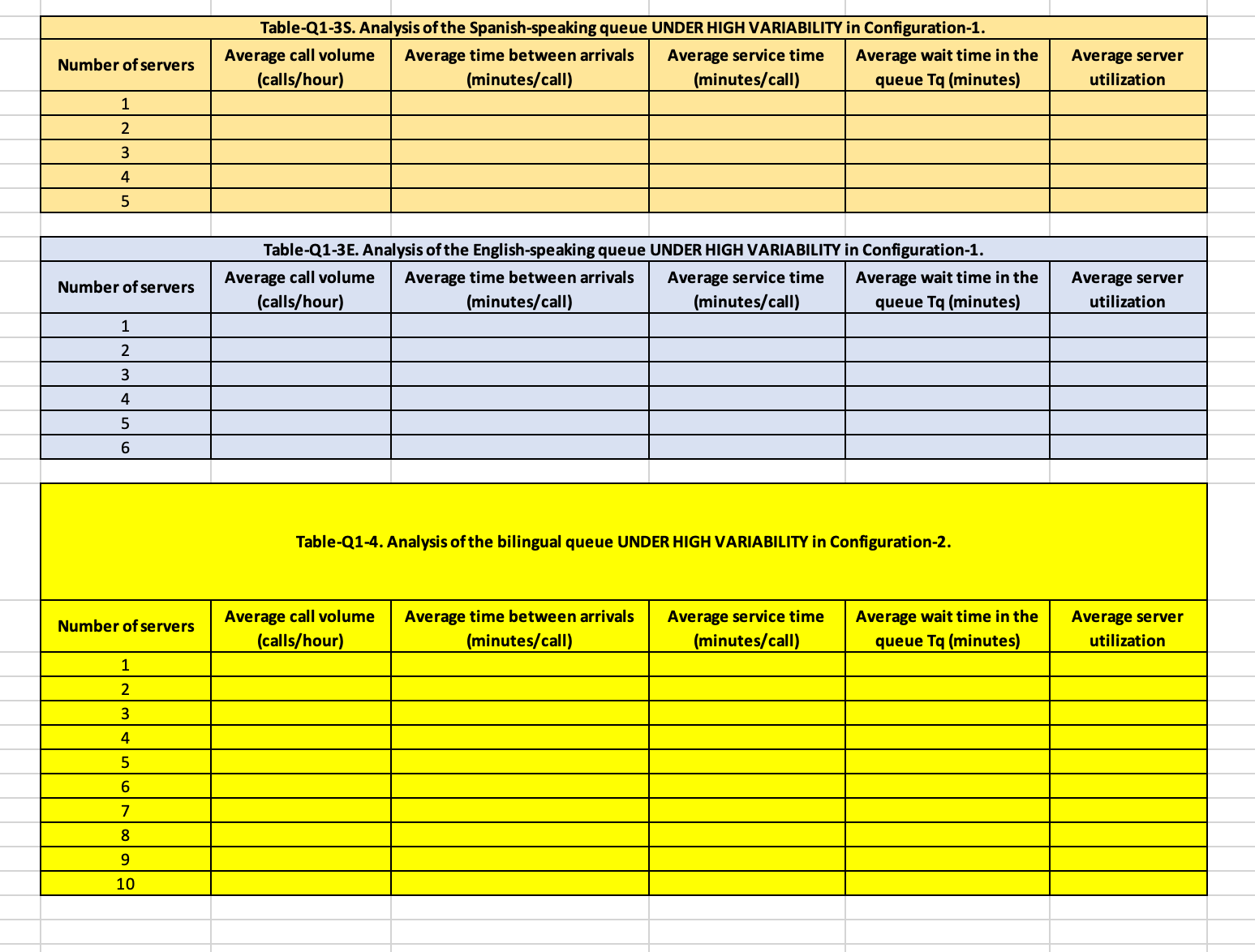
i points Complete TableQE TableQS and TableQ based on the new information.
Step by Step Solution
There are 3 Steps involved in it
1 Expert Approved Answer
Step: 1 Unlock

Question Has Been Solved by an Expert!
Get step-by-step solutions from verified subject matter experts
Step: 2 Unlock
Step: 3 Unlock
 Study Help