







Question: Quick sort ll Fido LTE 8:27 cs.sfu.ca using the insertion sort algorithm. The function should have two parameters, an array of type T (where T
 Quick sort
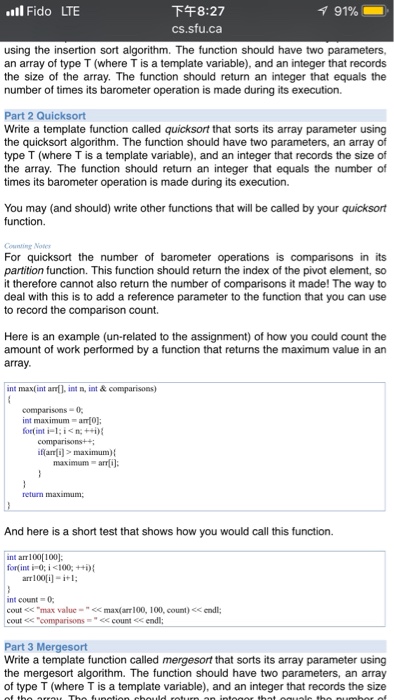
 ll Fido LTE 8:27 cs.sfu.ca using the insertion sort algorithm. The function should have two parameters, an array of type T (where T is a template variable), and an integer that records the size of the array. The function should return an integer that equals the number of times its barometer operation is made during its execution. Part 2 Quicksort Write a template function called quicksort that sorts its array parameter using the quicksort algorithm. The function should have two parameters, an array of type T (where T is a template variable), and an integer that records the size of the array. The function should return an integer that equals the number of times its barometer operation is made during its execution. You may (and should) write other functions that will be called by your quicksort function. Counting Notes For quicksort the number of barometer operations is comparisons in its partition function. This function should return the index of the pivot element, so it therefore cannot also return the number of comparisons it made! The way to deal with this is to add a reference parameter to the function that you can use to record the comparison count. Here is an example (un-related to the assignment) of how you could count the amount of work performed by a function that returns the maximum value in an array int max(int arr(], int n, int & Comparisons) int maximum-am[0)]; ammaximum) maximum - ari: return maximum And here is a short test that shows how you would call this function. int arr 100[100) fortin, i-o; i
Step by Step Solution
There are 3 Steps involved in it

Get step-by-step solutions from verified subject matter experts
 Study Help