







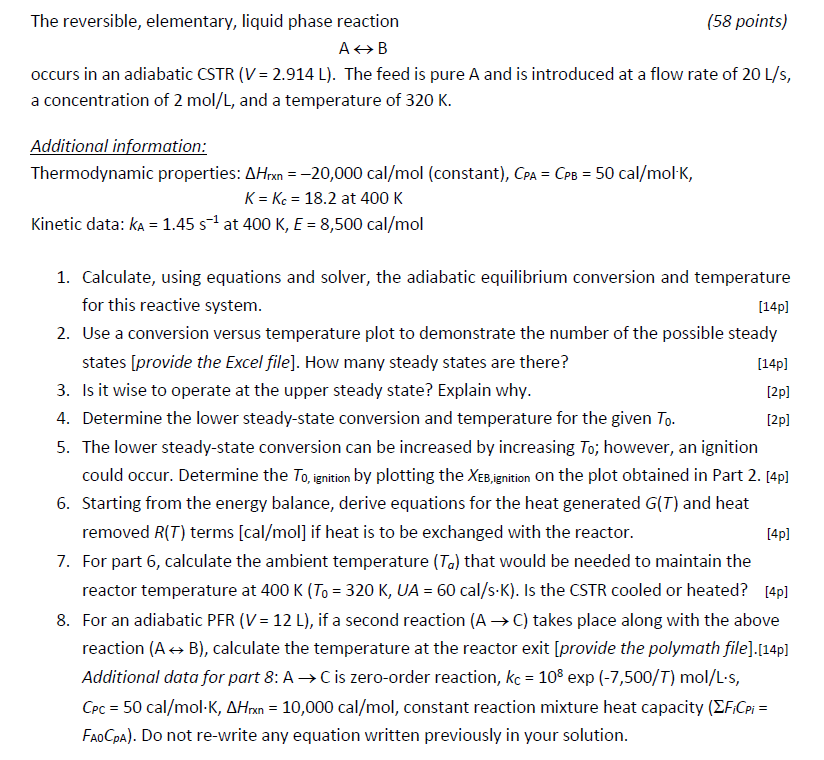
Question: reactor design The reversible, elementary, liquid phase reaction (58 points) AB occurs in an adiabatic CSTR (V = 2.914 L). The feed is pure A
 reactor design
The reversible, elementary, liquid phase reaction (58 points) AB occurs in an adiabatic CSTR (V = 2.914 L). The feed is pure A and is introduced at a flow rate of 20 L/s, a concentration of 2 mol/L, and a temperature of 320 K. Additional information: Thermodynamic properties: AHrxn=-20,000 cal/mol (constant), CPA = CPB = 50 cal/mol K, K = Kc = 18.2 at 400 K Kinetic data: ka = 1.45 s + at 400 K, E = 8,500 cal/mol 1. Calculate, using equations and solver, the adiabatic equilibrium conversion and temperature for this reactive system. (14p] 2. Use a conversion versus temperature plot to demonstrate the number of the possible steady states (provide the Excel file). How many steady states are there? (14p] 3. Is it wise to operate at the upper steady state? Explain why. [2p] 4. Determine the lower steady-state conversion and temperature for the given To. [2p] 5. The lower steady-state conversion can be increased by increasing To; however, an ignition could occur. Determine the To, ignition by plotting the XEB,ignition on the plot obtained in Part 2. [4] 6. Starting from the energy balance, derive equations for the heat generated G(T) and heat removed R(T) terms [cal/mol) if heat is to be exchanged with the reactor. [4] 7. For part 6, calculate the ambient temperature (Ta) that would be needed to maintain the reactor temperature at 400 K (T. = 320 K, UA = 60 cal/s-K). Is the CSTR cooled or heated? [4p] 8. For an adiabatic PFR (V = 12 L), if a second reaction (A C) takes place along with the above reaction (A + B), calculate the temperature at the reactor exit (provide the polymath file).[140] Additional data for part 8: AC is zero-order reaction, kc = 108 exp(-7,500/T) mol/L's, Cpc = 50 cal/mol-K, AHrxn = 10,000 cal/mol, constant reaction mixture heat capacity (EFCpi = FAOCpa). Do not re-write any equation written previously in your solution
Step by Step Solution
There are 3 Steps involved in it

Get step-by-step solutions from verified subject matter experts
 Study Help