Question: Read, analyze, reflect, and then write a 3-4page response. Read the attached Case Study describing when Mark Hurd became CEO of Hewlett Packard (HP) in
Read, analyze, reflect, and then write a 3-4page response. Read the attached Case Study describing when Mark Hurd became CEO of Hewlett Packard (HP) in 2005. Based on the information given in the attached over as article:1)From Exhibit 1.1, page 5of our textbook(Williams, 2019), describes how Mark Hurd used the four functions of management to reorganize and structure HP? 2)There are several approaches to understanding leadership in organizations. These approaches are complementary and consider different aspects of effective leadership. Based on this article, identify 3leadership traits, as identified in our textbook (Williams, 2019, pg. 308-310)demonstrated by Hurd. Be sure and support your argument with examples from the article.Of the two leadership behaviors discussed in our textbook(Williams, 2019, p. 311), which was Hurds predominant leadership behavior? Support your argument with information from the article. What is transformational leadership(Williams, 2019, p. 327)? Was Hurd a transformational leader? Why or why not? Be specific supporting your argument with the information given in the article.
Management Functions
Planning involves determining organizational goals and a means for achieving them.
Organizing is decided where decisions will be made, who will do what job and tasks, and who will work for whom in the company. In other words, organizing is about to determine how things get done.
Leading involves inspiring and motivating workweek to work hard to achieve organizational goals.
Controlling is monitoring progress toward goal achievement and taking corrective action when progress isnt made.
Leadership Traits
Drive: High levels of effort characterized by achievement, motivation, initiative, energy, and tenacity.
Desire to Lead: The want to be in charge and think of ways to influence or convince others about what should or should not be done.
Honesty: Being truthful to others
Integrity: The extent to which leaders do what they say they will do
Self-confidence: Believing in their ones own abilities. Having this trait is more likely to gain others' confidence.
Emotional Stability: The ability to remain even-tempered even when things are wrong and consistent in their outlook and the way they treat others.
Cognitive Abilities: They have the capacity to analyze large amounts of unrelated, complex information and see patterns, opportunities, or threats where others may not see them.
Knowledge of the Business: The ability to understand the decisions and concerns facing their companies.
Leadership behaviors
Initiating structure: The degree to which a leader structures the roles of followers by setting goals, giving directions, setting deadlines, and assigning tasks.
Consideration: The extent to which a leader is friendly, approachable, and supportive and shows concern for employees.
Transformational leadership: Leadership that generates awareness and acceptance of a groups purpose and mission and gets employees to see beyond their own needs and self-interests for the good of the company.
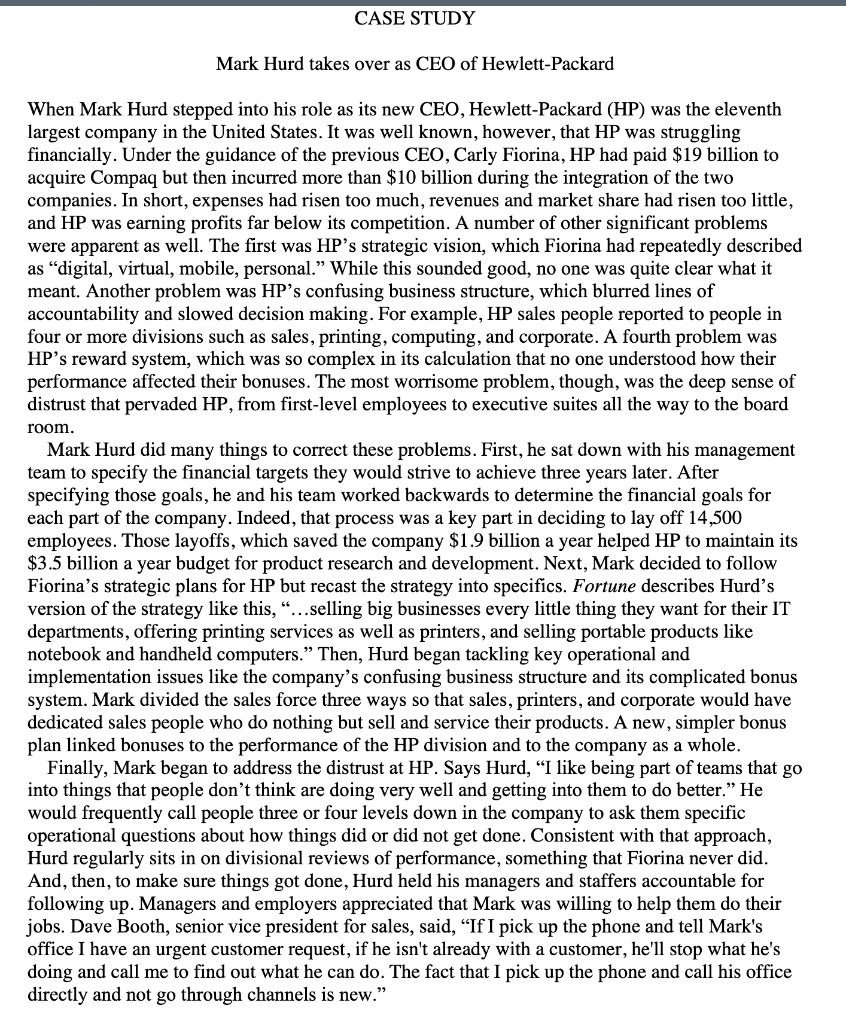
CASE STUDY Mark Hurd takes over as CEO of Hewlett-Packard When Mark Hurd stepped into his role as its new CEO, Hewlett-Packard (HP) was the eleventh largest company in the United States. It was well known, however, that HP was struggling financially. Under the guidance of the previous CEO, Carly Fiorina, HP had paid $19 billion to acquire Compaq but then incurred more than $10 billion during the integration of the two companies. In short, expenses had risen too much, revenues and market share had risen too little, and HP was earning profits far below its competition. A number of other significant problems were apparent as well. The first was HP's strategic vision, which Fiorina had repeatedly described as digital, virtual, mobile, personal. While this sounded good, no one was quite clear what it meant. Another problem was HP's confusing business structure, which blurred lines of accountability and slowed decision making. For example, HP sales people reported to people in four or more divisions such as sales, printing, computing, and corporate. A fourth problem was HP's reward system, which was so complex in its calculation that no one understood how their performance affected their bonuses. The most worrisome problem, though, was the deep sense of distrust that pervaded HP, from first-level employees to executive suites all the way to the board room. Mark Hurd did many things to correct these problems. First, he sat down with his management team to specify the financial targets they would strive to achieve three years later. After specifying those goals, he and his team worked backwards to determine the financial goals for each part of the company. Indeed, that process was a key part in deciding to lay off 14,500 employees. Those layoffs, which saved the company $1.9 billion a year helped HP to maintain its $3.5 billion a year budget for product research and development. Next, Mark decided to follow Fiorina's strategic plans for HP but recast the strategy into specifics. Fortune describes Hurd's version of the strategy like this, ...selling big businesses every little thing they want for their IT departments, offering printing services as well as printers, and selling portable products like notebook and handheld computers. Then, Hurd began tackling key operational and implementation issues like the company's confusing business structure and its complicated bonus system. Mark divided the sales force three ways so that sales, printers, and corporate would have dedicated sales people who do nothing but sell and service their products. A new, simpler bonus plan linked bonuses to the performance of the HP division and to the company as a whole. Finally, Mark began to address the distrust at HP. Says Hurd, I like being part of teams that go into things that people don't think are doing very well and getting into them to do better. He would frequently call people three or four levels down in the company to ask them specific operational questions about how things did or did not get done. Consistent with that approach, Hurd regularly sits in on divisional reviews of performance, something that Fiorina never did. And, then, to make sure things got done, Hurd held his managers and staffers accountable for following up. Managers and employers appreciated that Mark was willing to help them do their jobs. Dave Booth, senior vice president for sales, said, If I pick up the phone and tell Mark's office I have an urgent customer request, if he isn't already with a customer, he'll stop what he's doing and call me to find out what he can do. The fact that I pick up the phone and call his office directly and not go through channels is new. CASE STUDY Mark Hurd takes over as CEO of Hewlett-Packard When Mark Hurd stepped into his role as its new CEO, Hewlett-Packard (HP) was the eleventh largest company in the United States. It was well known, however, that HP was struggling financially. Under the guidance of the previous CEO, Carly Fiorina, HP had paid $19 billion to acquire Compaq but then incurred more than $10 billion during the integration of the two companies. In short, expenses had risen too much, revenues and market share had risen too little, and HP was earning profits far below its competition. A number of other significant problems were apparent as well. The first was HP's strategic vision, which Fiorina had repeatedly described as digital, virtual, mobile, personal. While this sounded good, no one was quite clear what it meant. Another problem was HP's confusing business structure, which blurred lines of accountability and slowed decision making. For example, HP sales people reported to people in four or more divisions such as sales, printing, computing, and corporate. A fourth problem was HP's reward system, which was so complex in its calculation that no one understood how their performance affected their bonuses. The most worrisome problem, though, was the deep sense of distrust that pervaded HP, from first-level employees to executive suites all the way to the board room. Mark Hurd did many things to correct these problems. First, he sat down with his management team to specify the financial targets they would strive to achieve three years later. After specifying those goals, he and his team worked backwards to determine the financial goals for each part of the company. Indeed, that process was a key part in deciding to lay off 14,500 employees. Those layoffs, which saved the company $1.9 billion a year helped HP to maintain its $3.5 billion a year budget for product research and development. Next, Mark decided to follow Fiorina's strategic plans for HP but recast the strategy into specifics. Fortune describes Hurd's version of the strategy like this, ...selling big businesses every little thing they want for their IT departments, offering printing services as well as printers, and selling portable products like notebook and handheld computers. Then, Hurd began tackling key operational and implementation issues like the company's confusing business structure and its complicated bonus system. Mark divided the sales force three ways so that sales, printers, and corporate would have dedicated sales people who do nothing but sell and service their products. A new, simpler bonus plan linked bonuses to the performance of the HP division and to the company as a whole. Finally, Mark began to address the distrust at HP. Says Hurd, I like being part of teams that go into things that people don't think are doing very well and getting into them to do better. He would frequently call people three or four levels down in the company to ask them specific operational questions about how things did or did not get done. Consistent with that approach, Hurd regularly sits in on divisional reviews of performance, something that Fiorina never did. And, then, to make sure things got done, Hurd held his managers and staffers accountable for following up. Managers and employers appreciated that Mark was willing to help them do their jobs. Dave Booth, senior vice president for sales, said, If I pick up the phone and tell Mark's office I have an urgent customer request, if he isn't already with a customer, he'll stop what he's doing and call me to find out what he can do. The fact that I pick up the phone and call his office directly and not go through channels is new.









 Study Help