







Question: Read and answer exercise 1. To see how one writer signals when she is asserting her own views and when she is summarizing those of
Read and answer 
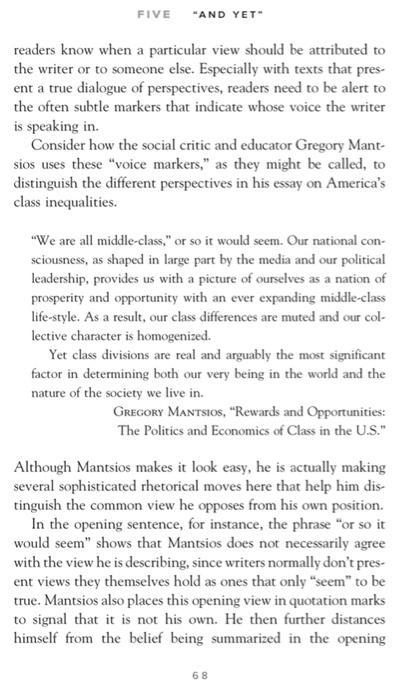
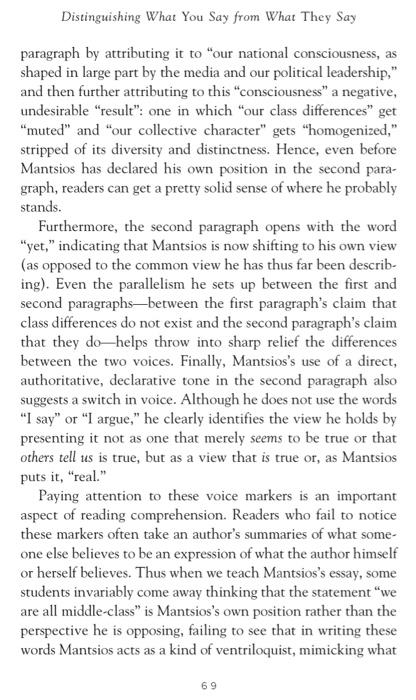
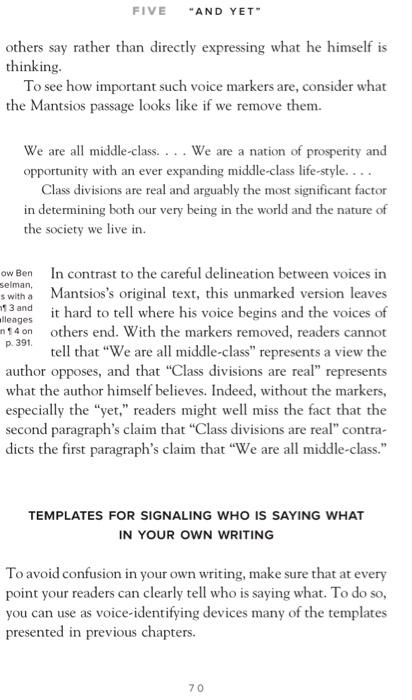
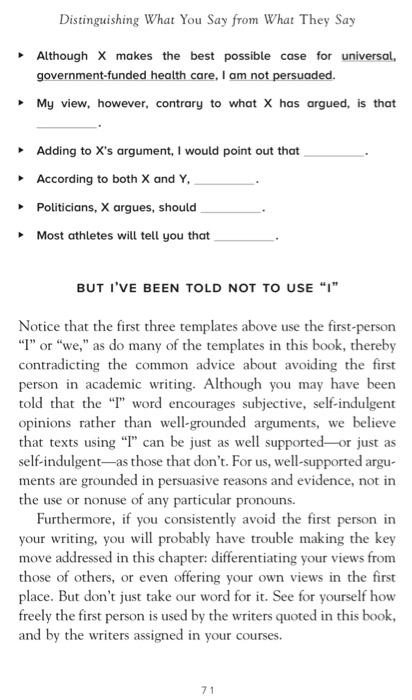
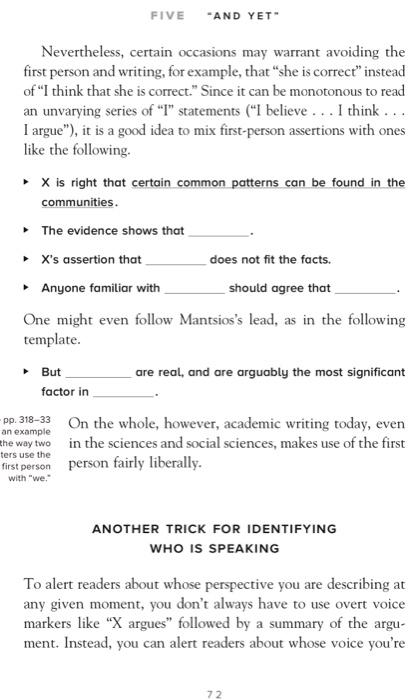
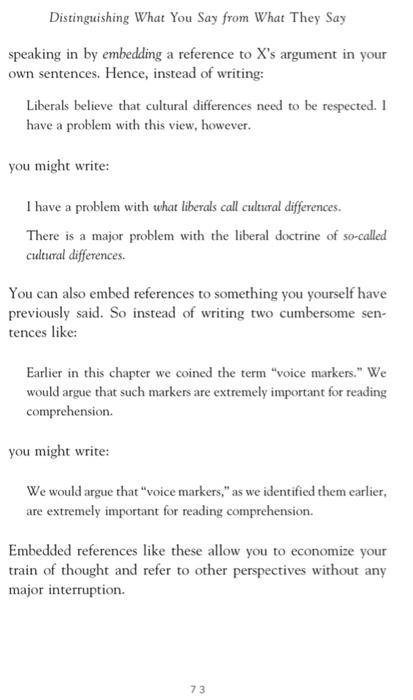
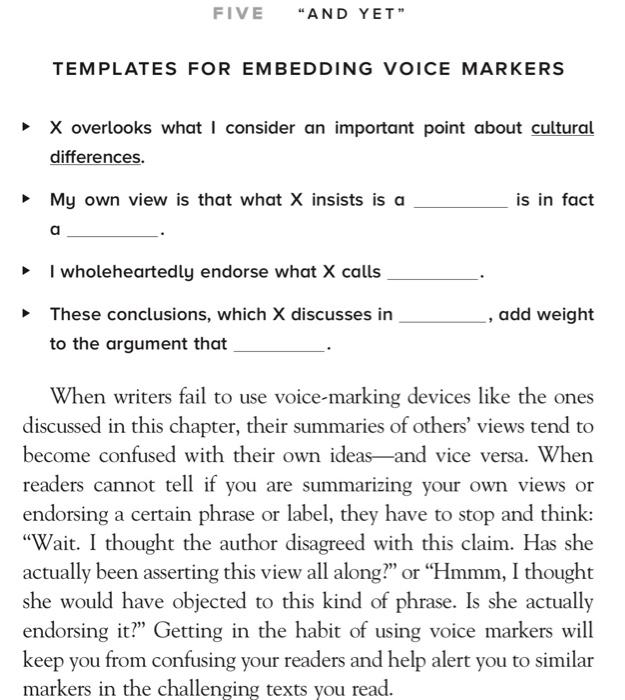
"AND YET Distinguishing What You Say from What They Say IF GOOD ACADEMIC Writing involves putting yourself into dialogue with others, it is extremely important that readers be able to tell at every point when you are expressing your own view and when you are stating someone else's. This chapter takes up the problem of moving from what they say to what you say without confusing readers about who is saying what. DETERMINE WHO IS SAYING WHAT IN THE TEXTS YOU READ Before examining how to signal who is saying what in your own writing, let's look at how to recognize such signals when they appear in the texts you readan especially important skill when it comes to the challenging works assigned in school. Frequently, when students have trouble understanding diffi- cult texts, it is not just because the texts contain unfamiliar ideas or words, but because the texts rely on subtle clues to let 67 FIVE "AND YET" readers know when a particular view should be attributed to the writer or to someone else. Especially with texts that pres. ent a true dialogue of perspectives, readers need to be alert to the often subtle markers that indicate whose voice the writer is speaking in. Consider how the social critic and educator Gregory Mant- sios uses these "voice markers," as they might be called, to distinguish the different perspectives in his essay on America's class inequalities. "We are all middle-class," or so it would seem. Our national con- sciousness, as shaped in large part by the media and our political leadership, provides us with a picture of ourselves as a nation of prosperity and opportunity with an ever expanding middle-class life-style. As a result, our class differences are muted and our col- lective character is homogenized. Yet class divisions are real and arguably the most significant factor in determining both our very being in the world and the nature of the society we live in. GREGORY MANTSIOS, "Rewards and Opportunities: The Politics and Economics of Class in the U.S." Although Mantsios makes it look easy, he is actually making several sophisticated rhetorical moves here that help him dis- tinguish the common view he opposes from his own position. In the opening sentence, for instance, the phrase "or so it would seem" shows that Mantsios does not necessarily agree with the view he is describing, since writers normally don't pres- ent views they themselves hold as ones that only "seem" to be true. Mantsios also places this opening view in quotation marks to signal that it is not his own. He then further distances himself from the belief being summarized in the opening 68 Distinguishing What You Say from What They Say paragraph by attributing it to our national consciousness, as shaped in large part by the media and our political leadership," and then further attributing to this "consciousness" a negative, undesirable "result": one in which "our class differences" get "muted" and "our collective character" gets "homogenized," stripped of its diversity and distinctness. Hence, even before Mantsios has declared his own position in the second para- graph, readers can get a pretty solid sense of where he probably stands. Furthermore, the second paragraph opens with the word "yet," indicating that Mantsios is now shifting to his own view (as opposed to the common view he has thus far been describ- ing). Even the parallelism he sets up between the first and second paragraphs-between the first paragraph's claim that class differences do not exist and the second paragraph's claim that they do-helps throw into sharp relief the differences between the two voices. Finally, Mantsios's use of a direct, authoritative, declarative tone in the second paragraph also suggests a switch in voice. Although he does not use the words "I say" or "I argue," he clearly identifies the view he holds by presenting it not as one that merely seems to be true or that others tell us is true, but as a view that is true or, as Mantsios puts it, "real." Paying attention to these voice markers is an important aspect of reading comprehension. Readers who fail to notice these markers often take an author's summaries of what some- one else believes to be an expression of what the author himself or herself believes. Thus when we teach Mantsios's essay, some students invariably come away thinking that the statement "we are all middle-class" is Mantsios's own position rather than the perspective he is opposing, failing to see that in writing these words Mantsios acts as a kind of ventriloquist, mimicking what 69 FIVE "AND YET" others say rather than directly expressing what he himself is thinking To see how important such voice markers are, consider what the Mantsios passage looks like if we remove them. We are all middle-class.... We are a nation of prosperity and opportunity with an ever expanding middle-class life-style.... Class divisions are real and arguably the most significant factor in determining both our very being in the world and the nature of the society we live in. selman, lleages p. 391 ow Ben In contrast to the careful delineation between voices in s with Mantsios's original text, this unmarked version leaves faqed it hard to tell where his voice begins and the voices of 14 on others end. With the markers removed, readers cannot tell that "We are all middle-class" represents a view the author opposes, and that "Class divisions are real" represents what the author himself believes. Indeed, without the markers, especially the "yet," readers might well miss the fact that the second paragraph's claim that "Class divisions are real" contra- dicts the first paragraph's claim that "We are all middle-class." TEMPLATES FOR SIGNALING WHO IS SAYING WHAT IN YOUR OWN WRITING To avoid confusion in your own writing, make sure that at every point your readers can clearly tell who is saying what. To do so, you can use as voice-identifying devices many of the templates presented in previous chapters. 70 Distinguishing What You Say from What They Say Although x makes the best possible case for universal. government-funded health care, I am not persuaded. My view, however, contrary to what X has argued, is that Adding to X's argument, I would point out that According to both X and Y. Politicians, X argues, should Most athletes will tell you that BUT I'VE BEEN TOLD NOT TO USE "" Notice that the first three templates above use the first-person "1" or "we," as do many of the templates in this book, thereby contradicting the common advice about avoiding the first person in academic writing. Although you may have been told that the "T" word encourages subjective, self-indulgent opinions rather than well-grounded arguments, we believe that texts using l" can be just as well supportedor just as self-indulgentas those that don't. For us, well-supported argu- ments are grounded in persuasive reasons and evidence, not in the use or nonuse of any particular pronouns. Furthermore, if you consistently avoid the first person in your writing, you will probably have trouble making the key move addressed in this chapter: differentiating your views from those of others, or even offering your own views in the first place. But don't just take our word for it. See for yourself how freely the first person is used by the writers quoted in this book, and by the writers assigned in your courses. 71 FIVE *AND YET Nevertheless, certain occasions may warrant avoiding the first person and writing, for example, that she is correct" instead of I think that she is correct." Since it can be monotonous to read an unvarying series of "1" statements ("I believe ... I think... 1 I argue"), it is a good idea to mix first-person assertions with ones like the following X is right that certain common patterns can be found in the communities. The evidence shows that X's assertion that does not fit the facts. Anyone familiar with should agree that One might even follow Mantsios's lead, as in the following template. But are real, and are arguably the most significant factor in - pp. 318-33 On the whole, however, academic writing today, even the way two in the sciences and social sciences, makes use of the first first person person fairly liberally. an example ters use the with "we." ANOTHER TRICK FOR IDENTIFYING WHO IS SPEAKING To alert readers about whose perspective you are describing at any given moment, you don't always have to use overt voice markers like "X argues" followed by a summary of the argu- ment. Instead, you can alert readers about whose voice you're 72 Distinguishing What You Say from What They Say speaking in by embedding a reference to X's argument in your own sentences. Hence, instead of writing: Liberals believe that cultural differences need to be respected. I have a problem with this view, however. you might write: I have a problem with what liberals call cultural differences. There is a major problem with the liberal doctrine of so-called cultural differences. You can also embed references to something you yourself have previously said. So instead of writing two cumbersome sen- tences like: Earlier in this chapter we coined the term voice markers." We would argue that such markers are extremely important for reading comprehension. you might write: We would argue that "voice markers," as we identified them earlier, are extremely important for reading comprehension. Embedded references like these allow you to economize your train of thought and refer to other perspectives without any major interruption. 73 FIVE "AND YET" TEMPLATES FOR EMBEDDING VOICE MARKERS X overlooks what I consider an important point about cultural differences. is in fact My own view is that what X insists is a a I wholeheartedly endorse what X calls , add weight These conclusions, which X discusses in to the argument that When writers fail to use voice-marking devices like the ones discussed in this chapter, their summaries of others' views tend to become confused with their own ideas and vice versa. When readers cannot tell if you are summarizing your own views or endorsing a certain phrase or label, they have to stop and think: "Wait. I thought the author disagreed with this claim. Has she actually been asserting this view all along?" or "Hmmm, I thought she would have objected to this kind of phrase. Is she actually endorsing it?" Getting in the habit of using voice markers will keep you from confusing your readers and help alert you to similar markers in the challenging texts you read
exercise 1. To see how one writer signals when she is asserting her own views and when she is summarizing those of someone else, read the following passage by the social historian Julie Charlip. As you do so, identify those spots where Charlip refers to the views of others and the signal phrases she uses to distinguish her views from theirs.
Step by Step Solution
There are 3 Steps involved in it
1 Expert Approved Answer
Step: 1 Unlock

Question Has Been Solved by an Expert!
Get step-by-step solutions from verified subject matter experts
Step: 2 Unlock
Step: 3 Unlock
 Study Help