



Question: Read and discuss what you got from reading THE GLOBALIZATION OF PRODUCTION The globalization of production refers to the sourcing of goods and services from
Read and discuss what you got from reading
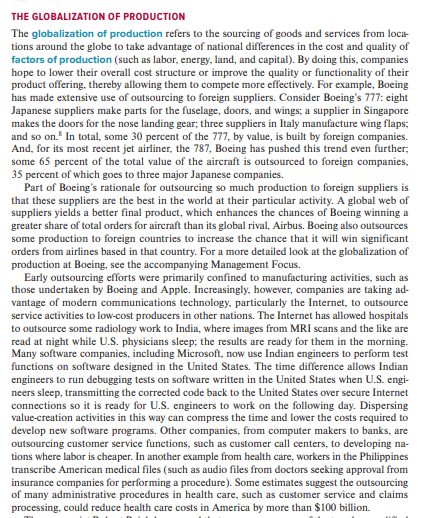
THE GLOBALIZATION OF PRODUCTION The globalization of production refers to the sourcing of goods and services from loca- tions around the globe to take advantage of national differences in the cost and quality of factors of production (such as labor, energy, land, and capital). By doing this companies hope to lower their overall cost structure or improve the quality or functionality of their product offering, thereby allowing them to compete more effectively. For example, Boeing has made extensive use of outsourcing to foreign suppliers. Consider Boeing's 777: eight Japanese suppliers make parts for the fuselage, doors, and wings; a supplier in Singapore makes the doors for the nose landing gear, three suppliers in Italy manufacture wing flaps; and so on. In total, some 30 percent of the 777, by value, is built by foreign companies. And, for its most recent jet airliner, the 787, Boeing has pushed this trend even further, some 65 percent of the total value of the aircraft is outsourced to foreign companies, 35 percent of which goes to three major Japanese companies. Part of Boeing's rationale for outsourcing so much production to foreign suppliers is that these suppliers are the best in the world at their particular activity. A global web of suppliers yields a better final product, which enhances the chances of Boeing winning a greater share of total orders for aircraft than its global rival, Airbus. Boeing also outsources some production to foreign countries to increase the chance that it will win significant orders from airlines based in that country. For a more detailed look at the globalization of production at Boeing, see the accompanying Management Focus. Early outsourcing efforts were primarily confined to manufacturing activities, such as those undertaken by Boeing and Apple. Increasingly, however, companies are taking ad- vantage of modern communications technology, particularly the Internet, to outsource service activities to low-cost producers in other nations. The Internet has allowed hospitals to outsource some radiology work to India, where images from MRI scans and the like are read at night while U.S. physicians sleep; the results are ready for them in the morning. Many software companies, including Microsoft, now use Indian engineers to perform test functions on software designed in the United States. The time difference allows Indian engineers to run debugging tests on software written in the United States when U.S. engi- neers sleep, transmitting the corrected code back to the United States over secure Internet connections so it is ready for U.S. engineers to work on the following day. Dispersing value-creation activities in this way can compress the time and lower the costs required to develop new software programs. Other companies, from computer makers to banks, are outsourcing customer service functions, such as customer call centers, to developing na- tions where labor is cheaper. In another example from health care, workers in the Philippines transcribe American medical files (such as audio files from doctors seeking approval from insurance companies for performing a procedure). Some estimates suggest the outsourcing of many administrative procedures in health care, such as customer service and claims processing, could reduce health care costs in America by more than $100 billion
Step by Step Solution
There are 3 Steps involved in it
1 Expert Approved Answer
Step: 1 Unlock

Question Has Been Solved by an Expert!
Get step-by-step solutions from verified subject matter experts
Step: 2 Unlock
Step: 3 Unlock