







Question: Read Case 7.6 and 5.3 to answer the question below in at least 100 words: Q) What guidelines would you propose for gift giving in
 Read Case 7.6 and 5.3 to answer the question below in at least 100 words:
Q) What guidelines would you propose for gift giving in business?
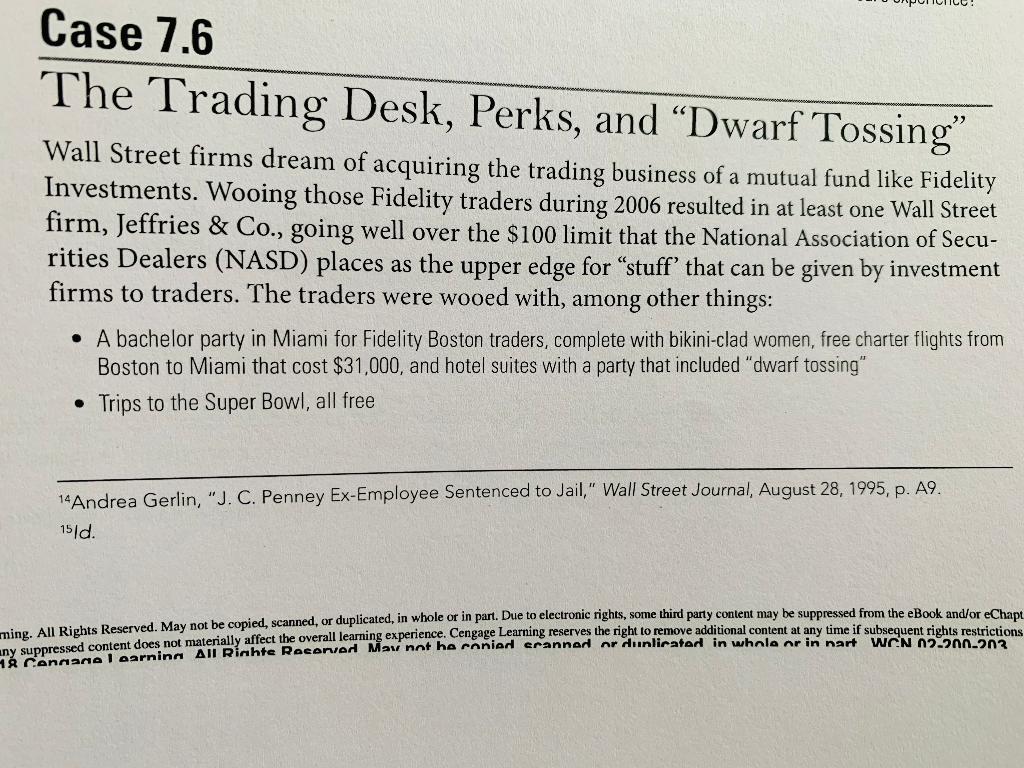
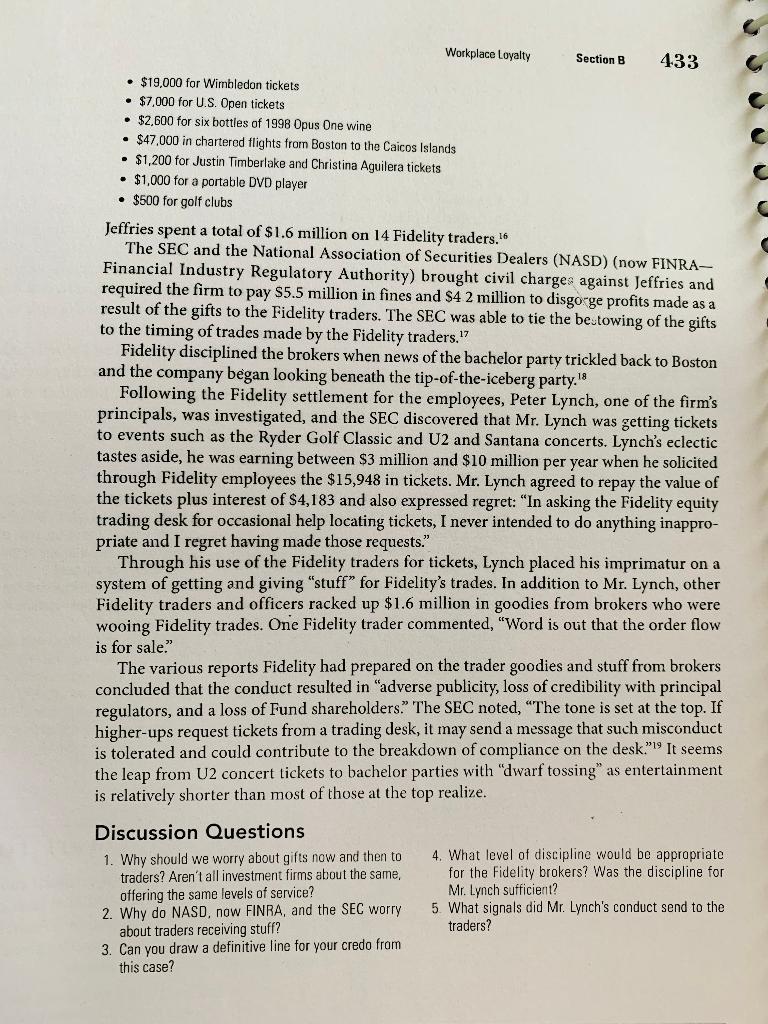
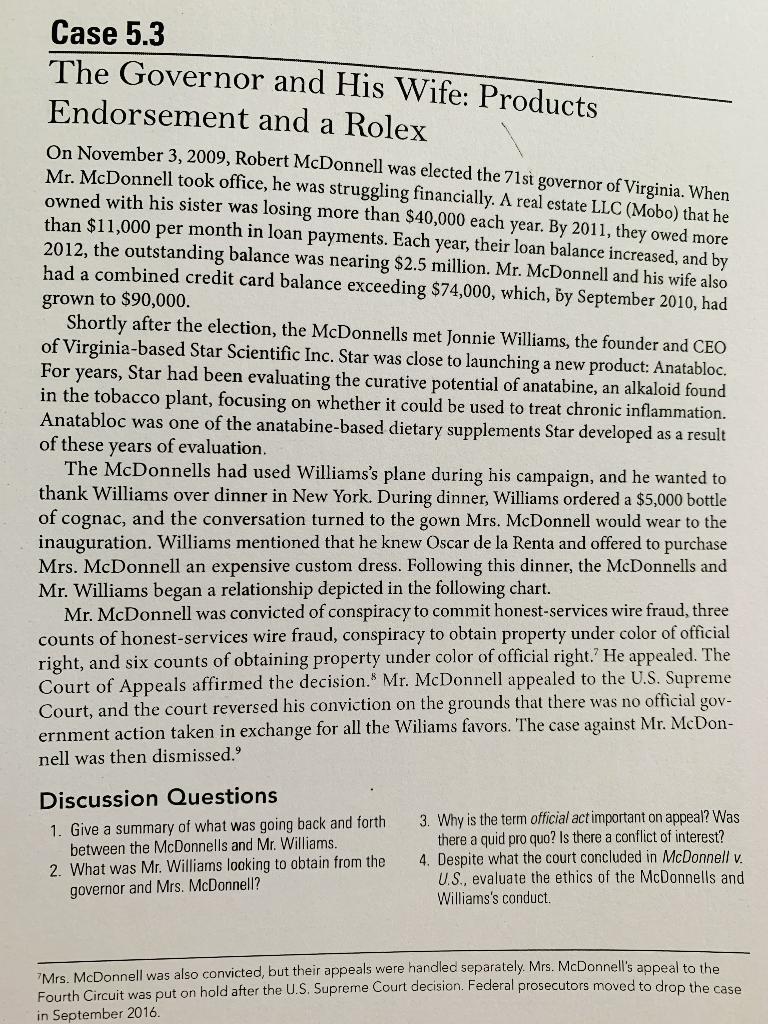
Case 7.6 The Trading Desk, Perks, and Dwarf Tossing Wall Street firms dream of acquiring the trading business of a mutual fund like Fidelity Investments. Wooing those Fidelity traders during 2006 resulted in at least one Wall Street firm, Jeffries & Co., going well over the $100 limit that the National Association of Secu- rities Dealers (NASD) places as the upper edge for "stuff' that can be given by investment firms to traders. The traders were wooed with, among other things: A bachelor party in Miami for Fidelity Boston traders, complete with bikini-clad women, free charter flights from Boston to Miami that cost $31,000, and hotel suites with a party that included "dwarf tossing" Trips to the Super Bowl, all free 14 Andrea Gerlin, "J. C. Penney Ex-Employee Sentenced to Jail," Wall Street Journal , August 28, 1995, p. A9. 151d. ming. All Rights Reserved. May not be copied, scanned, or duplicated, in whole or in part. Due to electronic rights, some third party content may be suppressed from the eBook and/or Chapt any suppressed content does not materially affect the overall Learning experience Cengan Learning reserves the right to remove additional content at any time if subsequent rights restrictions ronied erannad Workplace Loyalty Section B 433 $19,000 for Wimbledon tickets $7,000 for U.S. Open tickets $2,600 for six bottles of 1998 Opus One wine $47.000 in chartered flights from Bostan to the Caicos Islands $1,200 for Justin Timberlake and Christina Aguilera tickets $1,000 for a portable DVD player $500 for golf clubs Jeffries spent a total of $1.6 million on 14 Fidelity traders. 16 The SEC and the National Association of Securities Dealers (NASD) (now FINRA- Financial Industry Regulatory Authority) brought civil charges against Jeffries and required the firm to pay $5.5 million in fines and 54 2 million to disgorge profits made as a result of the gifts to the Fidelity traders. The SEC was able to tie the bestowing of the gifts to the timing of trades made by the Fidelity traders." Fidelity disciplined the brokers when news of the bachelor party trickled back to Boston and the company began looking beneath the tip-of-the-iceberg party.'' Following the Fidelity settlement for the employees, Peter Lynch, one of the firm's principals, was investigated, and the SEC discovered that Mr. Lynch was getting tickets to events such as the Ryder Golf Classic and U2 and Santana concerts. Lynch's eclectic tastes aside, he was earning between $3 million and $10 million per year when he solicited through Fidelity employees the $15,948 in tickets. Mr. Lynch agreed to repay the value of the tickets plus interest of $4,183 and also expressed regret: "In asking the Fidelity equity trading desk for occasional help locating tickets, I never intended to do anything inappro- priate and I regret having made those requests." Through his use of the Fidelity traders for tickets, Lynch placed his imprimatur on a system of getting and giving "stuff" for Fidelity's trades. In addition to Mr. Lynch, other Fidelity traders and officers racked up $1.6 million in goodies from brokers who were wooing Fidelity trades. One Fidelity trader commented, Word is out that the order flow is for sale." The various reports Fidelity had prepared on the trader goodies and stuff from brokers concluded that the conduct resulted in "adverse publicity, loss of credibility with principal regulators, and a loss of Fund shareholders." The SEC noted, The tone is set at the top. If higher-ups request tickets from a trading desk, it may send a message that such misconduct is tolerated and could contribute to the breakdown of compliance on the desk." It seems the leap from U2 concert tickets to bachelor parties with "dwarf tossing as entertainment is relatively shorter than most of those at the top realize. Discussion Questions 1. Why should we worry about gifts now and then to traders? Aren't all investment firms about the same, offering the same levels of service? 2. Why do NASD, now FINRA, and the SEC worry about traders receiving stuff? 3. Can you draw a definitive line for your credo from this case? 4. What level of discipline would be appropriate for the Fidelity brokers? Was the discipline for Mr. Lynch sufficient? 5 What signals did Mr. Lynch's conduct send to the traders? Case 5.3 The Governor and His Wife: Products Endorsement and a Rolex On November 3, 2009, Robert McDonnell was elected the 71st governor of Virginia. When Mr. McDonnell took office, he was struggling financially. A real estate LLC (Mobo) that he owned with his sister was losing more than $40,000 each year. By 2011, they owed more than $11,000 per month in loan payments. Each year, their loan balance increased, and by 2012, the outstanding balance was nearing $2.5 million. Mr. McDonnell and his wife also had a combined credit card balance exceeding $74,000, which, by September 2010, had grown to $90,000. Shortly after the election, the McDonnells met Jonnie Williams, the founder and CEO of Virginia-based Star Scientific Inc. Star was close to launching a new product: Anatabloc. For years, Star had been evaluating the curative potential of anatabine, an alkaloid found in the tobacco plant, focusing on whether it could be used to treat chronic inflammation. Anatabloc was one of the anatabine-based dietary supplements Star developed as a result of these years of evaluation. The McDonnells had used Williams's plane during his campaign, and he wanted to thank Williams over dinner in New York. During dinner, Williams ordered a $5,000 bottle of cognac, and the conversation turned to the gown Mrs. McDonnell would wear to the inauguration. Williams mentioned that he knew Oscar de la Renta and offered to purchase Mrs. McDonnell an expensive custom dress. Following this dinner, the McDonnells and Mr. Williams began a relationship depicted in the following chart. Mr. McDonnell was convicted of conspiracy to commit honest-services wire fraud, three counts of honest-services wire fraud, conspiracy to obtain property under color of official right, and six counts of obtaining property under color of official right. He appealed. The Court of Appeals affirmed the decision. Mr. McDonnell appealed to the U.S. Supreme Court, and the court reversed his conviction on the grounds that there was no official gov- ernment action taken in exchange for all the Wiliams favors. The case against Mr. McDon- nell was then dismissed. Discussion Questions 1. Give a summary of what was going back and forth between the McDonnells and Mr. Williams. 2. What was Mr. Williams looking to obtain from the governor and Mrs. McDonnell? 3. Why is the term official act important on appeal? Was there a quid pro quo? Is there a conflict of interest? 4. Despite what the court concluded in McDonnell v. U.S., evaluate the ethics of the McDonnells and Williams's conduct Mrs. McDonnell was also convicted, but their appeals were handled separately. Mrs. McDonnell's appeal to the Fourth Circuit was put on hold after the U.S. Supreme Court decision. Federal prosecutors moved to drop the case in September 2016Step by Step Solution
There are 3 Steps involved in it
1 Expert Approved Answer
Step: 1 Unlock

Question Has Been Solved by an Expert!
Get step-by-step solutions from verified subject matter experts
Step: 2 Unlock
Step: 3 Unlock
 Study Help