Read Chapter 8 of your textbook by Barrett
Create a role-play script of ineffective listening that you have learned from the textbook. Follow that up with a script with the strategies implemented. Make the scripting as realistic as possible.
It is not necessary to apply a formatting style for this assignment except when using a source to support your writing. (This chapter is From Leadership Communication Fourth Edition)
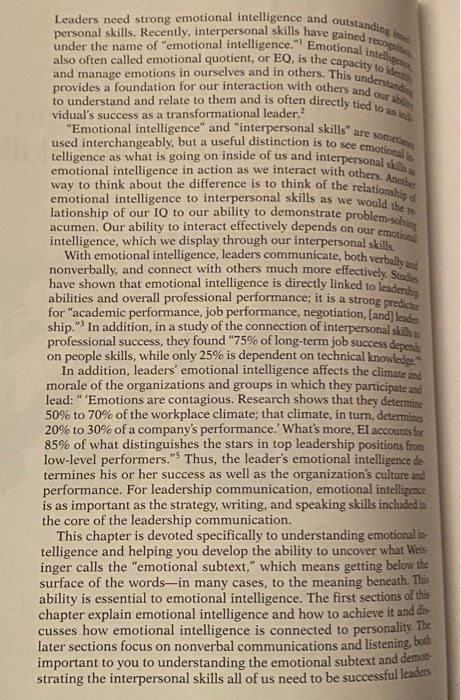
1 Leaders need strong emotional intelligence and outstanding in personal skills. Recently, interpersonal skills have gained recogs also often called emotional quotient, or EO, is the capacity to det under the name of "emotional intelligence. Emotional intelligent provides a foundation for our interaction with others and our and manage emotions in ourselves and in others. This understand to understand and relate to them and is often directly tied to an in "Emotional intelligence" and "interpersonal skills" are sometime used interchangeably, but a useful distinction is to see emotional telligence as what is going on inside of us and interpersonal skills emotional intelligence in action as we interact with others. Anothe emotional intelligence to interpersonal skills as we would the to way to think about the difference is to think of the relationship lationship of our IQ to our ability to demonstrate problem-solving have shown that emotional intelligence is directly linked to leadership vidual's success as a transformational leader.? acumen. Our ability to interact effectively depends on our emotion, intelligence, which we display through our interpersonal skills. With emotional intelligence, leaders communicate, both verbally and nonverbally, and connect with others much more effectively. Studio abilities and overall professional performance; it is a strong predicto for "academic performance, job performance, negotiation, (and) leade ship." In addition, in a study of the connection of interpersonal skills professional success, they found "75% of long-term job success depend on people skills, while only 25% is dependent on technical knowledge." In addition, leaders' emotional intelligence affects the climate and morale of the organizations and groups in which they participate and lead: "Emotions are contagious. Research shows that they determine 50% to 70% of the workplace climate; that climate, in turn, determines 20% to 30% of a company's performance. What's more, El accounts for 85% of what distinguishes the stars in top leadership positions from low-level performers." Thus, the leader's emotional intelligence de termines his or her success as well as the organization's culture and performance. For leadership communication, emotional intelligence is as important as the strategy, writing, and speaking skills included in the core of the leadership communication. This chapter is devoted specifically to understanding emotional in telligence and helping you develop the ability to uncover what Weis- inger calls the "emotional subtext," which means getting below the surface of the words-in many cases, to the meaning beneath. This ability is essential to emotional intelligence. The first sections of this chapter explain emotional intelligence and how to achieve it and dis- cusses how emotional intelligence is connected to personality. The later sections focus on nonverbal communications and listening, both important to you to understanding the emotional subtext and demon- strating the interpersonal skills all of us need to be successful leaders 1 Leaders need strong emotional intelligence and outstanding in personal skills. Recently, interpersonal skills have gained recogs also often called emotional quotient, or EO, is the capacity to det under the name of "emotional intelligence. Emotional intelligent provides a foundation for our interaction with others and our and manage emotions in ourselves and in others. This understand to understand and relate to them and is often directly tied to an in "Emotional intelligence" and "interpersonal skills" are sometime used interchangeably, but a useful distinction is to see emotional telligence as what is going on inside of us and interpersonal skills emotional intelligence in action as we interact with others. Anothe emotional intelligence to interpersonal skills as we would the to way to think about the difference is to think of the relationship lationship of our IQ to our ability to demonstrate problem-solving have shown that emotional intelligence is directly linked to leadership vidual's success as a transformational leader.? acumen. Our ability to interact effectively depends on our emotion, intelligence, which we display through our interpersonal skills. With emotional intelligence, leaders communicate, both verbally and nonverbally, and connect with others much more effectively. Studio abilities and overall professional performance; it is a strong predicto for "academic performance, job performance, negotiation, (and) leade ship." In addition, in a study of the connection of interpersonal skills professional success, they found "75% of long-term job success depend on people skills, while only 25% is dependent on technical knowledge." In addition, leaders' emotional intelligence affects the climate and morale of the organizations and groups in which they participate and lead: "Emotions are contagious. Research shows that they determine 50% to 70% of the workplace climate; that climate, in turn, determines 20% to 30% of a company's performance. What's more, El accounts for 85% of what distinguishes the stars in top leadership positions from low-level performers." Thus, the leader's emotional intelligence de termines his or her success as well as the organization's culture and performance. For leadership communication, emotional intelligence is as important as the strategy, writing, and speaking skills included in the core of the leadership communication. This chapter is devoted specifically to understanding emotional in telligence and helping you develop the ability to uncover what Weis- inger calls the "emotional subtext," which means getting below the surface of the words-in many cases, to the meaning beneath. This ability is essential to emotional intelligence. The first sections of this chapter explain emotional intelligence and how to achieve it and dis- cusses how emotional intelligence is connected to personality. The later sections focus on nonverbal communications and listening, both important to you to understanding the emotional subtext and demon- strating the interpersonal skills all of us need to be successful leaders




