Question: Read the article and write your reaction to : What was new or surprised you? What you agree or disagree? What in your own experience
Read the article and write your reaction to :
- What was new or surprised you?
- What you agree or disagree?
- What in your own experience corresponds to what you read?
- What was the main 'takeaway'?
- Should your peers read it or not? Why or why not?
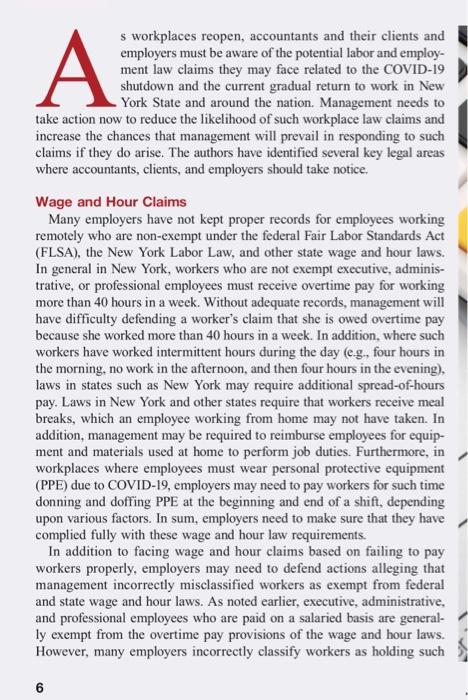
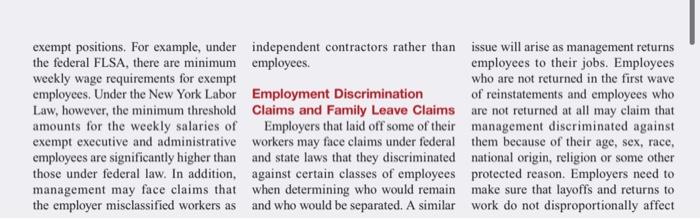
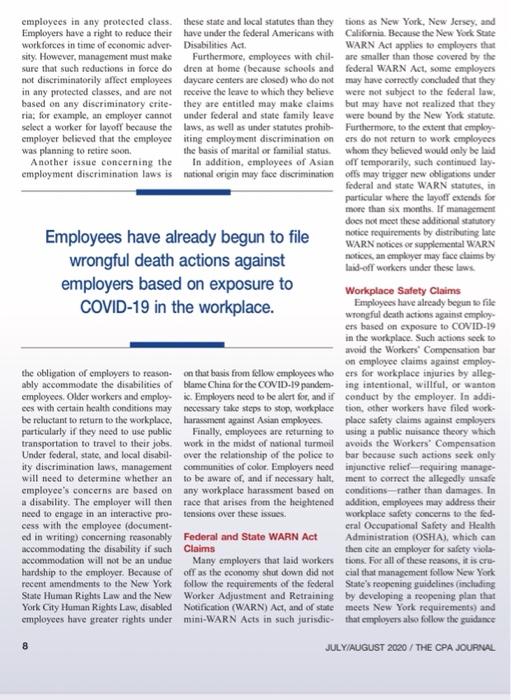
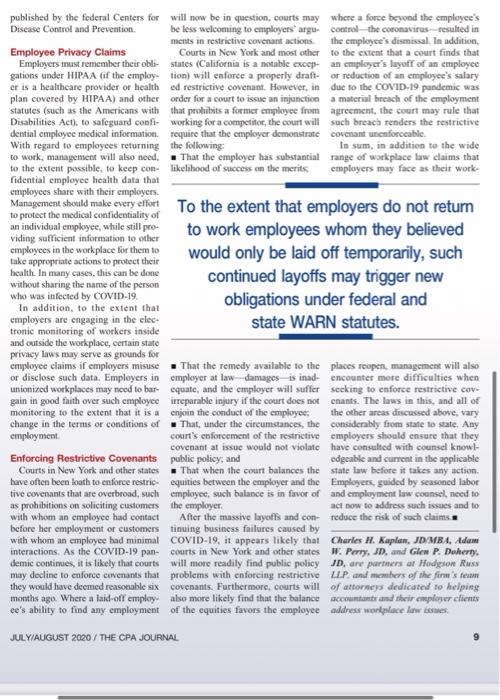
A s workplaces reopen, accountants and their clients and employers must be aware of the potential labor and employ- ment law claims they may face related to the COVID-19 shutdown and the current gradual return to work in New York State and around the nation. Management needs to take action now to reduce the likelihood of such workplace law claims and increase the chances that management will prevail in responding to such claims if they do arise. The authors have identified several key legal areas where accountants, clients, and employers should take notice. Wage and Hour Claims Many employers have not kept proper records for employees working remotely who are non-exempt under the federal Fair Labor Standards Act (FLSA), the New York Labor Law, and other state wage and hour laws. In general in New York, workers who are not exempt executive, adminis- trative, or professional employees must receive overtime pay for working more than 40 hours in a week. Without adequate records, management will have difficulty defending a worker's claim that she is owed overtime pay because she worked more than 40 hours in a week. In addition, where such workers have worked intermittent hours during the day (eg, four hours in the morning, no work in the afternoon, and then four hours in the evening), laws in states such as New York may require additional spread-of-hours pay. Laws in New York and other states require that workers receive meal breaks, which an employee working from home may not have taken. In addition, management may be required to reimburse employees for equip- ment and materials used at home to perform job duties. Furthermore, in workplaces where employees must wear personal protective equipment (PPE) due to COVID-19, employers may need to pay workers for such time donning and doffing PPE at the beginning and end of a shift, depending upon various factors. In sum, employers need to make sure that they have complied fully with these wage and hour law requirements. In addition to facing wage and hour claims based on failing to pay workers properly, employers may need to defend actions alleging that management incorrectly misclassified workers as exempt from federal and state wage and hour laws. As noted earlier, executive, administrative. and professional employees who are paid on a salaried basis are general- ly exempt from the overtime pay provisions of the wage and hour laws. However, many employers incorrectly classify workers as holding such 6 exempt positions. For example, under independent contractors rather than issue will arise as management returns the federal FLSA, there are minimum employees. employees to their jobs. Employees weekly wage requirements for exempt who are not returned in the first wave employees. Under the New York Labor Employment Discrimination of reinstatements and employees who Law, however, the minimum threshold Claims and Family Leave Claims are not returned at all may claim that amounts for the weekly salaries of Employers that laid off some of their management discriminated against exempt executive and administrative workers may face claims under federal them because of their age, sex, race, employees are significantly higher than and state laws that they discriminated national origin, religion or some other those under federal law. In addition, against certain classes of employees protected reason. Employers need to management may face claims that when determining who would remain make sure that layoffs and returns to the employer misclassified workers as and who would be separated. A similar work do not disproportionally affect Employees have already begun to file wrongful death actions against employers based on exposure to COVID-19 in the workplace. employees in any protected class. these state and local statutes than they tions as New York, New Jersey, and Employers have a right to reduce their have under the federal Americans with California. Because the New York State workforces in time of economic adver Disabilities Ad. WARN Act applies to employers that sity. However, management must make Furthermore, employees with chil- are smaller than those covered by the sure that such reductions in force do dren at home (because schools and federal WARN Act, some employers not discriminatorily affect employees daycare centers are closed) who do not may have correctly concluded that they in any protected classes, and are not receive the leave to which they believe were not subject to the federal law, based on any discriminatory crite- they are entitled may make claims but may have not realized that they ria: for example, an employer cannot under federal and state family leave were bound by the New York statute. select a worker for layoff because the laws, as well as under statutes prohib- Furthermore, to the extent that employ employer believed that the employee iting employment discrimination on ers do not return to work employees was planning to retire soon. the basis of marital or familial status whom they believed would only be laid Another issue concerning the In addition, employees of Asian off temporarily, such continued lay- employment discrimination laws is national origin may face discrimination offs may trigger new obligations under federal and state WARN statutes, in particular where the layoff extends for more than six months. If management does not meet these additional statutory notice requirements by distributing late WARN notices or supplemental WARN notices, an employer may face claims by laid-off workers under these laws Workplace Safety Claims Employees have already begun to file wrongful death actions against employ ers based on exposure to COVID-19 in the workplace. Such actions seck to avoid the Workers' Compensation bar on employee claims against employ the obligation of employers to reason on that basis from fellow employees who ers for workplace injuries by alleg- ably accommodate the disabilities of blame China for the COVID-19 pandem-ing intentional, willful, or wanton employees. Older workers and employ ic. Employers need to be alert for, and if conduct by the employer. In addi- ces with certain health conditions may necessary take steps to stop, workplace tion, other workers have filed work- be reluctant to return to the workplace. harassment against Asian employees. place safety claims against employers particularly if they need to use public Finally, employees are returning to using a public nuisance theory which transportation to travel to their jobs work in the midst of national turmoil avoids the Workers Compensation Under federal, state, and local disabil over the relationship of the police tobar because such actions soek only ity discrimination laws, management communities of color. Employers need injunctive relict-requiring manage- will need to determine whether an to be aware of, and if necessary halt, ment to correct the allegedly unsafe employee's concerns are based on any workplace harassment based on conditions-rather than damages. In a disability. The employer will then race that arises from the heightened addition, employees may address their need to engage in an interactive pro- tensions over these issues. workplace safety concerns to the fed- cess with the employee (document- cral Occupational Safety and Health ed in writing) concerning reasonably Federal and State WARN Act Administration (OSHA), which can accommodating the disability if such claims then cite an employer for safety viola- accommodation will not be an undue Many employers that laid workers tions. For all of these reasons, it is cre- hardship to the employer. Because of off as the economy shut down did not cial that management follow New York recent amendments to the New York follow the requirements of the federal State's reopening guidelines (including State Human Rights Law and the New Worker Adjustment and Retraining by developing a reopening plan that York City Human Rights Law, disabled Notification (WARN) Act, and of state meets New York requirements) and employees have greater rights under mini-WARN Acts in such jurisdic- that employers also follow the guidance 8 JULY/AUGUST 2020 / THE CPA JOURNAL To the extent that employers do not return to work employees whom they believed would only be laid off temporarily, such continued layoffs may trigger new published by the federal Centers for will now be in question, courts may where a force beyond the employee's Disease Control and Prevention. be less welcoming to employees argu- control the coronavirus-resulted in ments in restrictive covenant actions the employee's dismissal. In addition, Employee Privacy Claims Courts in New York and most other to the extent that a court finds that Employers must remember their obli- states (California is a notable excep- an employer's layofT of an employee gations under HIPAA Gif the employ tion) will enforce a properly draft or reduction of an employee's salary er is a healthcare provider or health ed restrictive covenant. However, in due to the COVID-19 pandemic was plan covered by HIPAA) and other order for a court to issue an injunction a material breach of the employment statutes (such as the Americans with that prohibits a formet employee from agreement, the court may rule that Disabilities Act), to safeguard confi- working for a competitor, the court will such breach renders the restrictive dential employee medical information. require that the employer demonstrate covenant une forccable. With regard to employees returning the following: In sum, in addition to the wide to work, management will also need that the employer has substantial range of workplace law claims that to the extent possible to keep con- likelihood of success on the merits employers may face as their work fidential employee health data that employees share with their employers. Management should make every effort to protect the medical confidentiality of an individual employee, while still pro viding sufficient information to other employees in the workplace for them to take appropriate actions to protect their health. In many cases, this can be done without sharing the name of the person who was infected by COVID-19. obligations under federal and In addition, to the extent that employers are engaging in the elec state WARN statutes. tronic monitoring of workers inside and outside the workplace, certain state privacy laws may serve as grounds for employee claims if employers misuse That the remedy available to the places reopen, management will also or disclose such data. Employers in employer at law damages is inad- encounter more difficulties when unionized workplaces may need to bar- equate, and the employer will suffer seeking to enforce restrictive cov gain in good faith over such employee irreparable injury if the court does not enants. The laws in this, and all of monitoring to the extent that it is a enjoin the conduct of the employee the other areas discussed above, vary change in the terms or conditions of That, under the circumstances, the considerably from state to state. Any employment court's enforcement of the restrictive employers should ensure that they covenant at issue would not violate have consulted with counsel knowl- Enforcing Restrictive Covenants public policy, and edgeable and current in the applicable Courts in New York and other states that when the court balances the state law before it takes any action have often been loath to enforce restric-equities between the employer and the Employers guided by seasoned labor tive covenants that are overbroad, such employec, such balance is in favor of and employment law counsel, need to as prohibitions on soliciting customers the employer act now to address such issues and to with whom an employee had contact After the massive layoffs and con- reduce the risk of such claims before her employment or customers tinuing business failures caused by with whom an employee had minimal COVID-19, it appears likely that Charles H. Kaplan, JD MBA, Adam interactions. As the COVID-19 pan- courts in New York and other states W. Por, JD, and Gler P. Doherty, demic continues, it is likely that courts will more readily find public policy JD. are partners ar Hodgson Russ may decline to enforce covenants that problems with enforcing restrictive LLP. and members of the firm's team they would have deemed reasonable six covenants. Furthermore, courts will of attorneys dedicated to helping months ago Where a laid-off employ also more likely find that the balance accountants and their employer clients ee's ability to find any employment of the equities favors the employee address workplace law termes JULY/AUGUST 2020 / THE CPA JOURNAL









 Study Help