Question: Read the article and write your reaction to : What was new or surprised you? What you agree or disagree? What in your own experience
Read the article and write your reaction to :
- What was new or surprised you?
- What you agree or disagree?
- What in your own experience corresponds to what you read?
- What was the main 'takeaway'?
- Should your peers read it or not? Why or why not?
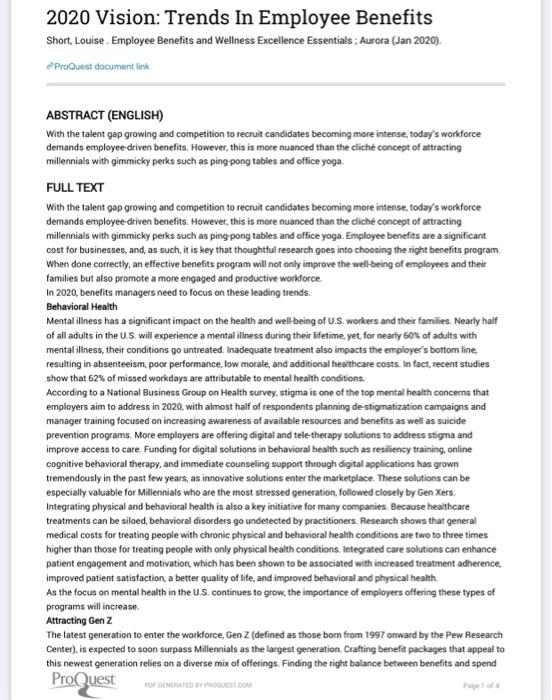
2020 Vision: Trends In Employee Benefits Short, Louise. Employee Benefits and Wellness Excellence Essentials: Aurora (Jan 2020). ProQuest document link ABSTRACT (ENGLISH) With the talent gap growing and competition to recruit candidates becoming more intense today's workforce demands employee-driven benefits. However, this is more nuanced than the clich concept of attracting millennials with gimmicky perks such as ping-pong tables and office yoga. FULL TEXT With the talent gap growing and competition to recruit candidates becoming more intense, today's workforce demands employee-driven benefits. However, this is more nuanced than the cliche concept of attracting millennials with gimmicky perks such as ping pong tables and office yoga. Employee benefits are a significant cost for businesses, and, as such, it is key that thoughtful research goes into choosing the right benefits program When done correctly, an effective benefits program will not only improve the well-being of employees and their families but also promote a more engaged and productive workforce. In 2020, benefits managers need to focus on these leading trends. Behavioral Health Mental illness has a significant impact on the health and well-being of U.S. workers and their families. Nearly half of all adults in the US will experience a mental illness during their lifetime, yet for nearly 60% of adults with mental illness, their conditions go untreated inadequate treatment also impacts the employer's bottom line resulting in absenteeism, poor performance, low morale, and additional healthcare costs. In fact, recent studies show that 62% of missed workdays are attributable to mental health conditions According to a National Business Group on Health survey, stigma is one of the top mental health concerns that employers aim to address in 2020, with almost half of respondents planning destigmatization campaigns and manager training focused on increasing awareness of available resources and benefits as well as suicide prevention programs. More employers are offering digital and tele therapy solutions to address stigma and improve access to care. Funding for digital solutions in behavioral health such as resiliency training, online cognitive behavioral therapy and immediate counseling support through digital applications has grown tremendously in the past few years, as innovative solutions enter the marketplace. These solutions can be especially valuable for Millennials who are the most stressed generation, followed closely by Gen Xets. Integrating physical and behavioral health is also a key initiative for many companies. Because healthcare treatments can be siloed behavioral disorders go undetected by practitioners. Research shows that general medical costs for treating people with chronic physical and behavioral health conditions are two to three times higher than those for treating people with only physical health conditions. Integrated care solutions can enhance patient engagement and motivation, which has been shown to be associated with increased treatment adherence, improved patient satisfaction, a better quality of life, and improved behavioral and physical health. As the focus on mental health in the U.S. continues to grow, the importance of employers offering these types of programs will increase Attracting Gen 2 The latest generation to enter the workforce, Gen Z (defined as those born from 1997 onward by the Pew Research Center), is expected to soon surpass Millennials as the largest generation. Crafting benefit packages that appeal to this newest generation relies on a diverse mix of offerings. Finding the right balance between benefits and spend ProQuest FOR GENERATED DUESTO on compensation is key for a successful program and will drive employee attraction/retention. First and foremost, with the average college debt among student loan borrowers at more than $30,000, student loan assistance programs are a highly valued benefit. Additionally, this new generation was born and raised with technology, so an effective employee benefits program for them must incorporate a level of digitization that allows easy access from their smartphone (either via an application or a mobile-friendly microsite). Finally, the younger generations are looking for flexibility, Offering the infrastructure that allows telecommuting and part-to full-time work-from-home capabilities will be a major draw in the coming years as more of Gen Z enters the workforce in terms of healthcare, this generation is looking for tech enabled solutions and convenient care, including primary care practices that have digital tools such as online scheduling, multiple modes of communication including privacy-protected texting, and solutions that provide immediate access Telehealth Telehealth is on the rise, growing 53% in the same time frame that urgent care centers saw only 14% growth and retail clinics a mere 7%. While nearly all large employers now offer some form of telehealth and/or virtual medicine, the options for how to do so are changing, and the utilization has not quite caught up with the offering. A major challenge for 2020 will be bridging the gap between the high availability of telehealth options and the low utilization by employees. Possible offerings include virtual solutions that leverage employees' local providers together with national networks. At a time when health costs are continuing to rise, telehealth provides a low cost, convenient alternative that also works to combat accessibility issues with options ranging from digital physical therapy to one on one counseling New Benefits on the Scene As the workforce's needs change, it is inevitable that new benefits offerings will become necessary to help employees balance work and family issues With more women putting off having families until later in life, the need to provide inclusive benefits for all types of families (e.g., LBGTA), and the development of new fertility technologies, the landscape of benefits and choices for employers is more complex than ever. One in eight couples is affected by infertility. Fertility related benefits can be expensive and the experience of seeking care and getting the right treatment can be confusing for patients. If an employer is adding fertility support benefits for the first time, a reasonable approach includes establishing goals and setting up a three-year strategy to add benefits and programs incrementally so that the organization can learn from experience and gauge utilization Another newer benefit that is growing in popularity is care giving While many employers offer employee assistance programs (EAP) that provide educational and referral services for elder care, there are additional options available. One example is a dependent care assistance plan (DCAP). Often referred to as the daycare benefit," DCAPs allow employees to set aside tax-free dollars for qualified elder care. With over one in six working Americans reporting that they assist with the care of an elderly or disabled dependent, employer support in this arena is a growing concern. An additional family-friendly caregiving benefit option is backup childcare, which provides short-term relief for primary caregivers. Offering these types of benefits is advantageous to the employer as well as caregiving is shown to reduce workplace productivity by nearly 20%. It is more important than ever for employers to research what their employees truly value and to craft a benefits package that aligns with the company's strategic goals. Creating a holistic plan-one that addresses physical, emotional, social, and financial well-being, including social determinants of health, will help employers attract and retain a healthy and productive workforce and assist in controlling medical spend Dr. Louise Short is the National Clinical Leader for Strategic Benefit Advisors









 Study Help