Question: Read the article in the chapter from the book titled Facebook for Organizations...and Machines? In examining Yammer and Chatter, explain how and why these enterprise
Read the article in the chapter from the book titled "Facebook for Organizations...and Machines?" In examining Yammer and Chatter, explain how and why these enterprise social media tools would be advantageous in your current place of employment. Or you can examine how they would be advantageous in a previous place of employment. Think about this question from a customer, employee, manager, and owner perspective and give insight.
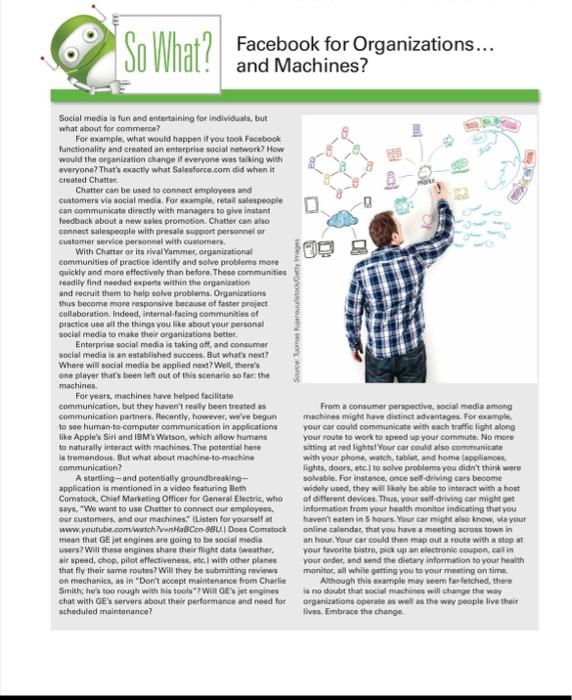
So What? Facebook for Organizations... and Machines? Social media is fun and entertaining for individuals. but what about for commerce? For example, what would happen if you took Facebook functionality and created an enterprise social network? How would the organization change if everyone was talking with everyone? That's exactly what Salesforce.com did when it created Chatter Chatter can be used to connect employees and customers via social media. For example, retail salespeople can communicate directly with managers to give instant feedback about a new sales promotion. Chatter can also connect salespeople with presale support personnel or customer service personnel with customers. With Chatter or its rival Yammer, organizational communities of practice identify and solve problems more quickly and more effectively than before. These communities readily find needed experts within the organization and recruit them to help solve problenia. Organizations thus become more responsive because of faster project collaboration. Indeed, internal-facing communities of practice use all the things you like about your personal social media to make their organizations better. Enterprise social media is taking off, and consumer social media is an established success. But what's next? Where will social media be applied next? Well, there's one player that's been left out of this scenario so far the machines For years, machines have helped facilitate communication, but they haven't really been treated as communication partners. Recently, however, we've begun to see human-to-computer communication in applications like Apple's Siti and IBM's Watson, which allow humans to naturally interact with machines. The potential here is tremendous. But what about machine-to-machine communication? A startling-and potentially groundbreaking- application is mentioned in a video featuring Beth Comstock, Chief Marketing Officer for General Electric, who says. "We want to use Chatter to connect our employees, our customers, and our machines. Listen for yourself at www.youtube.comwatchvenHasCen960. Does Comstock mean that GE jet engines are going to be social media users? Will these engines share their flight data (weather, air speed, chop. pilot effectiveness, etc. with other planes that fly their same routes? Will they be submitting reviews on mechanics, as in "Don't accept maintenance from Charlie Smith, he's too rough with his tools"? Will Gesjet engines chat with GE's servers about their performance and need for scheduled maintenance? Source: Tuomas et images From a consumer perspective, social media among machines might have distinct advantages. For example, your car could communicate with each traffic light along your route to work to speed up your commute. No mon sitting at red lights! Your car could also communicate with your phone, watch, tablet and home appliances lights, doors, etc to solve problems you didn't think were solvable. For instance, once self-driving cars become widely used, they will likely be able to interact with a host of different devices. Thus, your self-driving car might get information from your health monitor indicating that you haven't eaten in 5 hours. Your car might also know, via your online calendar, that you have a moting across town in an hour. Your car could then map out a route with a stop at your favorite bistro, pick up an electronic coupon, callin your order, and send the dietary information to your health monitor, all while getting you to your meeting on time. Although this example may seem far-fetched, there is no doubt that social machines will change the way organizations operate as well as the way people live their lives. Embrace the change









 Study Help