



Question: Read the case and Respond tothe questions ( Cite your answer ): Evaluate the Strict Products Liability Product Design Defect in this case. Use theelementsandanalyzeeachwithfacts.
Read the case and Respond tothe questions (Cite your answer):
- Evaluate the Strict Products Liability Product Design Defect in this case. Use theelementsandanalyzeeachwithfacts.
2.
- Evaluate the Negligent Failure to Warn claim in this case. Use the elements andanalyze each withfacts.
- Do you think a warning would have made a difference in this case? Why or whynot?
3. Using the Principles of Comparative Fault, assign each of the following parties theirpercent of fault from 0% up to 100% and explain/describe your reasoning: Wasabi,Dave, Gregory, SUVDriver.
4. What fact or facts was most important in determining your outcome? What fact orfactswould changethewinner of the lawsuit? Howwoulditchange?
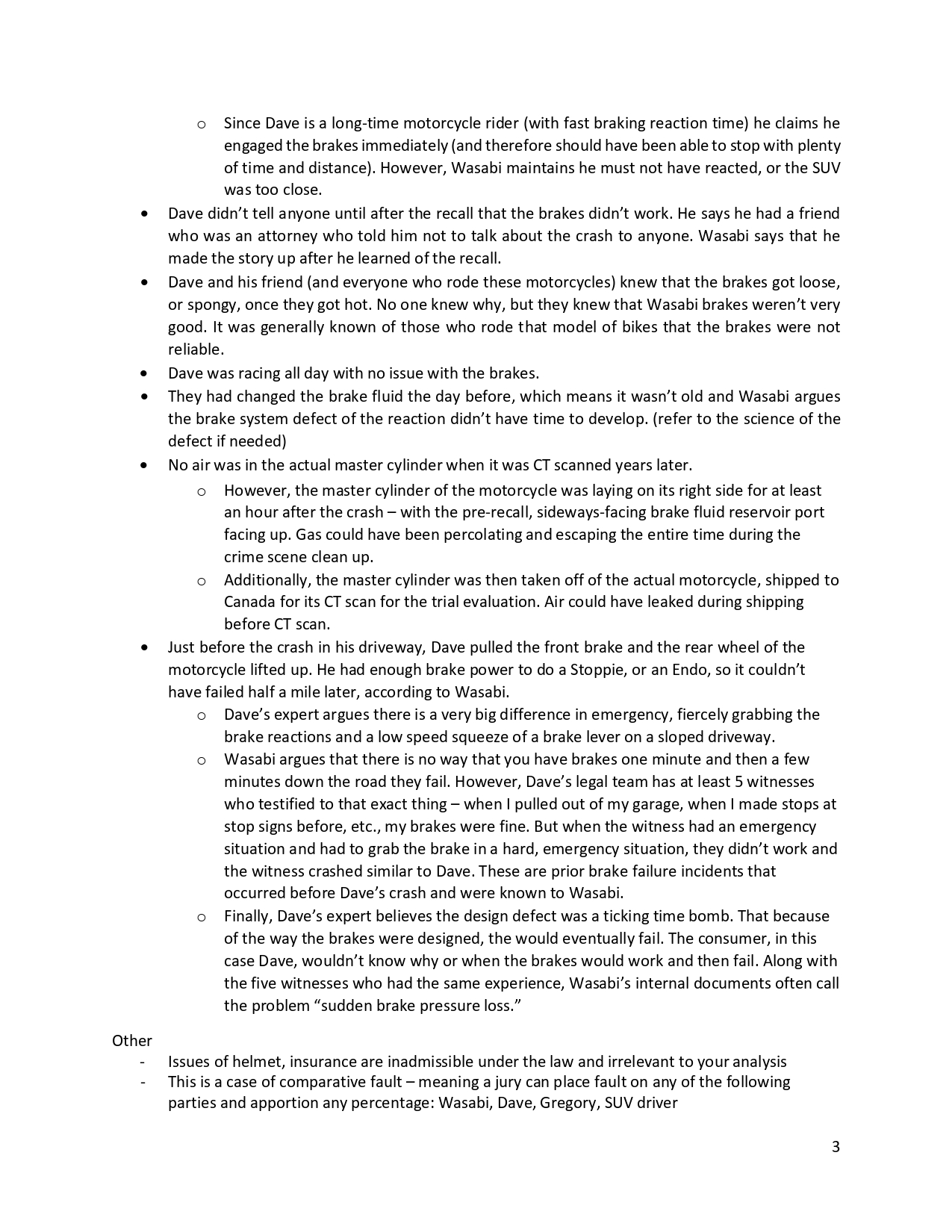
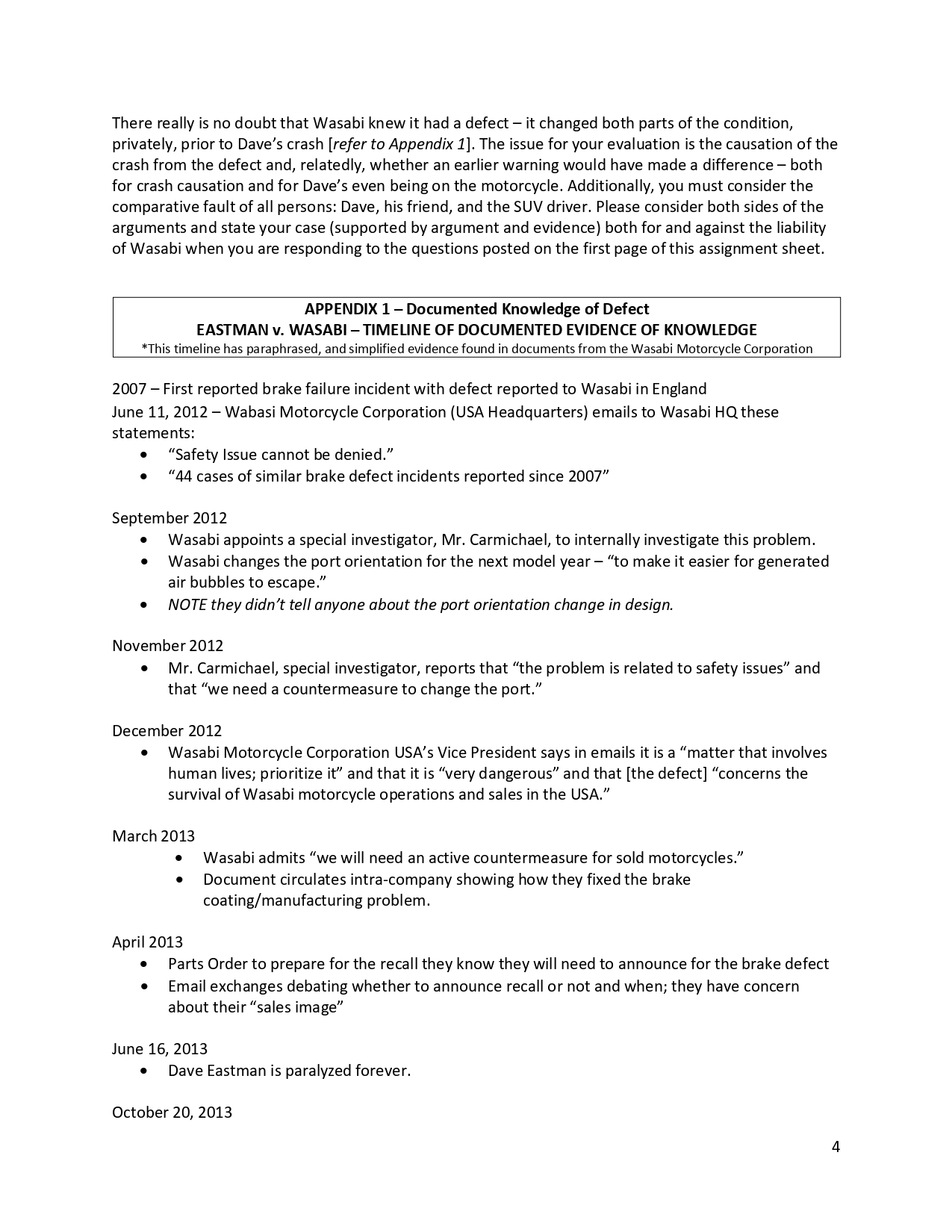
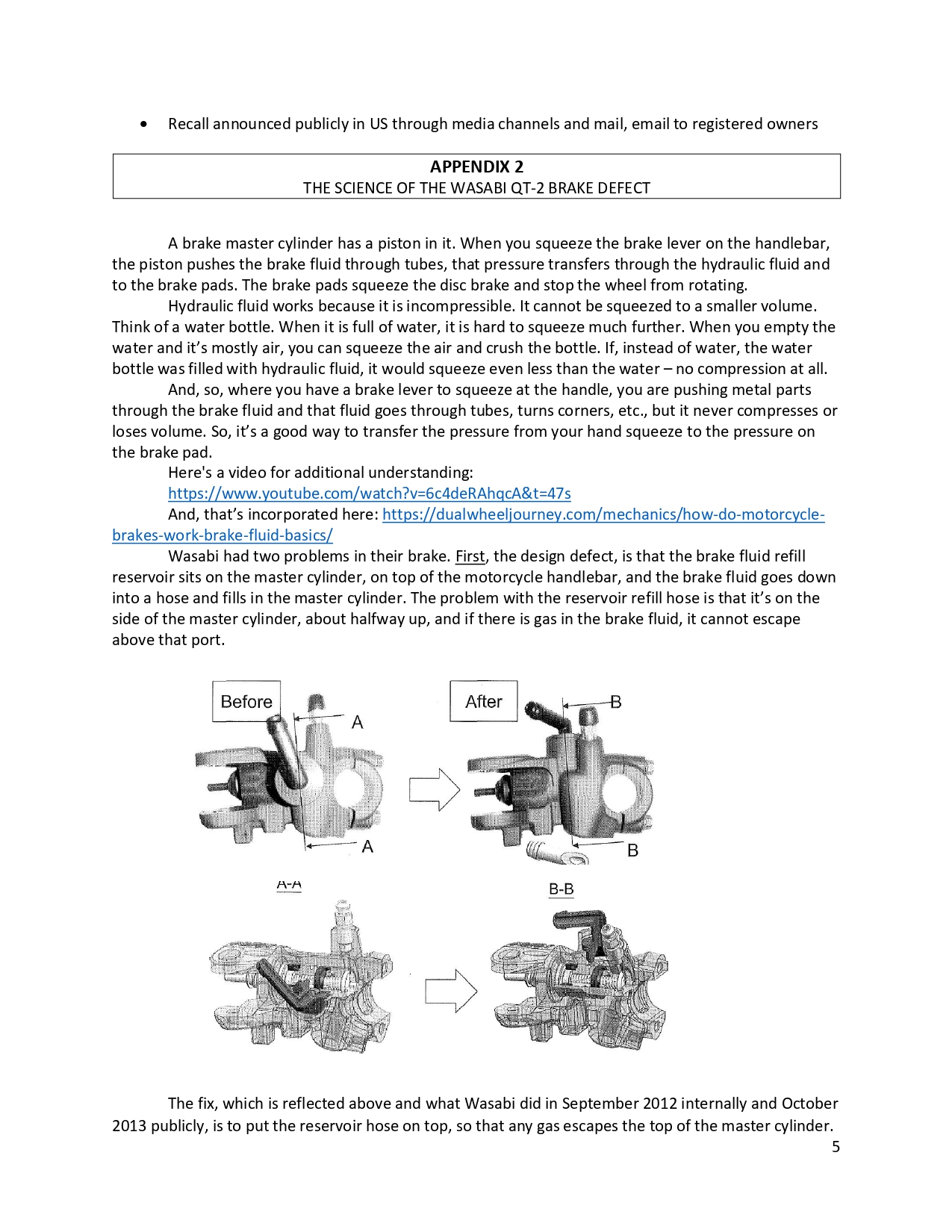
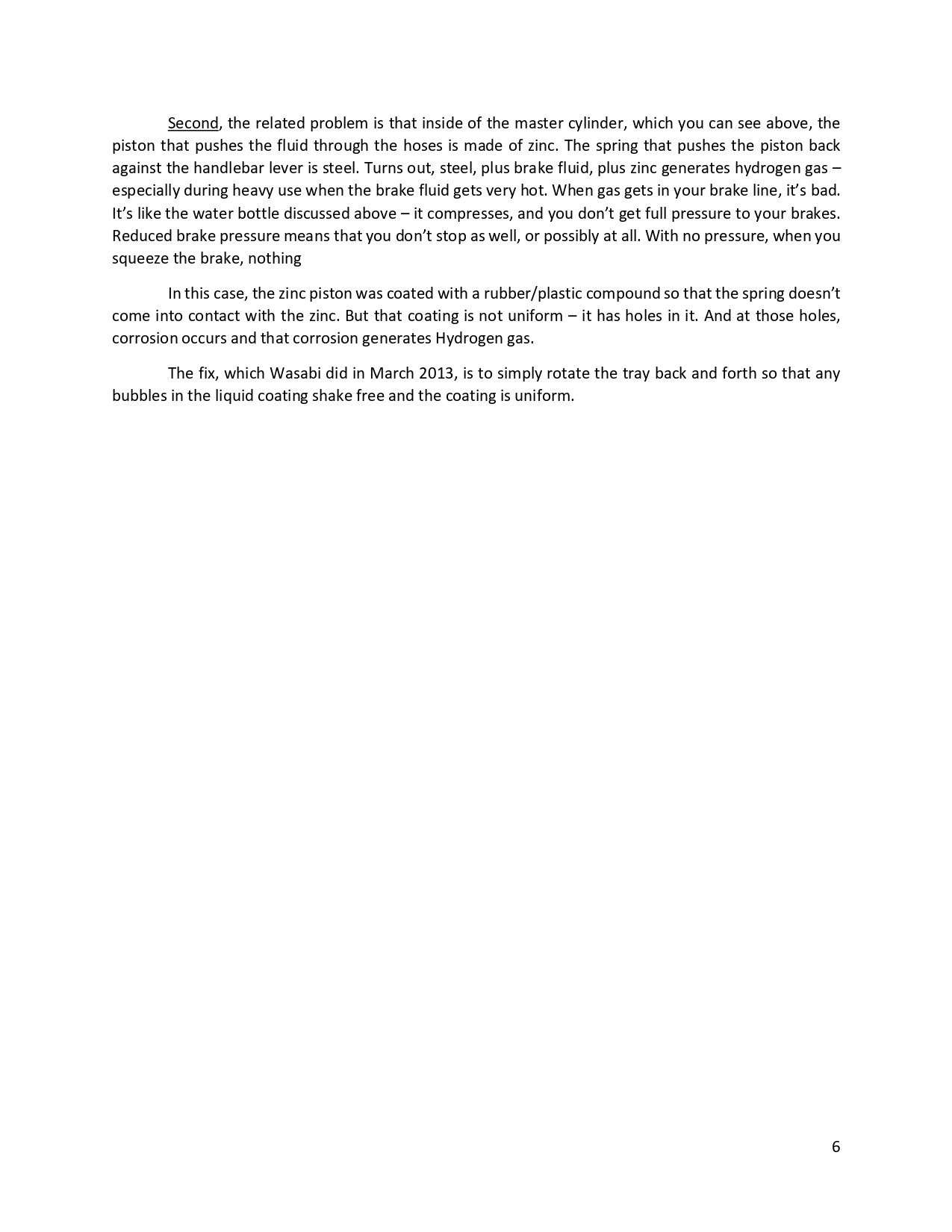
Torts Dave Eastman vs. Wasabi Motorcycle Corporation Dave: Dave Eastman is a motorcycle enthusiast and has been riding motorcycles almost his entire life since he earned his license about 18 years ago. He rides for leisure but also in organized groups on tracks for more advanced practice in controlled settings. Dave rides often enough and his interest high enough that his joy of motorcycle riding has also meant his friendships and social activities stem from riding bikes. Motorcycles really were his passion and his life. He rode a 2008 Wasabi Motorcycle Corporation Model CIT-2. In June 2013, Dave and his friend Gregory spent a few days at the track, for rider improvement days, practicing turning and cornering at high speeds, riding in groups, and other advanced motorcycle maneuvers. Once they finish riding that Saturday, they put their motorcycles in the back of Gregory's trailer, and they drive home an hour-and-a-half. They go to Dave's house to unload their motorcycles since they live very close to each other and it is easier to unload at Dave's house with the trailer. Like they have done many times before, Dave will ride Gregory's motorcycle home and Greg will follow in his truck to Greg's house after unloading. The plan is to take the motorcycle about two miles down the street to Gregoer house, drop it off, and go to eat dinner at Outback with some friends. On the way to the friend's house, an SUV turns left in front of Dave. Dave brakes immediately. Dave hits the front of the SUV, flips over the hood, and is now paralyzed from below his navel. Dave and Gregory both say that if they had known there was a concrete, identified problem with the motorcycle, they would have parked it and not ridden until there was a fix. So, Dave wouldn't even have been on the motorcycle that day. Dave hears about the Wasabi OT-2 recall in October 2013 {4 months after his crash) and pursues legal action against Wasabi suing for different causes of action against the company including strict products liability design defect and negligent failure to warn of a defect. Wasabi Motorcycle Company QTZ Model: Wasabi Motorcycle Corporation is a Japanese company that has headquarters both in Japan and a USA Wasabi Motorcycle Corporation Headquarters where they facilitate the US business on behalf of Wasabi's Japanese headquarters. Wasabi Japan issues a company-wide consumer recall in the USA in October 2013, known as the public recall informing consumers and owners by mail or email of a defect in its brakes. It is undisputed this October 2013 is the first and only public warning of the defect in the front brake master cylinder. Wasabi's October 2013 recal is for all 400,000 CIT-2 model Wasabi's from 2006 to 2013. [Appendix 2 is a detailed explanation of the brake defect] However, by September 2012, more than a year prior, Wasabi had already decided to fix the design defect to move the port to the top of the master cylinder "to make it easier for generated air bubbles to escape.\" But they don't tell anyone in the public and they don't put anything in writing. By March 2013, they have already decided to change the piston coating process to make it uniform and impede the corrosion process. They also tell no one of this and don't put it in writing. By April 2013, Wasabi orders 200,000 parts so that when the recall is announced, they have the parts on the shelf to fix the motorcycles. They ask the parts manufacturer to practice "information management" don't say that we've ordered parts because we've not publicly announced the recall yet. In September 2012, more than a year prior to the public recall in 2013, Wasabi had already decided to fix the design defect to move the port to the top of the master cylinder \"to make it easier for generated air bubbles to escape.\" But they don't tell anyone in the public and they don't put anything in writing. By March 2013, they have already decided to change the piston coating process to make it uniform and impede the corrosion process. They also tell no one of this and don't put it in writing. By April 2013, Wasabi orders 200,000 parts so that when the recall is announced, they have the parts on the shelf to fix the motorcycles. They ask their Wasabi dealerships to practice "information management\" for the parts don't say that we've ordered them because we've not publicly announced the recall yet. The September 2013 Wasabi Motorcycle Corporation CIT-2 Recall: o Fixes the Design Defect They move the brake fluid reservoir hose to the top of the master cylinder just like we see above and thus the gas can bubble up and out. No air stays trapped in the master cylinder. 0 Fixes the Manufacturing Defect the supplier simply rotates the tray of pistons during manufacturing so that bubbles get shaken out and the surface coating is uniform. The surface coating impedes chemical reactions and the generation of gas in the master cylinder. Additional Case Facts From DiscovegI Interviews, Investigation sl Degositions o Wasabi changed the brake structure more than a year before the recall (and year before Dave's crash} and Wasabi intentionally didn't say anything. 0 They changed the coating more than six months pre-recall, and intentionally didn't say anything. 0 Wasabi ordered parts because they wanted to be ready to replace them as soon as the recall was announced. Because, if they didn't have the parts on hand when recall was announced, everyone had to park their motorcycles and not drive them. That's bad for business. 0 Wasabi said that it was bad for business to do the recall during busy spring sales season \"there is a concern it could have a negative impact on retail sales if dealers are busy with the recall during the sales season.\" 0 During that intentional delay between Wasabi knowing of the bad braking system and the ultimate public warning in October 2013, Dave crashes and is paralyzed forever in June. 0 Dave's expert will testify there was corrosion on Dave's motorcycle master cylinder brake system when it was opened for legal case evaluation evidence of corrosion in line with the brake defect. o Wasabi's expert will say the amount of corrosion wasn't adequate to trigger the defect and that the motorcycle sat for 3 years before being opened so that we don't know how much of that corrosion was after the crash. 0 Note though: It was never ridden after the crash and Dave's metallurgist expert will say that the corrosion for a parked motorcycle will be minimal. 0 Dave and his friends guesstimate that the SUV was only 40 feet away when it turned, which is too close for him to have braked and it make a difference. {Wasabi claims that it wasn't the brakes that failed from the defect, the SUV was too close at time of accident for any braking to make a difference.) 0 The actual accident distance measured it from the point where Dave says he knew the SUVwas going to turn in front of him and it's 70.3 feet. Both parties agree to this distance. 0 Full braking power on the QT-2 requires 35-39 feet to stop. At 30 mph, you are traveling 44 feet per second. Other 0 Since Dave is a long-time motorcycle rider (with fast braking reaction time) he claims he engaged the brakes immediately (and therefore should have been able to stop with plenty of time and distance}. However, Wasabi maintains he must not have reacted, or the SUV was too close. Dave didn't tell anyone until after the recall that the brakes didn't work. He says he had a friend who was an attorney who told him not to talk about the crash to anyone. Wasabi says that he made the story up after he learned of the recall. Dave and his friend (and everyone who rode these motorcycles) knew that the brakes got loose, or spongy, once they got hot. No one knew why, but they knew that Wasabi brakes weren't very good. It was generally known of those who rode that model of bikes that the brakes were not reliable. Dave was racing all day with no issue with the brakes. They had changed the brake fluid the day before, which means it wasn't old and Wasabi argues the brake system defect of the reaction didn't have time to develop. (refer to the science of the defect if needed} No air was in the actual master cylinder when it was CT scanned years later. 0 However, the master wlinder of the motorwcle was laying on its right side for at least an hour after the crash with the pre-recall, sideways-facing brake fluid reservoir port facing up. Gas could have been percolating and escaping the entire time during the crime scene clean up. 0 Additionally, the master cylinder was then taken off of the actual motorcycle, shipped to Canada for its CT scan for the trial evaluation. Air could have leaked during shipping before CT scan. Just before the crash in his driveway, Dave pulled the front brake and the rear wheel of the motorcycle lifted up. He had enough brake power to do a Stoppie, or an Endo, so it couldn't have failed half a mile later, according to Wasabi. o Dave's expert argues there is a very big difference in emergency, fiercely grabbing the brake reactions and a low speed squeeze of a brake lever on a sloped driveway. o Wasabi argues that there is no way that you have brakes one minute and then a few minutes down the road they fail. However, Dave's legal team has at least 5 witnesses who testified to that exact thing when I pulled out of my garage, when I made stops at stop signs before, etc., my brakes were fine. But when the witness had an emergency situation and had to grab the brake in a hard, emergenqt situation, they didn't work and the witness crashed similar to Dave. These are prior brake failure incidents that occurred before Dave's crash and were known to Wasabi. 0 Finally, Dave's expert believes the design defect was a ticking time bomb. That because of the way the brakes were designed, the would eventually fail. The consumer, in this case Dave, wouldn't know why or when the brakes would work and then fail. Along with the five witnesses who had the same experience, Wasabi's internal documents often call the problem \"sudden brake pressure loss.\" Issues of helmet, insurance are inadmissible under the law and irrelevant to your analysis This is a case of comparative fault meaning a jury can place fault on any of the following parties and apportion any percentage: Wasabi, Dave, Gregory, SUV driver There really is no doubt that Wasabi knew it had a defect it changed both parts of the condition, privately, prior to Dave's crash [refer to Appendix 1]. The issue for your evaluation is the causation of the crash from the defect and, relatedly, whether an earlier warning would have made a difference both for crash causation and for Dave's even being on the motorcycle. Additionally, you must consider the comparative fault of all persons: Dave, his friend, and the SUV driver. Please consider both sides of the arguments and state your case {supported by argument and evidence} both for and against the liability of Wasabi when you are responding to the questions posted on the first page ofthis assignment sheet. APPENDIX 1 Documented Knowledge of Defect EASTMAN v. WASABI TIMEUNE 0F DOCUMENTED EVIDENCE OF KNOWLEDGE *This timeline has paraphrased, and simplified evidence found in documents from the Wasabi Motorcycle Corporation 2007 First reported brake failure incident with defect reported to Wasabi in England June 11, 2012 Wabasi Motorcycle Corporation {USA Headquarters) emails to Wasabi Hchese statements: 0 \"Safety Issue cannot be denied.\" 0 "44 cases of similar brake defect incidents reported since 2007\" September 2012 0 Wasabi appoints a special investigator, Mr. Carmichael, to internally investigate this problem. 0 Wasabi changes the port orientation for the next model year \"to make it easier for generated air bubbles to escape.\" 0 NOTE they didn't teii anyone about the port orientation change in design. November 2012 0 Mr. Carmichael, special investigator, reports that "the problem is related to safety issues\" and that "we need a countermeasure to change the port.\" December 2012 0 Wasabi Motorcycle Corporation USA's Vice President says in emails it is a \"matter that involves human lives; prioritize it" and that it is \"very dangerous\" and that [the defect] "concerns the survival of Wasabi motorcycle operations and sales in the USA.\" March 2013 0 Wasabi admits "we will need an active countermeasure for sold motorcycles.\" 0 Document circulates intra-company showing how they fixed the brake coating/manufacturing problem. April 2013 0 Parts Order to prepare for the recall they know they will need to announce for the brake defect 0 Email exchanges debating whether to announce recall or not and when; they have concern about their "sales image\" June 15, 2013 0 Dave Eastman is paralyzed forever. October 20, 2013 0 Recall announced publicly in US through media channels and mail, email to registered owners APPENDIX 2 THE SCIENCE OF THE WASABI CIT-2 BRAKE DEFECT A brake master cylinder has a piston in it. When you squeeze the brake lever on the handlebar, the piston pushes the brake fluid through tubes, that pressure transfers through the hydraulic fluid and to the brake pads. The brake pads squeeze the disc brake and stop the wheel from rotating. Hydraulic fluid works because it is incompressible. It cannot be squeezed to a smaller volume. Think of a water bottle. When it is full of water, it is hard to squeeze much further. When you empty the water and it's mostly air, you can squeeze the air and crush the bottle. If, instead of water, the water bottle was filled with hydraulic fluid, it would squeeze even less than the water no compression at all. And, so, where you have a brake lever to squeeze at the handle, you are pushing metal parts through the brake fluid and that fluid goes through tubes, turns corners, etc., but it never compresses or loses volume. So, it's a good way to transfer the pressure from your hand squeeze to the pressure on the brake pad. Here's a video for additional understanding: htt 5: www. outube.com watch?v=6c4deRAh cA&t=47s And, that's incorporated here: htt s: dualwheel'ourne .com mechanics how-do-motorc cle- brakes-workbrake-fluid-basics( Wasabi had two problems in their brake. E, the design defect, is that the brake fluid refill reservoir sits on the master cylinder, on top of the motorcycle handlebar, and the brake fluid goes down into a hose and fills in the master cylinder. The problem with the reservoir refill hose is that it's on the side of the master cylinder, about halfway up, and if there is gas in the brake fluid, it cannot escape above that port. The fix, which is reflected above and what Wasabi did in September 2012 internally and October 2013 publicly, is to put the reservoir hose on top, so that any gas escapes the top of the master cylinder. 5 Second. the related problem is that inside of the master cylinder, which you can see above, the piston that pushes the fluid through the hoses is made of zinc. The spring that pushes the piston back against the handlebar lever is steel. Turns out, steel, plus brake fluid, plus zinc generates hydrogen gas especially during heavy use when the brake fluid gets very hot. When gas gets in your brake line, it's bad. It's like the water bottle discussed above it compresses, and you don't get full pressure to your brakes. Reduced brake pressure means that you don't stop as well, or possibly at all. With no pressure, when you squeeze the brake, nothing In this case, the zinc piston was coated with a rubberfplastic compound so that the spring doesn't come into contact with the zinc. But that coating is not uniform it has holes in it. And at those holes, corrosion occurs and that corrosion generates Hydrogen gas. The fix, which Wasabi did in March 2013, is to simply rotate the tray back and forth so that any bubbles in the liquid coating shake free and the coating is uniform
Step by Step Solution
There are 3 Steps involved in it

Get step-by-step solutions from verified subject matter experts