Question: Read the Case Study 3.4, Determination of Supervisory Status Answer the question at the bottom of the case study from your assigned role's perspective. From
Read the Case Study 3.4, Determination of Supervisory Status
Answer the question at the bottom of the case study from your assigned role's perspective. From your assigned perspective write your argument for the following question:
Should the docking pilots be classified as supervisors and thus excluded from participating in a bargaining unit for purposes of collective bargaining?
- For the manager, list all the reasons why you think the docking pilots are supervisors.
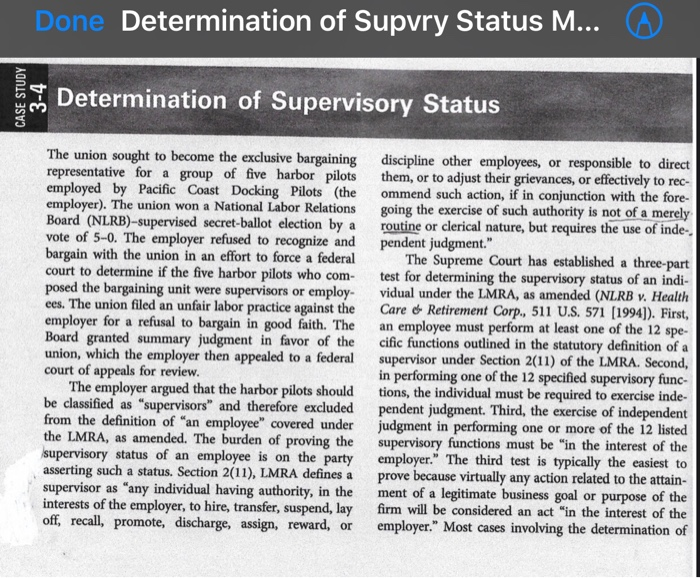
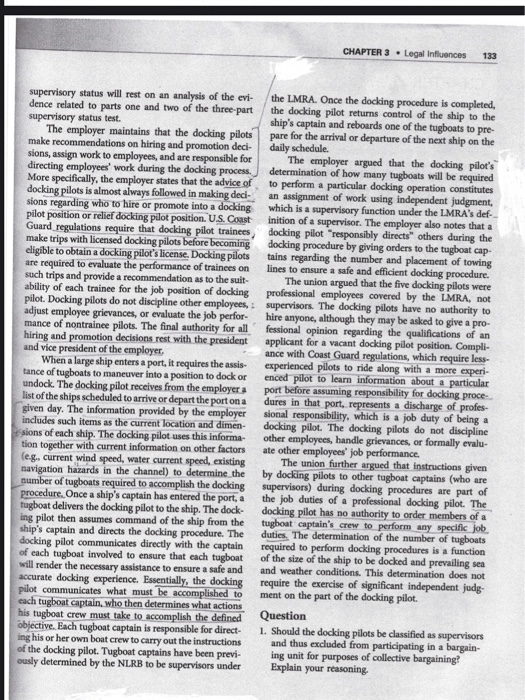
Done Determination of Supvry Status M... CASE STUDY 3-4 Determination of Supervisory Status The union sought to become the exclusive bargaining representative for a group of five harbor pilots employed by Pacific Coast Docking Pilots (the employer). The union won a National Labor Relations Board (NLRB)-supervised secret-ballot election by a vote of 5-0. The employer refused to recognize and bargain with the union in an effort to force a federal court to determine if the five harbor pilots who com- posed the bargaining unit were supervisors or employ- ees. The union filed an unfair labor practice against the employer for a refusal to bargain in good faith. The Board granted summary judgment in favor of the union, which the employer then appealed to a federal court of appeals for review. The employer argued that the harbor pilots should be classified as "supervisors" and therefore excluded from the definition of an employee" covered under the LMRA, as amended. The burden of proving the supervisory status of an employee is on the party asserting such a status. Section 2(11), LMRA defines a supervisor as "any individual having authority, in the interests of the employer, to hire, transfer, suspend, lay off, recall, promote, discharge, assign, reward, or discipline other employees, or responsible to direct them, or to adjust their grievances, or effectively to rec- ommend such action, if in conjunction with the fore- going the exercise of such authority is not of a merely routine or clerical nature, but requires the use of inde- pendent judgment." The Supreme Court has established a three-part test for determining the supervisory status of an indi- vidual under the LMRA, as amended (NLRB v. Health Care & Retirement Corp., 511 U.S. 571 [1994]). First, an employee must perform at least one of the 12 spe- cific functions outlined in the statutory definition of a supervisor under Section 2(11) of the LMRA. Second, in performing one of the 12 specified supervisory func- tions, the individual must be required to exercise inde- pendent judgment. Third, the exercise of independent judgment in performing one or more of the 12 listed supervisory functions must be "in the interest of the employer." The third test is typically the easiest to prove because virtually any action related to the attain- ment of a legitimate business goal or purpose of the firm will be considered an act "in the interest of the employer." Most cases involving the determination of CHAPTER 3 Legal Influences 133 supervisory status will rest on an analysis of the evi the LMRA. Once the docking procedure is completed, dence related to parts one and two of the three-part the docking pilot returns control of the ship to the supervisory status test. ship's captain and reboards one of the tugboats to pre- The employer maintains that the docking pilots pare for the arrival or departure of the next ship on the make recommendations on hiring and promotion deci daily schedule. sions, assign work to employees, and are responsible for The employer argued that the docking pilot's directing employees' work during the docking process. determination of how many tugboats will be required More specifically, the employer states that the advice of to perform a particular docking operation constitutes docking pilots is almost always followed in making deci an assignment of work using independent judgment, sions regarding who to hire or promote into a docking which is a supervisory function under the LMRA's def- pilot position or relief docking pilot position. U.S. Coast inition of a supervisor. The employer also notes that a Guard regulations require that docking pilot trainees, docking pilot "responsibly directs" others during the make trips with licensed docking pilots before becoming docking procedure by giving orders to the tugboat cap- eligible to obtain a docking pilot's license. Docking pilots tains regarding the number and placement of towing are required to evaluate the performance of trainees on lines to ensure a safe and efficient docking procedure. such trips and provide a recommendation as to the suit The union argued that the five docking pilots were ability of each trainee for the job position of docking professional employees covered by the LMRA, not pilot. Docking pilots do not discipline other employees, supervisors. The docking pilots have no authority to adjust employee grievances, or evaluate the job perfor hire anyone, although they may be asked to give a pro- mance of nontrainee pilots. The final authority for all fessional opinion regarding the qualifications of an hiring and promotion decisions rest with the president applicant for a vacant docking pilot position. Compli- and vice president of the employer, ance with Coast Guard regulations, which require less- When a large ship enters a port, it requires the assis experienced pilots to ride along with a more experi- tance of tugboats to maneuver into a position to dockor enced pilot to learn information about a particular undock. The docking pilot receives from the employer a port before assuming responsibility for docking proce list of the ships scheduled to arrive or depart the port on a dures in that port, represents a discharge of profes- given day. The information provided by the employer sional responsibility, which is a job duty of being a includes such items as the current location and dimen docking pilot. The docking pilots do not discipline sions of each ship. The docking pilot uses this informa other employees, handle grievances, or formally evalu- tion together with current information on other factors ate other employees' job performance. (e.g, current wind speed, water current speed, existing The union further argued that instructions given navigation hazards in the channel) to determine the by docking pilots to other tugboat captains (who are number of tugboats required to accomplish the docking supervisors) during docking procedures are part of procedure. Once a ship's captain has entered the port, a the job duties of a professional docking pilot. The tugboat delivers the docking pilot to the ship. The dock docking pilot has no authority to order members of a ing pilot then assumes command of the ship from the tugboat captain's crew to perform any specific job ship's captain and directs the docking procedure. The duties. The determination of the number of tugboats docking pilot communicates directly with the captain required to perform docking procedures is a function of each tugboat involved to ensure that each tugboat of the size of the ship to be docked and prevailing sea will render the necessary assistance to ensure a safe and and weather conditions. This determination does not accurate docking experience. Essentially, the docking require the exercise of significant independent judg. pilot communicates what must be accomplished to ment on the part of the docking pilot. cach tugboat captain, who then determines what actions his tugboat crew must take to accomplish the defined Question objective. Each tugboat captain is responsible for direct 1. Should the docking pilots be classified as supervisors ing his or her own boat crew to carry out the instructions and thus excluded from participating in a bargain- of the docking pilot. Tugboat captains have been previ ing unit for purposes of collective bargaining? ously determined by the NLRB to be supervisors under Explain your reasoning









 Study Help