







Question: Read the case study ABC Childcare, present and defend your analysis based on one of the organizational frames: ABC CHILDCARE MY HANDS ARE TIED by
Read the case study ABC Childcare, present and defend your analysis based on one of the organizational frames: 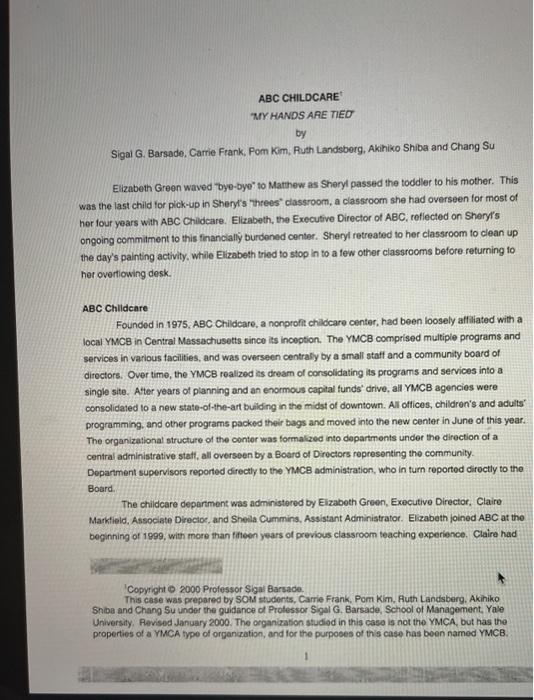
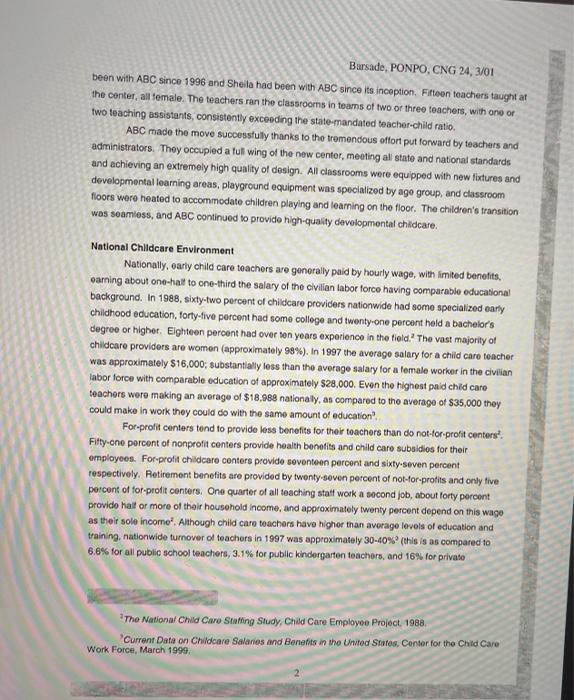
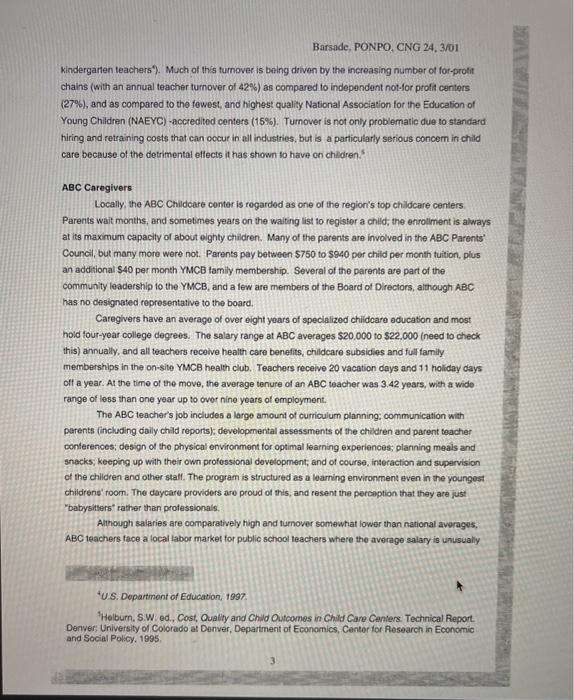
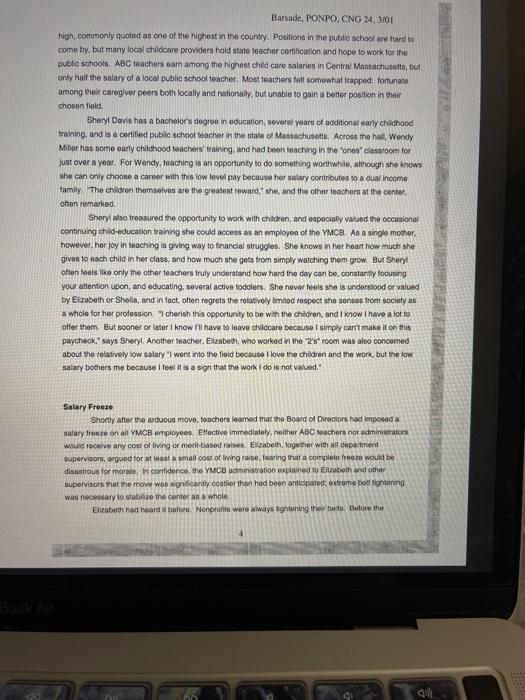
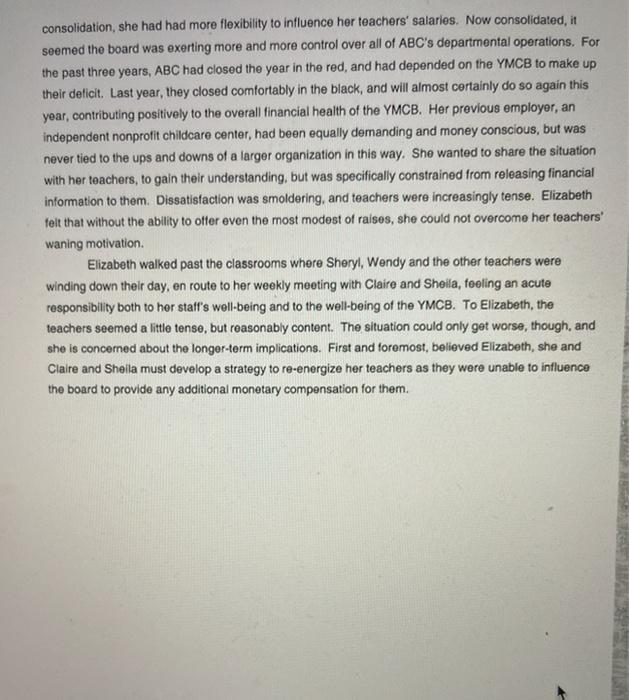
ABC CHILDCARE "MY HANDS ARE TIED by Sigal G. Barsade. Carrie Frank, Pom Kim, Ruth Landsberg, Akihiko Shiba and Chang Su Elizabeth Green waved "bye-byo to Matthew as Sheryl passed the toddler to his mother. This was the last child for pick-up in Sheryl's "Threes" classroom, a classroom she had overseen for most of her four years with ABC Childcare. Elizabeth, the Executive Director of ABC, reflected on Sheryl's ongoing commitment to this financially burdened center. Sheryl retreated to her classroom to clean up the day's painting activity, while Elizabeth tried to stop in to a few other classrooms before returning to her overflowing desk. ABC Childcare Founded in 1975. ABC Childcare, a nonprofit childcare center, had been loosely affiliated with a local YMCB in Central Massachusetts since its inception. The YMCB comprised multiple programs and services in various facilities, and was overseen centrally by a small staff and a community board of directors. Over time, the YMCB realized its dream of consolidating its programs and services into a single site. After years of planning and an enormous capital funds drive, all YMCB agencies were consolidated to a new state-of-the-art building in the midst of downtown. All offices, children's and adults programming and other programs packed their bags and moved into the new center in June of this year. The organizational structure of the conter was formalized into departments under the direction of a central administrative staff, all overseen by a Board of Directors representing the community Department supervisors reported directly to the YMCB administration, who in turn reported directly to the Board The childcare department was administered by Elzabeth Green, Executive Director, Claire Markfield, Associate Director, and Sheila Cummins, Assistant Administrator. Elizabeth joined ABC at the beginning of 1999, with more than fifteen years of previous classroom teaching experience, Claire had Copyright 2000 Professor Sight Barsade. This case was prepared by SOM students, Carrie Frank, Pom Kim, Ruth Landsberg, Akihiko Shiba and Chang Su under the guidance of Professor Sigal G. Barsade, School of Management, Yale University, Revised January 2000. The organization studied in this case is not the YMCA, but has the properties of a YMCA type of organization, and for the purposes of this case has been named YMCB. Bursade, PONPO, CNG 24, 3/01 been with ABC since 1996 and Sheila had been with ABC since its inception, Fiftoon teachers taught at the center, all female. The teachers ran the classrooms in teams of two or three teachers, with one or two teaching assistants, consistently exceeding the state-mandated teacher-child ratio. ABC made the move successfully thanks to the tremendous effort put forward by teachers and administrators. They occupied a ful wing of the new center, meeting all state and national standards and achieving an extremely high quality of design. All classrooms were equipped with new fixtures and developmental learning areas, playground equipment was specialized by age group and classroom floors were heated to accommodate children playing and learning on the floor. The children's transition was seamless, and ABC continued to provide high-quality developmental childcare. National Childcare Environment Nationally, early child care teachers are generally paid by hourly wage, with limited benefits, earning about one-half to one-third the salary of the civilian labor forco having comparable educational background. In 1988, sixty-two percent of childcare providers nationwide had some specialized early childhood education, forty-five percent had some college and twenty-one percent hold a bachelor's degree or higher. Eighteen percent had over ton years experience in the field. The vast majority of childcare providers are women (approximately 98%). In 1997 the average salary for a child care teacher was approximately $16,000; substantially less than the average salary for a female worker in the civilian labor force with comparable education of approximately $28,000. Even the highest paid child caro teachers were making an average of $18,988 nationally, as compared to the average of $35,000 they could make in work they could do with the same amount of education! For-profit centers tend to provide less benefits for their toachers than do not-for-profit centers". Fifty-one percent of nonprofit centers provide health benefits and child care subsidios for their employees. For-profit childcare centers provide seventeen percent and sixtyseven percent respectively. Retirement benefits are provided by twenty-seven percent of not-for-profits and only five percent of for-profit centers. Ono quarter of all teaching staff work a second job, about forty percent provido hall or more of their household income, and approximately twenty percent depend on this wago as their sole income'. Although child care toachers have higher than average levels of education and training, nationwide tumover of teachers in 1997 was approximately 30-40% (this is as compared to 6.8% for all public school teachers, 3.1% for public kindergarten teachers, and 16% for privato The National Child Care Staffing Study, Child Care Employee Project. 1988, Current Data on Childcare Salaries and Benefits in the United States. Contor for the Child Care Work Force, March 1999, Barsade, PONPO, CNG 24,3/01 kindergarten teachers'). Much of this turnover is being driven by the increasing number of for-profit chains (with an annual teacher turnover of 42%) as compared to independent not-for profit centers (27%), and as compared to the fewest, and highest quality National Association for the Education of Young Children (NAEYC) -accredited centers (15%). Turnover is not only problematic due to standard hiring and retraining costs that can oocur in all industries, but is a particularly serious concern in child care because of the detrimental effects it has shown to have on children ABC Caregivers Locally, the ABC Childcare contor is regarded as one of the region's top childcare centers Parents wait months, and sometimes years on the waiting list to register a child, the enrollment is always at its maximum capacity of about eighty children. Many of the parents are involved in the ABC Parents' Council, but many more were not. Parents pay between $750 to $940 per child per month tuition, plus an additional $40 per month YMCB family membership. Several of the parents are part of the community leadership to the YMCB, and a few are members of the Board of Directors, although ABC has no designated representative to the board. Caregivers have an average of over eight years of specialized childcare education and most hold four-year college degrees. The salary range at ABC averages $20,000 to $22,000 (need to check this) annually, and all teachers receive health care benefits, childcare subsidies and full family memberships in the on-site YMCB health club. Teachers receive 20 vacation days and 11 holiday days off a year. At the time of the move, the average tenure of an ABC teacher was 3.42 years, with a wide range of less than one yoar up to over nine years of employment. The ABC teacher's job includes a large amount of curriculum planning, communication with parents (including daily child reports), developmental assessments of the children and parent teacher conferences: design of the physical environment for optimal learning experiences; planning meals and snacks, keeping up with their own professional development, and of course, interaction and supervision of the children and other stall. The program is structured as a learning environment even in the youngest childrens' room. The daycare providers are proud of this, and resent the perception that they are just "babysitters rather than professionals Although salaries are comparatively high and turnover somewhat lower than national averages. ABC teachers taco a local labor market for public school teachers where the average salary is unusually U.S. Department of Education, 1997 Helburn, S.W. ed., Cost, Quality and Child Outcomes in Child Care Centers. Technical Report Denver University of Colorado at Denver, Department of Economics, Center for Research in Economic and Social Policy, 1995 3 Barsade, PONPO, CNG 24, 31/01 high, commonly quoted as one of the highest in the country. Positions in the public school are hard to come by, but many local childcare providers hold state teacher certification and hope to work for the public schools ABC teachers eam among the highest child care salaries in Central Mastachusetts, but only half the salary of a local public school teacher. Most teachers fell somewhat frapped: fortunato among their caregiver peers both locally and nationally, but unable to gain a better position in their chosen field Sheryl Davis has a bachelor's degree in education, several years of additional early childhood training, and is a certified public school teacher in the state of Massachusetts. Across the hall, Wendy Miler has some early childhood teachers training, and had been teaching in the ones classroom for just over a year. For Wendy, teaching is an opportunity to do something worthwhile, although she knows she can only choose a career with this low level pay because her salary contributes to a dual income family The children themselves are the greatest reward," she and the other teachers at the center often remarked Sheryl also treasured the opportunity to work with children, and especially valued the occasional continuing child-education training she could access as an employee of the YMCB. As a single mother however, her joy in teaching is giving way to financial struggles. She knows in her heart how much she gives to each child in her class, and how much she gets from simply watching them grow. But Sheryl often feels like only the other teachers truly understand how hard the day can be constantly focusing your attention upon, and educating, several active toddlers. She never feels she is understood or valued by Elzabeth or Sheila, and in fact, often regrets the relatively limited respect she senses from society as a whole for her profession cherish this opportunity to be with the children, and I know I have a lot to offer them. But sooner or later I know I'll have to leave childcaro because I simply can't make it on this paycheck." says Sheryl. Another teacher, Eizabeth, who worked in the room was also concerned about the relatively low salary "I went into the field because I love the children and the work, but the low salary bothers me because I feel it is a sign that the work I do is not valued. Salary Free Shortly after the arduous movo, foachers warned that the Board of Directors had imposed a salary freeze on all YMCB employees. Effective immediately. neither ABC teachers nor administrators would receive a cost of living or merit-based raises Ezabeth, together with all department Supervisors, argued for at least a small cost of living raiso, foaring that a complete frecce would be disastrous for morate in confidence, the YMCB administration explained to Euabeth and other supervisors that the move was ridicantly costier than had been anticipated extremo boll tightening was necessary to stabilize the center as a whole Elaboth had heard at before. Nonprofits were always stoning their bets Before the consolidation, she had had more flexibility to influence her teachers' salaries. Now consolidated, it seemed the board was exerting more and more control over all of ABC's departmental operations. For the past three years, ABC had closed the year in the red, and had depended on the YMCB to make up their deficit. Last year, they closed comfortably in the black, and will almost certainly do so again this year, contributing positively to the overall financial health of the YMCB. Her previous employer, an independent nonprofit childcare center, had been equally demanding and money conscious, but was never tied to the ups and downs of a larger organization in this way. She wanted to share the situation with her teachers, to gain their understanding, but was specifically constrained from releasing financial information to them. Dissatisfaction was smoldering, and teachers were increasingly tense. Elizabeth felt that without the ability to offer even the most modest of raises, she could not overcome her teachers' waning motivation Elizabeth walked past the classrooms where Sheryl, Wendy and the other teachers were winding down their day, en route to her weekly meeting with Claire and Shella, feeling an acute responsibility both to her staff's well-being and to the well-being of the YMCB. To Elizabeth, the teachers seemed a little tense, but reasonably content. The situation could only get worse, though, and she is concerned about the longer-term implications. First and foremost, believed Elizabeth, she and Claire and Shella must develop a strategy to re-energize her teachers as they were unable to influence the board to provide any additional monetary compensation for them
Step by Step Solution
There are 3 Steps involved in it
1 Expert Approved Answer
Step: 1 Unlock

Question Has Been Solved by an Expert!
Get step-by-step solutions from verified subject matter experts
Step: 2 Unlock
Step: 3 Unlock
 Study Help