







Question: Read the case study and then follow the Marking Template to write your report in the space below. you run out of space, you can
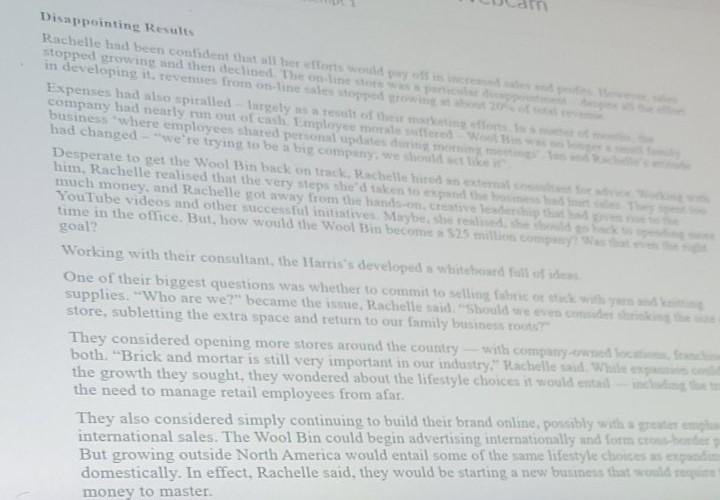
Read the case study and then follow the Marking Template to write your report in the space below. you run out of space, you can go to Question 2 and continue writing. If you don't run out of space, you don't need to use Question 2. The Wool Bin is a yarn and fabric retailer with one physical location in Toronto, Canada and a website for on-line sales. Its customers are individuals who enjoy knitting or making clothes at home. The company which now has 35 employees was owned by Rachelle and Tan Harris. Rachelle had worked in sales for an investment firm for ten years when she saw a niche in the knitting market that wasn't being satisfied and established the company in 2009 with $25,000 in savings. The Company was successful from the outset, growing from revenue of $100.000 in 2009, to si million in 2015, and to $4.5 million in 2017. Rachelle put in place numerous strategies to maintain revenue growth and to increase it further. However, in early 2018, the Wool Bin's sales increases had declined to zero percent and soon sales declined for the first time since the company was started. The decline continued, and the Harris's had to stop taking salaries and in some months pay employees out of their savings, as the company was not generating sufficient cash. Background Yarns are used in knitting. They are made from Natural (wool or cotton) and synthetic (man-made) fibres Knitting is the process of using two or more needles to manipulate yarn to create loops that result in a tes or article of clothing (scarf, socks, sweater, etc.). Today most clothes sold in stores and online are mass produced: made by machines in low wage countries like Bangladesh, Vietnam, and others primarily in Some high end designers produced hand made knitwear, but this was a very small segment of the clot- market. mtr roft Yarn and Premium Yarn. Craft yarn is primari old then Background Yarns are used in knitting. They are made from Natural wool or cotton and synthetic man-made bres Knitting is the process of using two or more needles to manipulate yarn to create loop vatretult in a textile or article of clothing (scarl, socks, swenter, etc.). Today most clothes sold in stores and online are produced: made by machines in low wage countries like Bangladesh Vietnam, and others inatily in Asts Some high end designers produced hand made Knitwear, but this was very small segment of the clothing market The yarn industry is made up of two segmente: Craft Yam and Premium Yam. Craft yam is primarily old big box stores (eg Wal-Marty and at craft stores og Michaels), while premium yam is sold through local yarn shops (LYS) and online stores. There are several thousand local yarn tihops in North America. Almond all are relatively small and many are family businesses, or have grown out of family businesses In recent years, approximately 30 million people in Canada and the United States participated in knitting spending approximately $3.0 billion annually. Seventy percent of knitters are women. The age of knitters is spread evenly rom 18 75. That is, young people are just as likely to knit older people. The number of knitters has fluctuated over the past decades it enjoys brief bursts of growth and populatity before sinking back to its core market five to seven years later. Wool Bin was founded near the beginning of one of these knitting booms'. Knitters overwhelmingly favour physical stores to purchase their supplies, although most do online resear before purchasing. 77% buy their supplies exclusively in a store: 4% buy exclusively online, and 19 bo both at a retail store and online. Wool Bin The Wool Bin was originally a small storefront operation in Toronto that opened in 2009. Rachelle in using social media, most notably posting product reviews and instructional videos on YouTube al from the beginning. This increased the customer base of the store from its original neighbourhood wide. The Company purchased most of its craft yarn from one of three main distributors in North Ames Kertzer, Diamond, and Coats. Premium yarns (those with particular textures or colours) are high Win in moment wide Kentrer Diamond and Tommy thout purchased from a number of independent prette in North America most were relatively small 60 and other onttinst supplies to 20 In 2014. Ian qut his job in the technolony industry and the on establishing and growing the online business Combined with the sales took of hitting 54.5 million in 2018. The majority of events from morning tonight. Online sales prew slowly over the years Expansion In 2017 the Harris's decided to add fabrics to their existing product line of yaman The Company invested $250,000 in inventory and estimated that total reven to five years because of the expanded product line Fabric is another name for cloth together cotton, nylon, wool, silk, or other threads and is used by homes for the clothes, curtains, cushion covers, etc. At the same time, the Harris's left their original 3500 sq ft the retail outlet for a 20.000 square included retail showroom, warehouse and offices. They spent 550.000 making modificata Not only was the new location much larger, but it was in a better part of the city, which payments skyrocketed. Stall also had to be added. The size of the new store was roughly the same as a Michael's craft and hobby store Michael store that sells some yarn and knitting supplies, but that was only a small part (15) of Schals iditinn Michael's generally sold lower quality craft yams. The other lateret hand bcam Higesting store in the GIA by a wide margin Rachelle spent less time on guiding the day-to-day operations of the company and more time beam ambassador for the Wool Bin She left matingement to one of the term employees and pattery to grow the company in both the Canadian and US markets in order to make the old the introduced numerous initiatives, including sponsorship support of clans inced advertising In order to support the growth, the Company increased its marketing star to eight time empleyors Previously three people had contributed to the marketing effort at the same times working in the warehouse. The Company also hired two IT professionals to help tan with that side of the bus the extra help. Rachelle bad less time to knit herself and stopped porking on YouTube For the next year, Rachelle travelled constantly. She joined a campaign to get there to emitace which made numerous promotional stops at professional sports training Incilities Shelterede minute 'infomercial for TSC - The Shopping Channel and discussed potential partners with the candidates. Her next project was to see if they could develop a line of business teaching, Knitting conventions and supplying yarn to the attendees While all this was going on. Rachelle even managed to publish a book primarily written on simples hotels while travelling) which showed winter sports enthusiasts how to knit their owtarments and accessories. By the end of 2017 she was exhausted, Disappointing Results Rachelle had been confident that all her efforts would pay off in increased sales and profits. However, tales stopped growing and then declined. The on-line store was a particular disappointment - despite all the lion in developing it, revenues from on-line sales stopped growing at about 20% of total revenue Expenses had also spiralled - largely as a result of their marketing efforts. In a matter of months, the company had nearly run out of cash. Employee morale suffered - Wool Bin was no longer a small family business 'where employees shared personal updates during morning meetings'. Tan and Rachelle's attit had changed "We're trying to be a big company, we should act like it. Desperate to get the Wool Bin back on track, Rachelle hired an external consultant for advice Working Disappointing Results Rachelle had been confident that all her stopped growing and then declined the online in developing it revenues from online Expenses had also spitalled lyst of the company bad nearly run out of each Employee mettere business where employees shared person updates du had changed we're trying to be able company white Desperate to get the Wool Bin back on track Rachelle him, Rachelle realised that the very steps the'd taken to end much money, and Rachelle not away from the hands-on chevel YouTube videos and other successful initiatives Maybe here time in the office. But, how would the Wool Bin become 525 million goal? Working with their consultant, the Hams's developed a white fille One of their biggest questions was whether to commit to show supplies. "Who are we? became the issue. Rachelle said. Should we de store, subletting the extra space and return to our family business They considered opening more stores around the country with company both "Brick and mortar is still very important in our industry" Rachelles the growth they sought, they wondered about the lifestyle choices it would the need to manage retail employees from afar They also considered simply continuing to build their brand online, possibly with a international sales. The Wool Bin could begin advertising internationally and form But growing outside North America would entail some of the same lifestyle choices and domestically. In effect. Rachelle said, they would be starting a new business that money to master
Step by Step Solution
There are 3 Steps involved in it
1 Expert Approved Answer
Step: 1 Unlock

Question Has Been Solved by an Expert!
Get step-by-step solutions from verified subject matter experts
Step: 2 Unlock
Step: 3 Unlock
 Study Help