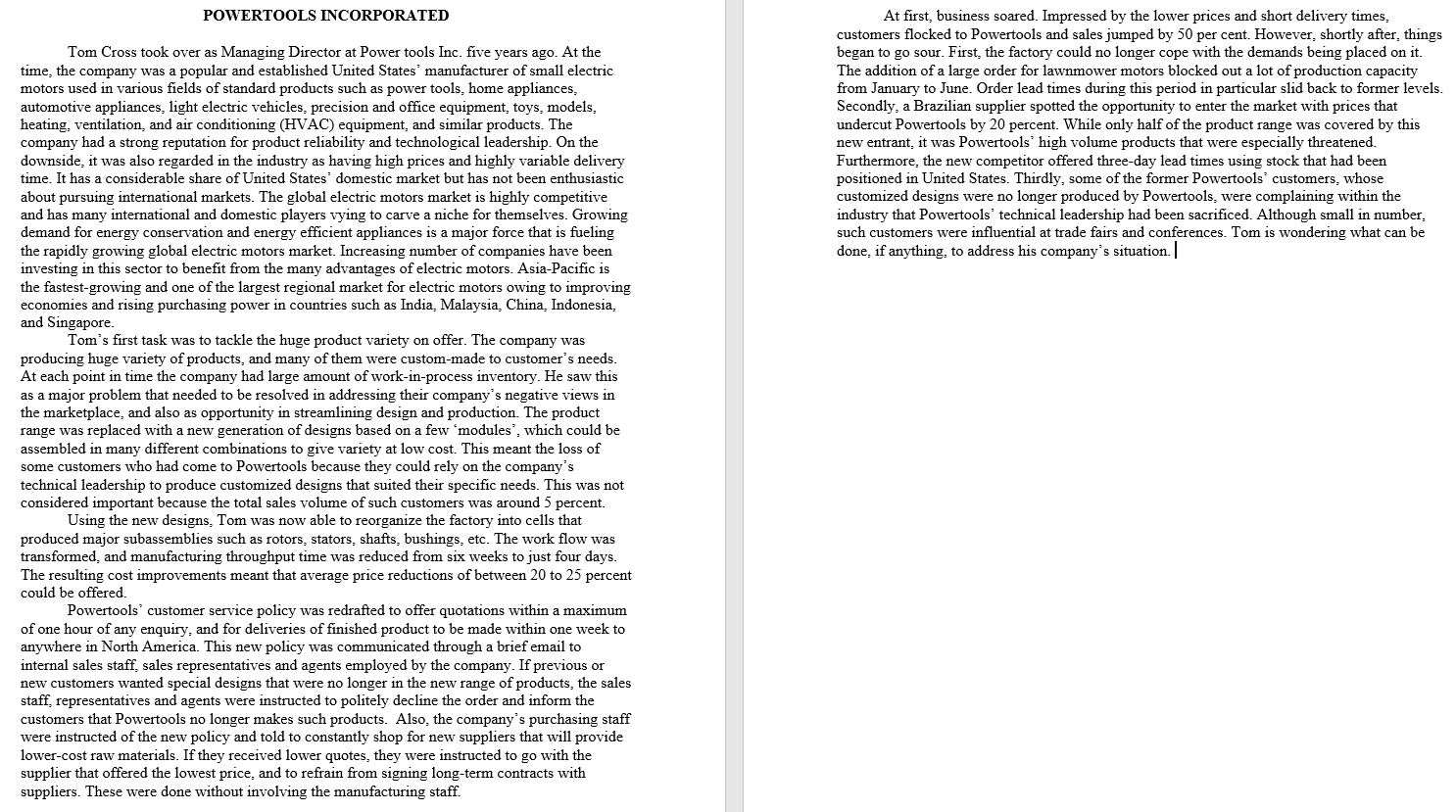
Question: Read The Case Study & Answer Follow the directions in the LAST Picture ! . . . . POWERTOOLS INCORPORATED At first, business soared. Impressed
Read The Case Study & Answer Follow the directions in the LAST Picture !
.
.
.
.
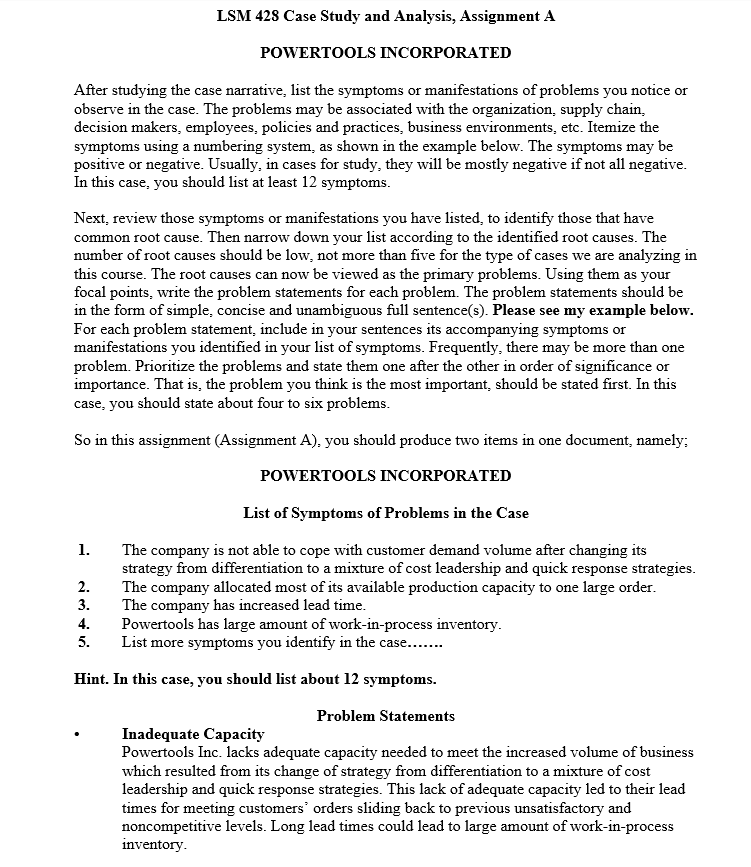
POWERTOOLS INCORPORATED At first, business soared. Impressed by the lower prices and short delivery times, customers flocked to Powertools and sales jumped by 50 per cent. However, shortly after, things began to go sour. First, the factory could no longer cope with the demands being placed on it. The addition of a large order for lawnmower motors blocked out a lot of production capacity from January to June. Order lead times during this period in particular slid back to former levels. Secondly, a Brazilian supplier spotted the opportunity to enter the market with prices that undercut Powertools by 20 percent. While only half of the product range was covered by this new entrant, it was Powertools high volume products that were especially threatened. Furthermore, the new competitor offered three-day lead times using stock that had been positioned in United States. Thirdly, some of the former Powertools' customers, whose customized designs were no longer produced by Powertools, were complaining within the industry that Powertools technical leadership had been sacrificed. Although small in number, such customers were influential at trade fairs and conferences. Tom is wondering what can be done, if anything, to address his company's situation. Tom Cross took over as Managing Director at Power tools Inc. five years ago. At the time, the company was a popular and established United States' manufacturer of small electric motors used in various fields of standard products such as power tools, home appliances, automotive appliances, light electric vehicles, precision and office equipment, toys, models, heating, ventilation, and air conditioning (HVAC) equipment, and similar products. The company had a strong reputation for product reliability and technological leadership. On the downside, it was also regarded in the industry as having high prices and highly variable delivery time. It has a considerable share of United States' domestic market but has not been enthusiastic about pursuing international markets. The global electric motors market is highly competitive and has many international and domestic players vying to carve a niche for themselves. Growing demand for energy conservation and energy efficient appliances is a major force that is fueling the rapidly growing global electric motors market. Increasing number of companies have been investing in this sector to benefit from the many advantages of electric motors. Asia-Pacific is the fastest-growing and one of the largest regional market for electric motors owing to improving economies and rising purchasing power in countries such as India, Malaysia, China, Indonesia, and Singapore. Tom's first task was to tackle the huge product variety on offer. The company was producing huge variety of products, and many of them were custom-made to customer's needs. At each point in time the company had large amount of work-in-process inventory. He saw this as a major problem that needed to be resolved in addressing their company's negative views in the marketplace, and also as opportunity in streamlining design and production. The product range was replaced with a new generation of designs based on a few modules", which could be assembled in many different combinations to give variety at low cost. This meant the loss of some customers who had come to Powertools because they could rely on the company's technical leadership to produce customized designs that suited their specific needs. This was not considered important because the total sales volume of such customers was around 5 percent. Using the new designs, Tom was now able to reorganize the factory into cells that produced major subassemblies such as rotors, stators, shafts, bushings, etc. The work flow was transformed, and manufacturing throughput time was reduced from six weeks to just four days. The resulting cost improvements meant that average price reductions of between 20 to 25 percent could be offered Powertools' customer service policy was redrafted to offer quotations within a maximum of one hour of any enquiry, and for deliveries of finished product to be made within one week to anywhere in North America. This new policy was communicated through a brief email to internal sales staff, sales representatives and agents employed by the company. If previous or new customers wanted special designs that were no longer in the new range of products, the sales staff, representatives and agents were instructed to politely decline the order and inform the customers that Powertools no longer makes such products. Also, the company's purchasing staff were instructed of the new policy and told to constantly shop for new suppliers that will provide lower-cost raw materials. If they received lower quotes, they were instructed to go with the supplier that offered the lowest price, and to refrain from signing long-term contracts with suppliers. These were done without involving the manufacturing staff. LSM 428 Case Study and Analysis, Assignment A POWERTOOLS INCORPORATED After studying the case narrative, list the symptoms or manifestations of problems you notice or observe in the case. The problems may be associated with the organization, supply chain, decision makers, employees, policies and practices, business environments, etc. Itemize the symptoms using a numbering system, as shown in the example below. The symptoms may be positive or negative. Usually, in cases for study, they will be mostly negative if not all negative. In this case, you should list at least 12 symptoms. Next, review those symptoms or manifestations you have listed, to identify those that have common root cause. Then narrow down your list according to the identified root causes. The number of root causes should be low, not more than five for the type of cases we are analyzing in this course. The root causes can now be viewed as the primary problems. Using them as your focal points, write the problem statements for each problem. The problem statements should be in the form of simple, concise and unambiguous full sentence(s). Please see my example below. For each problem statement include in your sentences its accompanying symptoms or manifestations you identified in your list of symptoms. Frequently, there may be more than one problem. Prioritize the problems and state them one after the other in order of significance or importance. That is, the problem you think is the most important, should be stated first. In this case, you should state about four to six problems. So in this assignment (Assignment A), you should produce two items in one document, namely: POWERTOOLS INCORPORATED List of Symptoms of Problems in the Case im The company is not able to cope with customer demand volume after changing its strategy from differentiation to a mixture of cost leadership and quick response strategies. The company allocated most of its available production capacity to one large order. The company has increased lead time. Powertools has large amount of work-in-process inventory. List more symptoms you identify in the case....... 5. Hint. In this case, you should list about 12 symptoms. Problem Statements Inadequate Capacity Powertools Inc. lacks adequate capacity needed to meet the increased volume of business which resulted from its change of strategy from differentiation to a mixture of cost leadership and quick response strategies. This lack of adequate capacity led to their lead times for meeting customers' orders sliding back to previous unsatisfactory and noncompetitive levels. Long lead times could lead to large amount of work-in-process inventory









 Study Help